
Key takeaways
What's inside
Best exercise bike for elderly riders is a question about getting on, staying steady and getting off again, not about resistance ceilings. This buying guide compares five machines on step-through access, pedal security, frame stability, console clarity and user capacity in lb and kg, with each drawback stated plainly.
As an Amazon Associate we earn from qualifying purchases at no extra cost to you. Product prices and availability are accurate as of the date shown and are subject to change.

#1 Pick

#2 Pick

#3 Pick

#4 Pick

#5 Pick

#6 Pick

#7 Pick

As an Amazon Associate we earn from qualifying purchases at no extra cost to you. Product prices and availability are accurate as of the date shown and are subject to change.
By Chris Parker
🛒 Best Price Today on Amazon
Prime members get fast, free shipping on everything above, plus member-only deals. New members get a 30-day free trial — cancel anytime.
How to Choose the Best Exercise Bike for Elderly Riders
The features that decide daily use are unglamorous: how low you have to step, whether the frame moves as you sit down, whether your feet stay put, and whether the display is readable without leaning forward. On any best exercise bike for elderly use, everything else on the specification sheet comes after those four.
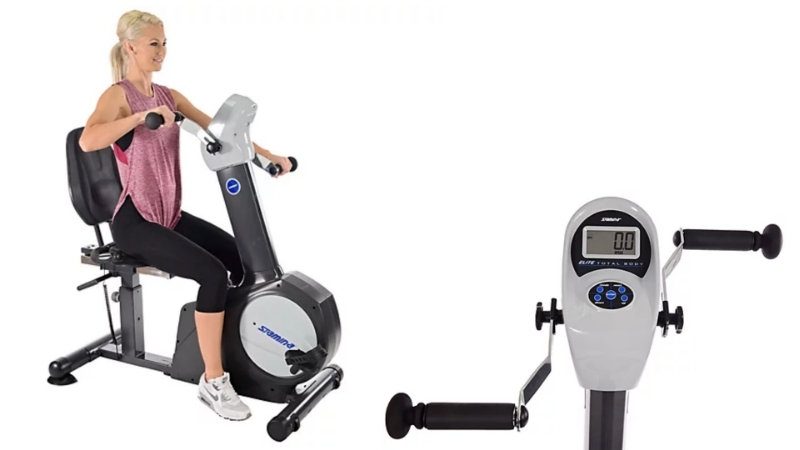
Step-Through Access and Getting Seated Safely
A recumbent with a low step-over height and an unobstructed path between the seat and the pedals is comfortably the easiest format to get into. Uprights ask you to swing a leg over the frame, and pedal exercisers remove the problem entirely by working from a chair you already own and trust.
Side handles beside the seat matter more than most listings suggest, because they give something solid to push against when standing up. This guide covers equipment only, so anyone with a balance, joint or mobility concern should get advice from a doctor or a certified physical therapist before choosing.
Pedal Security and Foot Placement
Wide pedals with a textured surface hold an ordinary shoe securely without any cycling-specific footwear, and adjustable straps keep the foot located without needing to be pulled tight. A strap that has to be cinched hard before every session quietly becomes a reason to skip the session altogether.
Crank position matters as well. On a recumbent the pedals sit ahead of the body, which keeps the knee travelling in a straight line and removes any need to reach downward. Setting the seat so that the knee stays slightly bent at full extension is the single most useful adjustment to get right.
Frame Stability and Low Starting Resistance
Stability comes from assembled weight, base width and levelling feet under the frame. A bike that shifts slightly while you settle onto the seat feels unsafe even when it is structurally fine, and that impression alone is enough to stop the best exercise bike for elderly use being used after a fortnight.
Starting resistance decides the first month. Machines with eight broad levels often begin firmer than machines with 20 to 25 finer steps, so a longer level count usually means a gentler bottom end as well as more precision later. Magnetic resistance is silent, non-contact and repeatable.
Console Clarity and Simple Controls
Large digits showing time, speed, distance and resistance level are far easier to use than a dense screen full of nested menus, and a backlit display helps considerably in a dim room. Physical buttons also stay reliable when hands are dry, which touch panels frequently do not.
Subscription screens are worth checking carefully, since much of their content stops working when payments stop. An offline console with built-in programmes does exactly the same job in year five as in week one, with no account to manage and nothing at all to renew.
Footprint, Capacity and Assembly Effort
Recumbent frames run 55 to 68 in long by 22 to 27 in wide (140 to 173 cm by 56 to 69 cm) and need roughly 12 in (30 cm) of clearance on the access side, or a good deal more if a walking frame or a helper is involved. Pedal exercisers need only the space in front of a chair.
User capacity spans 300 lb (136 kg) to 400 lb (181 kg) and should be treated as a hard engineering limit rather than a target. Full-size bikes take over an hour to assemble and involve lifting heavy sections, so paid assembly is often worth it. Measure the wall run and every doorway before ordering anything this long.
Top Picks: Best Exercise Bike for Elderly Use Compared
Five machines chosen for access, stability and simplicity, because the best exercise bike for elderly riders is the one used three times a week rather than the one with the longest feature list. Specifications are manufacturer figures, and cost is given as a tier rather than a number.
| Machine | Type | Resistance levels | User capacity |
|---|---|---|---|
| Exerpeutic 900XL | Recumbent | 8 | 400 lb (181 kg) |
| Schwinn 270 | Recumbent | 25 | 300 lb (136 kg) |
| Marcy ME-709 | Compact recumbent | 8 | 300 lb (136 kg) |
| Exerpeutic 400XL | Folding recumbent | 8 | 300 lb (136 kg) |
| DeskCycle 2 | Pedal exerciser | 8 | Used from a chair |
Exerpeutic 900XL: Best Access and Capacity
Eight magnetic tension levels on a reinforced frame rated to 400 lb (181 kg), with a wide seat and a large step-through opening. Everything about this frame is built around getting on and off easily and staying planted once seated, which is exactly the right priority here.
Eight broad levels make progression coarse, and the top setting will feel light to stronger riders within a few months. The console reports only basic figures with no connectivity, and the assembled weight means repositioning it later needs two people rather than one.
Schwinn 270: Best Comfort and Fine Control
25 magnetic resistance levels and a 300 lb (136 kg) capacity, with a ventilated seat back and a rail that slides without tools. Fine level spacing means setting one is genuinely light, and tool-free adjustment makes it practical when two people of different heights share the bike.
Assembly takes well over an hour and involves lifting heavy sections, so paid setup is worth considering. The console is dated beside touchscreen machines, and the media shelf covers part of the display whenever a tablet is resting on it during a ride.
Marcy ME-709: Best Compact Frame
Eight magnetic resistance levels, a step-through design and a 300 lb (136 kg) capacity in one of the shorter recumbent frames on sale, which suits a spare room where a full-size bike would otherwise dominate everything. The display sticks to time, speed, distance and estimated calories in large clear digits.
Seat padding is thinner than mid-range models and becomes noticeable past thirty minutes, so a seat pad may be needed for longer rides. The lighter frame also moves slightly more than heavier bikes when you are settling into position.
Exerpeutic 400XL: Best Folding Option
A folding recumbent with eight magnetic tension levels and a 300 lb (136 kg) user capacity, which stores away in roughly half the floor area that a fixed frame occupies. In a living room shared with the rest of the household, being able to fold it away is what keeps it in regular use.
Folding frames flex more than fixed ones under harder pedalling, and the seat-to-pedal geometry is more compromised. Folding and unfolding also has to be manageable for whoever uses it, so check the mechanism carefully rather than assuming it will be effortless.
DeskCycle 2: Best When Mounting a Bike Is the Problem
A compact pedal exerciser with eight calibrated resistance settings, used from an armchair or dining chair rather than mounted at all. For anyone who finds climbing onto a frame difficult or unsafe, this removes that barrier completely and stores under a sofa between sessions.
It trains the legs only, offers no back support of its own, and the height of your chair decides the pedalling position, which is far less adjustable than a proper seat rail. Resistance is also limited compared with a full bike, so it caps how demanding sessions can eventually become.
Frequently Asked Questions
These four questions settle most decisions here, and the answers usually choose which format the best exercise bike for elderly riders should take well before any particular model gets compared on price.
Recumbent, upright or pedal exerciser?
A recumbent suits most people, with its low step-through access and a supportive seat back. An upright asks considerably more of balance and hip mobility when mounting. A pedal exerciser suits anyone who finds getting onto a frame difficult, since it works from a chair that is already in the house.
How light should the easiest setting be?
Light enough that ten minutes feels comfortable on the first day. Bikes with 20 to 25 levels usually start gentler than those with eight broad steps, so check the level count rather than the maximum resistance figure when comparing two machines side by side.
How long should each session be?
The World Health Organization’s 2020 guidance suggests 150 to 300 minutes of moderate activity weekly, which works out at roughly 22 to 43 minutes a day across five days, and shorter sessions still count toward that total. Speak to a doctor before beginning any new programme.
Is assembly manageable at home?
Full-size recumbents take over an hour and involve heavy sections, so paid assembly is frequently the sensible choice. Compact frames are simpler, and pedal exercisers arrive essentially ready to use, which is worth weighing alongside the specification when comparing formats.
See More:
- Hot yoga mat best
- Best dumbbells exercises
- Best workout dumbbells
- Best back exercises using dumbbells
- Best exercise upright bike
- Best exercise stationary bike
Final Thoughts
The best exercise bike for elderly riders is the one that is easy to step into, steady while settling in, gentle at level one and readable at a glance. Prioritise access and stability over specification, arrange assembly help for full-size frames, measure the doorway, and speak to a doctor before starting.


Write Your Review
No reviews yet. Be the first to share your experience!