
Comparing a jump rope with counter vs alternatives requires understanding what the counter measures and how rope construction affects skipping. Standard, smart, cordless, weighted, and speed ropes serve different purposes. This guide explains tracking accuracy, movement mechanics, durability, and cost to help you select equipment that supports your workouts.
Quick Verdict: Do You Really Need a Counting Jump Rope?
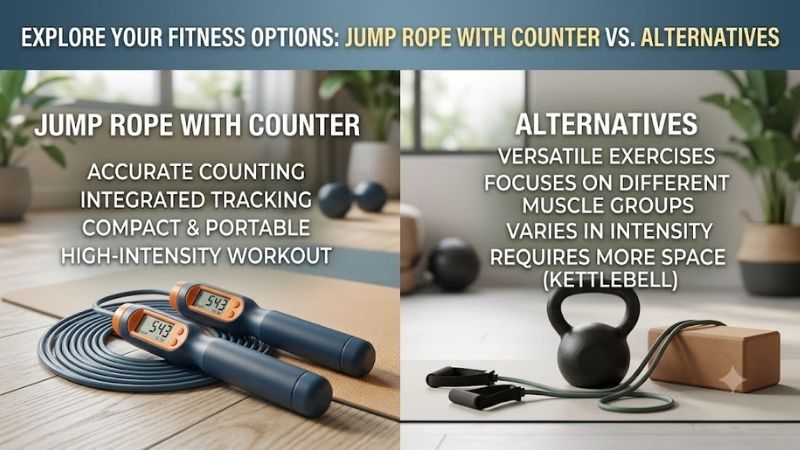
A jump rope with a counter combines conventional or cordless skipping equipment with a mechanism that records movement. Depending on the product, that mechanism may count rope rotations, handle movements, or estimated jumps.
The central advantage is convenience. The user can monitor repetitions without counting mentally or relying entirely on an external device.
However, a counter does not automatically improve the quality of the rope.
A well-designed conventional rope can rotate smoothly, fit comfortably, and provide a predictable skipping experience without electronics. A counting rope with poor cable sizing, uncomfortable handles, or unreliable connections may be less practical despite its display.
The accuracy of the counter also deserves attention. Some systems register a rope rotation even when the user fails to clear the cable. Cordless designs may record handle movement without establishing whether the user actually jumps.
Smart ropes add connectivity, session records, and other features, but those functions create additional considerations involving software compatibility, charging, and possible subscriptions.
Choose a basic counting rope when convenient repetition tracking is useful.
Choose a regular rope when simplicity and traditional skipping mechanics matter most.
Choose a smart rope when connected training records genuinely support your routine.
Choose a cordless rope when limited clearance makes a conventional cable impractical.
Choose a weighted rope when additional rotating mass is part of your preferred exercise.
Choose a speed rope when rapid rotation and technical skipping are priorities.
The most important buying principle is to choose the rope mechanics first and the tracking features second.
Jump Rope With Counter vs. Alternatives: Comparison Table
| Rope type | Primary feature | Main advantage | Main limitation |
|---|---|---|---|
| Basic digital counting rope | Electronic movement count | Convenient repetition tracking | May count missed jumps |
| Regular jump rope | Simple cable and handles | Straightforward operation | No integrated tracking |
| Mechanical counting rope | Physical rotation counter | May operate without batteries | Limited functions and mechanical wear |
| Smart jump rope | Digital counting and connectivity | Workout history and connected features | App and battery dependence |
| Cordless counting rope | Short attachments instead of full cable | Less clearance needed | Different timing and jump verification |
| Weighted jump rope | Additional cable or handle mass | Different rotational loading | Greater control demands |
| Speed rope | Fast cable rotation | Technical skipping | Different feedback and cable durability |
How Jump Rope Counters Actually Work
Rope-Rotation Counting
Some counting ropes record movement through a sensor connected to the rotating cable or handle mechanism.
This can provide a consistent record of attempted rope rotations.
However, one rotation is not always one successful jump. The rope may catch the user’s feet, strike the body, or complete an incomplete skipping attempt while the counter still increases.
That distinction does not necessarily mean the device is malfunctioning. It may be measuring precisely the physical event it was designed to detect.
For buyers, the important question is what the recorded figure represents.
A rotation count may be sufficient when the goal is tracking practice volume. Someone who wants an exact count of successful jumps should look for a device specifically validated for that task.
Motion-Sensor Counting
Other counting ropes use accelerometers or related motion sensors.
These detect changes in handle movement. Software interprets those signals and identifies patterns associated with repetitions.
The advantage is flexibility. The counter may work without a direct mechanical link to the cable.
The limitation is that the classification depends on the device’s algorithm and normal movement assumptions.
Slow rotations, irregular wrist motion, pauses, or unusual techniques may influence the result.
A motion-sensor device should not automatically be described as more accurate than a rotation-based counter. Their performance must be evaluated for the intended exercise.
Mechanical Counting Mechanisms
A mechanical counting rope may use gears or another physical arrangement that advances a numerical display when the mechanism rotates.
Such devices may require no batteries.
This simplifies ownership, but mechanical contact can create wear.
Some systems may also miss or miscount incomplete movements.
A mechanical counter can be a sensible purchase when the buyer wants a simple activity record and does not need timers, applications, or connected workout data.
However, it should still be evaluated for handle comfort and rope quality.
Cordless Counting and False Assumptions
Cordless ropes do not pass a full-length cable beneath the feet.
They typically use short rotating attachments or weighted elements connected to the handles.
This can make them useful in restricted spaces, but it changes the relationship between arm movement and jumping.
A user can rotate the handles while standing still.
If the counter primarily detects that handle movement, the displayed total may increase even though no actual jumps occur.
Therefore, buyers should not assume cordless repetition counts are directly equivalent to completed traditional rope skips.
Counting Rope vs. Regular Jump Rope
Does the Counter Change the Exercise?
If two ropes have similar cable materials, dimensions, and handle arrangements, adding a counter does not fundamentally change the movement required for skipping.
The user still has to coordinate rotation and jumping.
The counter provides information rather than mechanical resistance.
That information can be useful for goals based on repetitions. However, it may contribute relatively little to workouts organized around time or perceived effort.
For someone who completes fixed-duration intervals, a simple regular rope and a separate timer may provide everything needed.
For someone who tracks increasing repetition totals, an integrated counter can reduce the inconvenience of manual counting.
Simplicity and Reliability
A conventional rope has fewer electronic components to maintain.
It does not need charging, pairing, or software updates.
However, that does not make it indestructible. Cables can wear, handles can crack, and rotating components can fail.
A counting rope introduces additional possible points of failure, including a display, sensor, battery, and buttons.
The added complexity may be worthwhile if the tracking feature is used regularly.
If the counter is rarely checked, a simple rope may be better value.
Handle Weight and Balance
Integrating electronics into a handle can change its dimensions and mass.
Depending on the design, one handle may contain a battery, display, and controls.
This does not automatically make the rope uncomfortable, but it can affect how the equipment feels compared with a very light speed rope.
For a casual exerciser, the difference may be unimportant.
For someone focused on fast technical skipping, handle geometry and rotational feel can matter greatly.
Buyers should therefore evaluate the rope as exercise equipment, not merely as an electronic counter.
Long-Term Cost
A conventional rope may require replacement cables or handles.
A counting rope may also need batteries or a charging arrangement.
A damaged counter could eliminate its main advantage, even if the rope remains mechanically usable.
Check whether the cable is replaceable and whether the sensor is protected from normal sweat exposure.
Buying verdict: Choose a counting rope if repetition records help your routine. Choose a conventional rope when mechanical simplicity and low maintenance are more important.
Counting Rope vs. Smart Jump Rope
Basic Tracking vs. Connected Data
A basic counting rope may display repetitions, exercise time, and estimated calories.
A smart rope may transfer session information to a phone or compatible fitness application.
This can help users review previous workouts or follow connected programs.
However, storing more information does not make the underlying count more accurate.
If the sensor misclassifies rotations, transferring those readings to an application does not correct them automatically.
The best connected device is one that provides meaningful data and remains reliable during the exercise.
Bluetooth and App Compatibility
Many smart ropes use Bluetooth connectivity.
However, Bluetooth alone does not establish compatibility with every phone, tablet, or exercise application.
The manufacturer may require a particular application or supported operating-system version.
A buyer who wants to use an existing fitness platform should verify that the rope can provide the required data.
Some applications may offer workout storage without exporting detailed information to other services.
That limitation can matter to users who maintain training records across multiple devices.
Subscriptions and Ownership Cost
Connected training platforms may offer premium content or features through subscriptions.
The physical rope may remain usable without a membership, but some digital functions can depend on continued software access.
Before purchasing, determine which features work without recurring payments.
A buyer should also consider whether the manufacturer supports replacement batteries, cables, and handles.
An expensive smart rope may be good value for someone who regularly uses its connected functions. It may be unnecessary for someone who simply wants a visible repetition count.
Smart Features vs. Rope Quality
Smart handles and premium applications should not distract from cable length, connection security, and rotation quality.
A rope that is difficult to swing will not become mechanically better because it offers advanced workout graphs.
For technical skipping, the appropriate cable and handle arrangement remains essential.
Buying verdict: Choose a smart rope when connected records and programs are central to your workouts. Choose a basic counter when simple numerical feedback is enough.
Counting Rope vs. Cordless Jump Rope
Traditional Skipping Mechanics
A conventional rope moves over the head and beneath the feet.
Successful skipping requires the user to coordinate the jump with cable rotation.
This timing requirement is part of the exercise.
A corded counting rope preserves it.
The counter records activity while the user performs conventional skipping.
Cordless Movement
Cordless ropes replace the long cable with shorter attachments.
The user may jump or step rhythmically while moving the handles.
However, no full-length cable must pass beneath the feet.
This makes the activity mechanically different.
It can still be a useful movement option, but the buyer should not assume it provides identical coordination training.
Space Requirements
A full-length rope requires clearance around and above the user’s body.
Nearby furniture, ceiling fans, lighting fixtures, and other obstacles can make conventional skipping unsafe.
A cordless rope reduces the full cable-swing area.
However, short attachments still rotate, and the user needs room for body movement.
The device does not eliminate the need for a clear exercise area.
Floor Impact
A cordless rope avoids repeated contact between a full cable and the floor.
However, jumping still generates landing forces.
In apartments, those impacts may transmit noise through the floor.
A suitable exercise mat may protect surfaces and reduce some vibration, but it cannot guarantee silence.
Counting Accuracy
A cordless device may count handle rotations rather than successful jumps.
This limitation matters if the buyer intends to compare counts directly with conventional skipping.
For general rhythmic exercise, the count may still be useful as a consistent activity measure.
Buying verdict: Choose corded counting equipment for traditional skipping technique. Choose cordless when available space is the main limitation and the different movement is acceptable.
Counting Rope vs. Weighted Jump Rope
Rotating Cable Mass
Weighted ropes incorporate additional mass into the cable, handles, or both.
When the additional mass is distributed along the rotating cable, it changes rotational inertia and the force required to accelerate the rope.
This is different from adding a counter.
A rope can be both weighted and equipped with a counter, but those are independent features.
Handle Weight vs. Cable Weight
A heavy cable and weighted handles do not produce identical mechanical loading.
Mass near the hands behaves differently from mass rotating around the body.
Therefore, buyers should check whether a product’s advertised weight refers to the cable, handles, or complete assembly.
An impressive total weight may provide little information about actual skipping feel.
Technique and Control
A heavier rope may require more deliberate movement.
However, more weight is not automatically better.
If the user cannot maintain controlled rotation, the chosen configuration may be too demanding.
A lighter counting rope may be more suitable for someone focused on quick repetitions.
A weighted rope may appeal to someone who specifically wants additional rotational load.
Can You Get Both Weight and Counting?
Some product systems combine weighted cables with smart handles.
Crossrope, for example, offers interchangeable weighted rope configurations and connected handle options.
However, the exact included components and supported functions vary.
The buyer should compare the whole system rather than assuming that every weighted set includes counting.
Buying verdict: Choose weighted equipment for its distinct rotational loading. Choose a counting rope for repetition feedback. Combine them only when both features serve a clear purpose.
Counting Rope vs. Speed Rope
Speed-Oriented Cable Design
Speed ropes commonly use relatively thin cables and efficient rotating handle mechanisms.
Their purpose is to support rapid, controlled cable movement.
A general-purpose counting rope may use thicker PVC cables or different handle constructions.
These differences can affect timing and feel.
Someone who focuses on double unders or rapid rotation should evaluate speed-rope mechanics before considering a counter.
Double-Under Performance
Double unders require the rope to pass beneath the feet twice during one jump.
This demands precise timing.
A thick or relatively heavy counting rope may not provide the desired rotation characteristics.
However, a basic counter does not necessarily prevent fast skipping if the underlying rope is suitable.
The important issue is whether the complete cable-and-handle system supports the intended technique.
Counter Accuracy at High Cadence
A counter may track ordinary rotations reliably but behave differently during rapid movement.
Without credible testing, an advertised high counting range should not be treated as proof of accuracy at advanced skipping speeds.
For a buyer whose main goal is double-under training, a reliable speed rope may be more important than integrated counting.
Surface Durability
Thin coated cables can wear on abrasive flooring.
Cable replacement options can therefore influence ownership value.
A speed rope should be selected for its intended surface and movement style.
Buying verdict: Choose a speed rope when fast technical rotation is the priority. Choose a basic counting rope for convenient general-purpose repetition tracking.
Real Product Configurations Worth Understanding
Crossrope Weighted and Connected Systems
Crossrope’s Get Lean system includes lighter weighted ropes, commonly using 1/4-pound and 1/2-pound cable configurations.
Its Get Strong system includes heavier 1-pound and 2-pound ropes.
The company also offers smart-handle options.
These product configurations illustrate the difference between cable weight and electronic tracking.
A buyer should not assume all sets include the same accessories or software capabilities.
The exact package matters.
Why Brand Features Do Not Prove Measurement Accuracy
A reputable manufacturer may publish detailed product specifications, but those specifications do not necessarily establish counting accuracy against an independent reference.
A rope can have well-designed handles, secure connections, and connected features without proving that every displayed repetition is a successful jump.
If precise counting is central to the purchase, measurement evidence matters.
For casual activity tracking, consistency may be sufficient even when the result is an estimate.
Rope Length, Fit, and Rotation Quality
Correct Cable Length
A rope that is too long can strike the floor excessively and require wider arm movement.
A rope that is too short can catch the feet or force uncomfortable hand positioning.
The correct size depends on height, technique, and manufacturer guidance.
A digital counter cannot compensate for poor rope fit.
Adjustable Cable Systems
Some ropes use clamps, screws, or interchangeable lengths.
The connection must remain secure.
Do not leave exposed sharp cable ends or use unapproved modifications.
For shared household use, convenient adjustment can be valuable.
Handle Diameter and Comfort
Handle size influences grip.
A thick electronic handle may feel comfortable to some users but awkward to others.
Grip texture, shape, and mass distribution should be considered.
Bearings and Swivels
Bearings or swivel joints can support cable rotation.
However, bearing count alone does not establish smoothness.
Secure attachment and consistent movement are more important than marketing labels.
Electronics, Batteries, and Data Interpretation
Replaceable vs. Rechargeable Batteries
Digital ropes may use replaceable batteries or rechargeable cells.
Each arrangement has trade-offs.
Replaceable batteries require occasional purchases. Rechargeable models require charging access and may have limited battery serviceability.
Calorie Estimates
Some ropes display estimated calories.
These values often rely on simplified calculations using repetitions, duration, or entered body information.
They should not be treated as precise energy-expenditure measurements.
Session Memory
Stored workout history may help users compare activity over time.
However, check whether data survives battery changes or requires an application.
Data Export
If you want to use workout records in another service, verify export compatibility.
Connected devices do not always support open data transfer.
Price, Durability, and Long-Term Ownership
A basic regular rope often has the lowest technological complexity.
A counting rope adds sensors and power requirements.
A smart rope adds software and connectivity.
A weighted interchangeable system may require additional cables.
The best value depends on which features the buyer actually uses.
Replacement cables, secure connectors, moisture protection, and manufacturer support can matter more than a large display.
A premium rope is poor value when its expensive features remain unused.
Which Rope Should You Buy?
Beginner Learning Traditional Skipping
A comfortable regular rope or basic counting rope may be appropriate.
Prioritize sizing and timing.
User Tracking Repetition Goals
A simple digital counter can provide useful feedback.
Check what the device counts.
Advanced Double-Under Athlete
A suitable speed rope is likely more relevant.
Counter accuracy should be evaluated separately.
Small-Apartment Exerciser
A cordless rope may reduce clearance demands.
Floor impact remains important.
User Seeking Additional Rotational Load
A weighted cable may be preferable.
Choose manageable weight rather than the heaviest option.
Data-Focused Buyer
A smart rope may be useful when connected records and app features are important.
Common Buying Mistakes
Confusing Rotations With Successful Jumps
The counter’s measurement definition matters.
Paying for Connectivity Without Checking Software
A smart feature is useful only when compatible with your devices.
Ignoring Rope Fit
Incorrect length can make skipping difficult.
Choosing Weight Over Control
A heavy cable is not inherently better.
Overlooking Floor Clearance
A full-length rope needs room to rotate safely.
Ignoring Replacement Components
Cables and connections can wear.
Frequently Asked Questions
Is a Counting Jump Rope Better Than a Regular Rope?
It is more convenient when repetition tracking matters. Otherwise, a regular rope can offer the same basic skipping movement with fewer electronic components.
Are Smart Jump Ropes More Accurate?
Not necessarily. Connectivity does not guarantee better sensing.
Can Cordless Ropes Count Actual Jumps?
Some systems estimate activity from motion, but they may count handle rotations without confirming that a jump occurred.
Can a Counting Rope Be Used for Double Unders?
Some can, depending on cable and handle design. A speed rope may be more suitable for specialized technical skipping.
Are Weighted Ropes Better for Tracking?
Weight and tracking are separate characteristics. A weighted rope does not automatically provide better measurement.
What Matters Most When Buying a Counting Rope?
Correct length, comfortable handles, reliable rotation, counter measurement method, and durability.
Conclusion
The right jump rope with counter vs alternatives decision depends on whether you value tracking, simple skipping, fast rotation, weighted resistance, or limited-space convenience. Counting ropes provide repetition feedback, smart ropes offer connected records, cordless designs reduce cable clearance, and weighted or speed ropes change the movement. Choose the rope mechanics first and pay for tracking features that support your routine.









Write Your Review
No reviews yet. Be the first to share your experience!