
Key takeaways
-
Choose an under-desk elliptical when seated leg movement and a compact equipment footprint are priorities.
-
Choose a mini pedal exerciser when circular cycling motion is preferred.
-
Choose a compact recumbent bike when integrated back support and a dedicated cycling position matter.
-
Choose a mini stair stepper when you want standing stepping exercise and can maintain the required balance.
-
Choose a walking pad when walking is your preferred activity and you have sufficient floor length.
-
Choose a full-size elliptical when a larger standing elliptical movement is important and adequate space is available.
Comparing an under desk elliptical vs alternatives requires understanding the differences between seated pedaling, cycling, standing exercise, and walking. Desk clearance, chair stability, resistance, noise, and movement patterns all affect the decision. This guide explains those trade-offs and helps you choose equipment that fits your workspace and exercise preferences.
Quick Verdict: When Is an Under-Desk Elliptical the Better Choice?
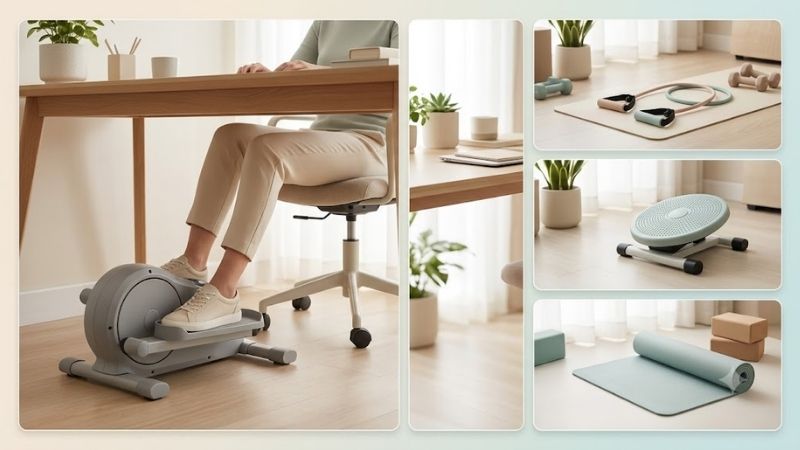
An under-desk elliptical is a compact exercise device that allows the user to move the feet through an elliptical path while seated.
It can be convenient for home offices, apartments, and workspaces where a full-sized cardio machine would occupy too much room.
However, the term under-desk does not guarantee compatibility with every desk.
Knee clearance, chair position, pedal travel, and floor stability determine whether the machine can be used comfortably.
Alternative equipment serves different purposes.
A mini pedal exerciser provides circular cycling movement. A compact recumbent bike includes its own supported seat. A mini stair stepper normally requires standing, while a walking pad allows walking on a moving belt.
The most useful starting recommendations are:
-
Choose an under-desk elliptical when seated leg movement and a compact equipment footprint are priorities.
-
Choose a mini pedal exerciser when circular cycling motion is preferred.
-
Choose a compact recumbent bike when integrated back support and a dedicated cycling position matter.
-
Choose a mini stair stepper when you want standing stepping exercise and can maintain the required balance.
-
Choose a walking pad when walking is your preferred activity and you have sufficient floor length.
-
Choose a full-size elliptical when a larger standing elliptical movement is important and adequate space is available.
For people who primarily want movement while remaining seated at a desk, the under-desk elliptical is often the most directly relevant category.
However, the actual workstation must be evaluated before purchase.
Quick Comparison Table
| Feature | Under-desk elliptical | Mini pedal exerciser | Recumbent bike | Mini stepper | Walking pad |
|---|---|---|---|---|---|
| Exercise position | Seated | Seated | Seated with back support | Standing | Standing/walking |
| Movement | Compact elliptical | Circular pedaling | Cycling | Alternating steps | Walking |
| Integrated seat | No | No | Yes | No | No |
| Typical footprint | Small | Very small | Larger | Very small | Long and narrow |
| Desk use | Designed for suitable desks | Possible | Usually impractical | Not conventional seated use | Requires appropriate walking workstation |
| Resistance | Magnetic, friction, or powered designs | Model-dependent | Often magnetic | Often hydraulic | Belt speed |
| Main advantage | Seated elliptical movement | Simple compact pedaling | Supported cycling | Compact standing exercise | Walking-specific movement |
| Main limitation | Desk and chair compatibility | Different knee movement | Larger footprint | Balance requirements | Motor and belt requirements |
Understanding the Movement Differences
The most important distinction among these devices is their movement mechanism.
Under-Desk Elliptical Motion
An under-desk elliptical guides the feet through an elongated movement path.
The exact shape depends on the pedal linkage.
Some models permit forward and reverse movement.
However, a seated elliptical’s stride is generally much shorter than the movement of a conventional standing elliptical trainer.
This makes the machine easier to place beneath furniture but changes the exercise experience.
Circular Pedaling Motion
A mini pedal exerciser uses a bicycle-style crank arrangement.
The feet move around a circular path.
The height of the knees during the pedal cycle depends on crank length, seat height, and the user’s body dimensions.
A pedal exerciser may be compact on the floor but still require significant knee clearance.
Therefore, the smallest machine height does not necessarily indicate the best desk compatibility.
Standing Stepping Motion
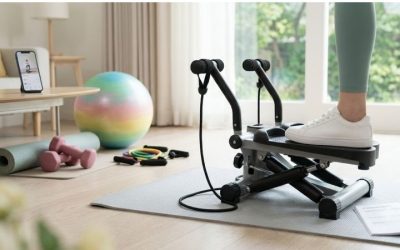
A mini stepper uses alternating downward foot pressure.
Many models have hydraulic resistance.
The movement requires a standing position and suitable balance.
It should not be confused with an under-desk elliptical simply because both devices have small footprints.
Walking Pad Movement
A walking pad provides a moving belt.
The user walks rather than pedals.
This can be suitable when walking is the desired activity.
However, the equipment requires greater floor length and appropriate standing clearance.
Under-Desk Elliptical vs. Mini Pedal Exerciser
These two categories are often directly compared because both can be used while seated.
Elliptical vs. Circular Pedal Path
The primary difference is the movement trajectory.
A mini pedal exerciser uses circular motion.
An under-desk elliptical uses an elongated path.
Neither is universally more comfortable.
The preference depends on joint positioning, body proportions, and the complete mechanism.
Knee Clearance
Circular pedals can raise the knees significantly, depending on crank size.
An elliptical may use lower vertical travel, but this is not guaranteed.
Some compact ellipticals still require considerable knee movement.
The correct choice depends on actual pedal geometry.
Resistance Control
Both types may offer adjustable resistance.
However, the mechanisms differ.
Some use magnetic systems, while others rely on friction or powered movement.
Resistance-level counts are not standardized.
Chair Stability
Both devices require a stable seated position.
Rolling office chairs can move when the user presses against the pedals.
Some manufacturers provide approved wheel stops or stabilization accessories.
Desk Compatibility
The equipment should allow natural leg movement without contacting the desk.
If the machine requires an uncomfortable chair height, it may not be suitable.
Which Should You Choose?
Choose an elliptical for its particular pedal movement.
Choose a mini pedal exerciser when circular cycling motion is preferred.
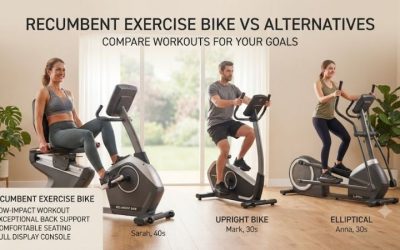
Under-Desk Elliptical vs. Recumbent Exercise Bike
A recumbent bike provides a complete seated exercise station.
Integrated Seat and Backrest
A recumbent bike includes its own seat.
An under-desk elliptical relies on a separate chair.
This changes the stability and support arrangement.
Pedal Geometry
A recumbent bike uses circular pedaling with the pedals positioned forward.
An under-desk elliptical uses a compact guided path.
Resistance Capability
Recumbent bikes may offer a broader range of electronically controlled workout features, depending on the model.
Under-desk ellipticals vary widely.
However, a larger machine is not automatically capable of greater meaningful workload.
Space Requirements
A recumbent bike usually occupies substantially more floor area.
The Schwinn 590R, for example, measures 66.4 inches long and 28 inches wide.
A compact seated elliptical may fit within a much smaller floor area.
Portability
Many under-desk machines are portable.
A full recumbent bike is usually heavier and less convenient to relocate.
Which Should You Choose?
Choose a recumbent bike when integrated seating and dedicated cycling are priorities.
Choose an under-desk elliptical when compactness and use with an existing chair matter more.
Under-Desk Elliptical vs. Mini Stair Stepper
These machines can appear similar in product photographs, but their normal usage differs.
Seated vs. Standing Operation
Most under-desk ellipticals are intended for seated use.
Mini steppers are normally designed for standing exercise.
Certain compact elliptical models support both seated and standing operation, but this must be confirmed.
Movement Pattern
Ellipticals use an elongated foot path.
Mini steppers use short stepping motion.
Resistance Design
Many mini steppers use hydraulic cylinders.
Under-desk ellipticals may use magnetic or other resistance systems.
Operating Limits
Some hydraulic steppers have continuous-use and cooling requirements.
These are model-specific and must be followed.
Stability
A mini stepper must support the standing user.
An under-desk elliptical depends on chair stability as well as its own floor grip.
Which Should You Choose?
Choose an under-desk elliptical for seated movement.
Choose a mini stepper for standing stepping when balance and floor conditions are suitable.
Under-Desk Elliptical vs. Walking Pad
Walking pads are sometimes marketed for use with standing desks, but they provide a different movement.
Seated vs. Walking Activity
An under-desk elliptical allows seated pedaling.
A walking pad requires standing and walking.
Workstation Compatibility
A walking pad is usually associated with an appropriately positioned standing desk.
An under-desk elliptical may work with a conventional seated workstation.
Space Requirements
Walking pads require substantial belt length.
Under-desk ellipticals typically occupy less floor area.
Noise
Walking pads create motor, belt, and foot-contact noise.
Ellipticals may produce mechanical pedaling sounds.
Neither should automatically be called silent.
Power Requirements
Walking pads usually require electricity.
Manual under-desk ellipticals may not need household power for resistance.
Which Should You Choose?
Choose a walking pad when walking is the intended activity.
Choose an under-desk elliptical when seated movement is the priority.
Under-Desk Elliptical vs. Full-Size Elliptical
Exercise Position
A full-size elliptical usually supports standing exercise.
An under-desk elliptical is primarily intended for seated operation.
Stride Length
Full-size ellipticals generally provide longer travel.
Compact seated ellipticals use shorter movements.
Frame Support
A full-size machine supports the user through its frame.
An under-desk elliptical relies partly on a separate chair.
Resistance and Workload
Both types may have adjustable resistance.
However, their exercise configurations differ, making direct workload comparisons difficult.
Storage
A portable under-desk device is generally easier to store.
A full-size elliptical may require permanent space.
Which Should You Choose?
Choose the full-size machine when a standing elliptical workout is important.
Choose the under-desk device when portability and seated convenience are essential.
Desk Clearance: The Most Important Space Measurement
The footprint of an under-desk elliptical does not describe its entire operating envelope.
Machine Height
A compact machine may have a low housing.
However, the pedal and user’s knee can rise above that housing.
Knee Movement
Knee clearance depends on the user’s leg dimensions, chair height, and pedal path.
Desk Construction
Drawers, cable trays, and support bars can reduce available space.
Chair Height
Adjusting the chair may help, but doing so should not create an uncomfortable workstation.
Desk Depth
The machine must sit at a suitable distance from the chair.
Insufficient desk depth can make positioning difficult.
Example of a Compact Device
The Stamina InMotion E1000 Compact Strider measures approximately 24.5 inches long, 17 inches wide, and 11.38 inches high.
That provides a useful reference for equipment footprint.
However, the machine height does not guarantee a particular amount of knee clearance for every user.
Resistance and Pedaling Feel
Manual Resistance
Some ellipticals allow resistance adjustment through a dial.
Magnetic Resistance
Magnetic systems may provide relatively smooth adjustment, depending on design.
Motorized Pedal Movement
Certain devices drive the pedals using a motor.
This should not be confused with actively overcoming resistance.
Reverse Pedaling
Some models support reverse movement.
Check manufacturer instructions.
Workload Expectations
Exercise effort depends on the user and resistance mechanism.
Do not assume a compact device produces the same workout as a large standing machine.
Chair Stability and Posture
Rolling Office Chairs
Wheels may allow the chair to move backward during pedaling.
Use suitable stabilization.
Seated Position
The user should remain comfortably supported.
Hip and Knee Alignment
Pedaling should not require excessive reaching or cramped positioning.
Foot Support
Pedals should accommodate the feet securely.
Chair Height
The appropriate setting must support both comfortable pedaling and reasonable workstation posture.
Backrest
The chair should provide suitable support for the user’s intended position.
Noise, Floors, and Storage
Drivetrain Noise
Bearings, pedals, and resistance assemblies can generate mechanical sound.
Floor Sliding
Some devices may move across smooth floors.
Use manufacturer-approved stabilization methods.
Floor Mats
A compatible mat may protect flooring and improve grip.
Portability
Consider equipment weight and carrying handles.
Storage Orientation
Do not assume vertical storage is permitted.
Daily Convenience
A machine that is easy to position and remove may be more practical than one with advanced electronics but awkward handling.
Tracking, Connectivity, and Maintenance
Workout Duration
A basic timer can help monitor exercise sessions.
Stride Count
Different machines may count pedal movements differently.
Distance Estimates
Displayed distance may be calculated rather than physically measured.
Calorie Estimates
Consumer calculations can be approximate.
Bluetooth
Check app compatibility before buying.
Maintenance
Inspect moving components and follow cleaning instructions.
Replacement Parts
Availability can affect long-term ownership.
Three Practical Buying Scenarios
Scenario 1: Seated Work at a Conventional Desk
An under-desk elliptical may be the most relevant option.
However, verify knee clearance and chair stability first.
A walking pad would require a different workstation arrangement.
Scenario 2: A Small Apartment Without Desk Use
If exercise will occur separately from desk work, a compact stepper or exercise bike may deserve consideration.
The desk-specific advantages of an under-desk elliptical may be less important.
Scenario 3: A User Who Prefers Walking
A walking pad may provide the desired movement more directly.
An under-desk elliptical is a different activity and should not be purchased merely because it is smaller.
Frequently Asked Questions
Is an Under-Desk Elliptical Better Than a Pedal Exerciser?
Neither is universally better. The main differences involve pedal geometry, knee clearance, and movement preference.
Can an Under-Desk Elliptical Replace a Full-Size Elliptical?
It provides a different exercise arrangement, usually seated with shorter pedal travel. It should not be assumed equivalent.
Is an Under-Desk Elliptical Better Than a Walking Pad?
It is more suitable for conventional seated work, while a walking pad is more relevant to walking-based exercise.
Can You Use an Under-Desk Elliptical While Working?
Yes, provided the equipment fits and does not interfere with posture, desk clearance, or the task being performed.
Are Under-Desk Ellipticals Suitable for Older Adults?
Some may be, depending on individual mobility, seating stability, and exercise needs. Medical concerns may require professional guidance.
Do Under-Desk Ellipticals Require Electricity?
Some manual models do not require wall power for resistance. Motorized or electronically controlled models may require electricity.
Conclusion
When comparing an under desk elliptical vs alternatives, the most important question is whether seated elliptical movement meets your needs. Pedal exercisers offer circular motion, recumbent bikes provide integrated seating, mini steppers emphasize standing movement, and walking pads support walking. Prioritize desk clearance, chair stability, resistance behavior, and practical storage rather than choosing solely by equipment size.

Write Your Review
No reviews yet. Be the first to share your experience!