
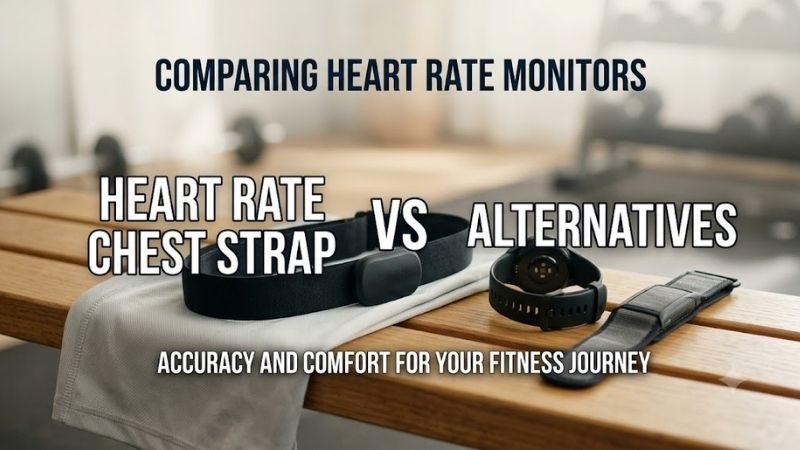
Comparing a heart rate chest strap vs alternatives requires understanding sensing technology, workout accuracy, comfort, and device compatibility. Smartwatches, optical armbands, smart rings, and fitness-machine sensors collect heart rate data differently. This guide examines their advantages and limitations to help you choose the right monitor for your exercise routine.
Quick Verdict: Should You Buy a Chest Strap Instead of a Smartwatch?
A heart rate chest strap is a wearable exercise sensor that detects electrical activity associated with heartbeats through electrodes placed against the skin.
Most modern consumer chest straps process those signals and transmit heart rate information to compatible watches, phones, exercise machines, or fitness applications.
A smartwatch or optical armband generally uses a different measurement method called photoplethysmography, commonly abbreviated PPG. These devices use light to detect changes associated with blood volume in tissue.
Both approaches can provide useful exercise data, but they have different strengths and limitations.
A chest strap can be particularly attractive for dedicated workouts, especially when the user values electrical sensing, live data transmission, and compatibility with established training equipment.
A smartwatch is often more convenient for everyday use because it can combine heart rate monitoring with timekeeping, notifications, activity tracking, and other features.
An optical armband can appeal to users who dislike wearing a tight band around the chest. A smart ring offers a discreet everyday wearable but may not provide the same live exercise-data capabilities.
Built-in exercise-machine sensors may be sufficient for basic monitoring, although they often require the user to hold designated grips.
Choose a chest strap when exercise-specific monitoring and device compatibility are the priorities.
Choose a smartwatch when everyday functionality and broad activity tracking matter more.
Choose an optical armband when you prefer arm-based monitoring and it meets your measurement needs.
Choose a smart ring when comfortable everyday wear is central to the purchase.
Choose integrated machine sensors when basic readings are enough and their hand-contact requirements are acceptable.
A chest strap is not automatically a medical diagnostic device, and no consumer wearable should be assumed perfectly accurate in every situation.
Heart Rate Chest Strap vs. Alternatives: Comparison Table
| Device | Measurement method | Main advantage | Main limitation |
|---|---|---|---|
| Electrical chest strap | Cardiac electrical signals | Dedicated exercise sensing | Requires chest contact |
| Optical smartwatch | PPG on wrist | Everyday convenience | Motion and placement can affect readings |
| Optical armband | PPG on arm | Alternative wearing position | Compatibility and optical limitations |
| Smart ring | Optical and other sensors | Compact daily wearable | Exercise features vary |
| Exercise-machine grips | Contact-based sensing | No separate wearable needed | Requires hand contact |
| Fitness band | Usually optical PPG | Simple continuous wear | Measurement and software limitations |
| Medical ECG device | Clinical electrical recording | Diagnostic capability when indicated | Different purpose and clinical context |
Understanding Electrical vs. Optical Heart Rate Measurement
How Electrical Chest Straps Detect Heartbeats
The heart generates electrical activity during each cardiac cycle.
A conventional chest strap uses electrodes positioned against the skin to detect electrical changes associated with heartbeats.
The sensor processes those signals to calculate heart rate.
This method differs from estimating heart-related information through optical blood-volume measurements.
However, a consumer chest strap is not automatically equivalent to a clinical electrocardiogram device.
Its intended use and measurement capabilities are different.
For buyers, the important benefit is obtaining exercise heart rate information through electrical sensing.
The limitations include the need for suitable electrode contact, appropriate positioning, and a compatible receiving device.
How Optical Sensors Work
Optical heart rate sensors use LEDs and light-sensitive components to detect changes in tissue associated with blood flow.
The device’s software interprets those signals to estimate heart rate.
This method is widely used in smartwatches, fitness bands, optical armbands, and smart rings.
However, optical performance can be influenced by sensor placement, contact pressure, movement, and individual conditions.
The exact effect depends on the device.
Optical sensing is not inherently unsuitable for workouts. Many products can provide useful readings in appropriate conditions.
The choice should be informed by the intended exercise and actual product performance rather than broad assumptions.
Why Sensor Placement Matters
A chest strap typically measures electrical signals from the torso.
An optical smartwatch measures signals from the wrist.
An armband measures signals at another location on the arm.
A smart ring measures signals from the finger.
These locations experience different movement and contact conditions.
For example, gripping exercise equipment may change wrist position and pressure around a watch.
A chest strap avoids direct wrist movement but can shift during certain torso movements.
An armband may remain comfortable during cycling yet feel different during lifting.
The most appropriate sensor depends partly on where it can maintain reliable contact throughout the intended activity.
Sensing Accuracy vs. Wireless Reliability
A device can detect heartbeats correctly but fail to transmit them reliably.
Conversely, a device may maintain a stable wireless connection while its sensing data becomes less reliable.
These are separate problems.
For example, a chest strap may show dropouts because the electrodes are dry. A watch may show unstable readings because the optical contact changes during movement.
A Bluetooth connection problem requires different troubleshooting from a sensor-contact problem.
Buyers should understand this distinction, especially when comparing devices for structured workouts.
Chest Strap vs. Smartwatch
Exercise-Specific Monitoring vs. Everyday Convenience
A chest strap is primarily an exercise accessory.
It usually has no full display and relies on another device for viewing or recording measurements.
A smartwatch combines heart rate monitoring with many everyday functions.
This makes the smartwatch convenient for someone who wants one wearable throughout the day.
However, its broad feature set does not automatically make its heart rate sensing superior during exercise.
A user who already owns a compatible smartwatch may choose to pair it with an electrical chest strap for selected workouts.
That combination can provide everyday convenience and a different sensing method during training.
Rapid Heart Rate Changes
Some exercisers care about how quickly a monitor reflects changes during intervals.
Electrical and optical devices use different sensing and processing methods.
However, response characteristics also depend on software smoothing, display updates, and wireless transmission.
It would be inaccurate to claim that every chest strap responds instantly or that every smartwatch lags behind.
Model-specific comparisons are needed.
For buyers interested in interval training, consistent readings during the intended exercise are more important than generalized accuracy claims.
Motion and Grip-Related Measurement Problems
Wrist movement can influence the contact and optical measurement conditions of a smartwatch.
Some exercises involve gripping handlebars, dumbbells, or rowing handles.
Those movements may affect how the watch sits against the skin.
A chest strap is positioned away from the wrist, which can be advantageous in certain activities.
However, chest sensors can still lose contact if the strap shifts.
The practical decision is which wearing arrangement remains comfortable and reliable during the user’s actual workouts.
Wearing Comfort
Smartwatches are convenient because many people already wear them.
However, wristbands can feel uncomfortable when tightened for exercise.
Chest straps need secure contact around the torso.
Some users find that comfortable, while others dislike the pressure or experience chafing.
A sensor that produces useful data but is uncomfortable enough to discourage use may not be the best purchase.
Battery Management
Many smartwatches require regular charging.
Some chest straps use replaceable coin-cell batteries and can operate for long periods under the manufacturer’s stated usage conditions.
Others are rechargeable.
Neither approach is universally superior.
Choose the arrangement that fits your routine and maintenance preferences.
Which Should You Buy?
Choose a smartwatch for everyday functionality and convenient general monitoring.
Choose a chest strap for dedicated electrical heart rate sensing and compatibility with workout equipment.
Chest Strap vs. Optical Armband
Electrical vs. Optical Measurement
An optical armband generally uses PPG sensing.
A conventional chest strap uses electrical sensing.
The different measurement principles can affect performance under certain conditions.
However, accuracy should not be ranked universally without testing specific devices.
An armband may work well for many users, while a chest strap may be preferred for certain exercise-monitoring needs.
The buyer should consider comfort, compatibility, and the type of data required.
Wearing Position and Comfort
An armband is usually worn on the upper arm or forearm.
It avoids compression around the chest.
This can appeal to people who dislike conventional chest straps.
However, an armband still needs secure contact.
If it is too loose, readings may become unstable. If too tight, it may be uncomfortable.
The sensor can also interfere with certain clothing or exercises.
The appropriate wearing position depends on the model and user.
Real Product Example: Polar Verity Sense
Polar Verity Sense is an optical sensor that supports compatible arm or temple placement.
The manufacturer lists Bluetooth and ANT+ connectivity, rechargeable operation, and onboard recording.
This makes it a useful example of an optical alternative to conventional chest sensors.
However, optical measurement is not electrically equivalent to the sensing used by Polar H9 or H10.
The buyer should determine whether the alternate wearing position and supported features justify selecting it instead of a chest strap.
Connectivity
Optical armbands may support Bluetooth, ANT+, or other methods.
However, not every armband supports every receiver.
Compatibility should be checked just as carefully as with a chest strap.
Which Should You Buy?
Choose an armband when chest comfort is a significant concern and optical sensing meets your needs.
Choose an electrical chest strap when its sensing method and supported exercise data are more important.
Chest Strap vs. Smart Ring
Everyday Tracking vs. Workout Monitoring
Smart rings are designed around compact everyday wear.
Some include optical heart rate sensing, temperature measurements, and other functions.
However, their exercise capabilities vary widely.
Certain models emphasize sleep and general wellness information rather than continuous transmission to training equipment.
A chest strap is more directly designed for live exercise heart rate data.
This distinction matters when the buyer wants to connect to an indoor cycling computer, rowing monitor, or another dedicated receiver.
Finger Placement During Exercise
A ring can be convenient during ordinary daily activities.
However, gripping weights, bars, or exercise-machine handles can create pressure around the finger.
Some exercises may make ring wear uncomfortable or inappropriate.
A chest strap avoids those finger-contact issues.
However, it introduces a different form of body contact.
The better option depends on the activity.
Wireless Data Compatibility
Not every smart ring transmits heart rate through a standard fitness-device protocol.
Some primarily synchronize information through the manufacturer’s app.
A chest strap supporting Bluetooth Heart Rate Service or ANT+ may connect more directly to compatible sports equipment.
However, protocol support must always be verified.
Accuracy and Interpretation
Smart rings may use different algorithms and sampling patterns for everyday and exercise measurements.
It would be misleading to assume that all displayed data are equivalent to continuous electrical heart rate monitoring.
Choose according to the information you need and the product’s documented capabilities.
Which Should You Buy?
Choose a smart ring for its supported everyday tracking and comfortable form factor.
Choose a chest strap when dedicated workout measurement and external-device compatibility are central.
Chest Strap vs. Exercise-Machine Grip Sensors
How Built-In Contact Sensors Work
Some treadmills, exercise bikes, and ellipticals have metal contact areas integrated into the handlebars.
The user places the hands on these sensors to obtain heart rate readings.
The system may estimate heart rate using contact-based measurement.
Its behavior depends on the equipment design.
The main advantage is convenience: no separate wearable is required.
However, the user may need to maintain steady contact with designated areas.
Hand Position and Exercise Technique
Holding specific grips can be inconvenient during workouts that involve changing hand positions.
For example, an indoor cyclist may prefer different handlebar positions.
A user on an elliptical may want to use moving handles rather than stationary pulse grips.
A compatible chest strap can provide heart rate data without requiring continuous hand contact.
However, the exercise machine must support its wireless protocol, or the strap must connect to a separate watch or phone.
Measurement Consistency
Built-in grip sensors may be sufficient for occasional readings.
However, measurement can be interrupted when the hands are removed.
A chest strap may provide more continuous data under appropriate conditions.
That practical difference can matter for users tracking entire workouts.
Which Should You Buy?
Use grip sensors when they provide adequate information and are convenient.
Choose a chest strap when continuous external monitoring and flexible hand positioning are important.
Bluetooth vs. ANT+: Understanding Compatibility
Bluetooth Low Energy
Bluetooth Low Energy is widely used by compatible phones, watches, fitness equipment, and applications.
However, the presence of Bluetooth does not guarantee that a device can receive heart rate data.
The receiver must support the correct service or approved connection method.
A buyer should verify the intended devices before purchasing.
ANT+ Broadcasting
ANT+ is supported by certain sports watches, cycling computers, and exercise consoles.
It can be useful when heart rate data needs to be received by compatible fitness equipment.
However, ANT+ is not available on every phone or machine.
A Bluetooth-only chest strap may be unsuitable for equipment that expects ANT+.
Dual-Protocol Sensors
Some chest straps support both Bluetooth and ANT+.
This can make them flexible across different workout setups.
However, dual-protocol support does not guarantee unlimited simultaneous connections.
The actual limits depend on the model.
Simultaneous Bluetooth Connections
Polar documents two simultaneous Bluetooth connections for the H10.
The H9 does not offer that same dual-Bluetooth capability.
The Verity Sense also supports two simultaneous Bluetooth connections.
These differences can matter when a user wants heart rate displayed on a watch and another compatible device at the same time.
The correct purchase should match the required connection arrangement.
Legacy Gym Equipment
Some older fitness machines use transmission technologies other than Bluetooth or ANT+.
Polar H10 and H9 support a 5 kHz GymLink transmission method for certain compatible equipment.
The availability of this feature may be important when keeping an older treadmill or stationary bike.
However, the buyer must still confirm compatibility with the exact machine.
Polar H10 vs. H9 vs. Verity Sense
The differences among these sensors illustrate why specification comparison matters more than appearance.
| Feature | Polar H10 | Polar H9 | Polar Verity Sense |
|---|---|---|---|
| Sensing method | Electrical | Electrical | Optical |
| Wearing location | Chest | Chest | Arm or supported alternative |
| Bluetooth Low Energy | Yes | Yes | Yes |
| ANT+ | Yes | Yes | Yes |
| Two simultaneous Bluetooth connections | Yes | No | Yes |
| Onboard recording | One training session | No | Supported |
| Battery | Replaceable | Replaceable | Rechargeable |
| 5 kHz GymLink | Yes | Yes | No |
| Main benefit | Expanded chest-sensor features | Simpler electrical sensing | Optical alternative |
These are manufacturer-published product features, not a ranking of independently measured accuracy.
When the Polar H10 Makes Sense
The H10 may be attractive when two simultaneous Bluetooth connections or its supported recording functions matter.
However, those features provide little benefit if the user only needs basic heart rate transmission to one device.
When the Polar H9 Makes Sense
The H9 can be practical when straightforward electrical heart rate monitoring is the priority.
A buyer should not automatically pay extra for advanced H10 functions that will not be used.
When Verity Sense Makes Sense
Verity Sense may be appropriate when an arm-worn optical sensor is preferable to a chest strap.
Its rechargeable battery and onboard recording provide different ownership characteristics.
What the Specifications Do Not Prove
The feature table does not establish which sensor is most accurate during every activity.
Accuracy requires appropriate measurement comparisons under defined conditions.
The intended exercise, fit, and receiving devices remain important.
Heart Rate Variability and Advanced Data
Heart Rate vs. HRV
Heart rate measures the frequency of beats.
Heart rate variability describes variation in the intervals between successive heartbeats.
These are different measurements.
A sensor can provide useful average heart rate information without necessarily supporting every data field required for advanced HRV analysis.
RR Interval Data
Some electrical chest straps transmit or record beat-to-beat interval information.
Compatible applications may use that information for HRV calculations.
However, data support varies by model.
The buyer should verify the exact recording and transmission capabilities.
Software Compatibility
An HRV application may require a particular protocol or raw interval data.
A chest strap advertised as compatible with fitness apps is not automatically compatible with every HRV platform.
Interpreting HRV Values
HRV is affected by recording conditions, signal quality, and processing methods.
It should not be interpreted as a simple universal score of health or recovery.
Consumer HRV metrics are not medical diagnoses.
Comfort, Fit, and Electrode Maintenance
Chest Circumference
Manufacturers provide size ranges for their textile straps.
These may refer to strap length or chest circumference.
Use the correct sizing method.
Secure but Comfortable Tension
A strap should remain in contact with the skin without excessive compression.
Poor fit can affect measurement and comfort.
Electrode Preparation
Some manufacturers recommend moistening electrode areas before exercise.
This can improve initial contact.
Follow the product’s instructions.
Chafing and Movement
Running and other repetitive exercises may cause strap movement.
Material, sizing, and positioning influence comfort.
Cleaning
Sweat and residue should be removed according to manufacturer guidance.
Detachable textile straps may have separate washing instructions from the sensor module.
Replacement Straps
Some manufacturers provide compatible replacement bands.
This can help extend the useful life of a functioning sensor module.
Battery Life, Recording, and Ownership Cost
Replaceable Batteries
Many chest straps use coin-cell batteries.
Follow the approved replacement procedure.
Rechargeable Alternatives
Some optical armbands use rechargeable batteries.
This changes maintenance requirements.
Onboard Memory
Certain sensors record workouts without requiring continuous connection to a receiver.
However, the recording function may need to be activated through a compatible application.
Long-Term Cost
Consider replacement batteries, textile straps, charging components, and software dependencies.
Warranty and Support
Review electronic coverage and replacement-part availability.
A sensor whose strap cannot be replaced may be less attractive over time.
Choosing the Right Monitor by Exercise
Running
A chest strap may be useful when dedicated heart rate monitoring is important.
Fit and resistance to chafing deserve attention.
Indoor Cycling
Compatibility with cycling computers, training apps, and bike consoles is often the deciding factor.
A dual-protocol sensor may provide flexibility.
Rowing and SkiErg Workouts
A compatible chest strap can transmit heart rate data without requiring hand contact with built-in grip sensors.
Check monitor compatibility.
Strength Training
A chest module may be uncomfortable during some exercises involving benches or equipment contact.
An optical armband may offer another wearing option.
Swimming
Water resistance does not guarantee live underwater Bluetooth or ANT+ transmission.
Check the specific sensor’s supported swimming functions.
Everyday Tracking
A smartwatch or smart ring may be more convenient for continuous daily wear.
A chest strap is generally more specialized.
Three Buying Scenarios
User With a Smartwatch and Indoor Bike
A chest strap may be worthwhile if it supports the desired connection to both devices.
Check simultaneous connection limits.
User Who Dislikes Chest Bands
An optical armband may provide more comfortable monitoring.
However, its sensing method and compatibility should be evaluated.
User Interested in HRV Analysis
A suitable chest strap may provide beat-to-beat data for compatible applications.
The software and measurement procedure matter as much as the sensor.
Common Buying Mistakes
Assuming Electrical Sensing Guarantees Perfect Accuracy
Contact problems and signal processing can still affect readings.
Ignoring Wireless Protocols
Not every receiver supports every sensor.
Overlooking Simultaneous Connection Limits
Bluetooth connections vary by product.
Treating Waterproofing as Underwater Connectivity
These are different capabilities.
Buying HRV Features Without Compatible Software
The relevant data must be supported end to end.
Neglecting Strap Maintenance
Poor cleaning and worn electrodes can affect performance.
Frequently Asked Questions
Is a Chest Strap More Accurate Than a Smartwatch?
Electrical and optical sensors work differently. The most reliable option depends on specific devices, fit, and exercise conditions.
Is an Optical Armband Better Than a Chest Strap?
It may be more comfortable for some users, but it uses optical sensing rather than electrical chest electrodes.
Can a Chest Strap Connect to Multiple Devices?
Some can. Connection limits vary by model and protocol.
Does a Chest Strap Need a Smartwatch?
No. A compatible phone, cycling computer, fitness machine, or application may receive the data.
Can Chest Straps Measure HRV?
Some support the necessary beat-to-beat information. Compatible software and proper recording conditions are required.
Are Chest Straps Medical Devices?
Most consumer fitness chest straps are intended for exercise monitoring and should not be treated as substitutes for diagnostic ECG equipment.
Conclusion
The best heart rate chest strap vs alternatives choice depends on sensing requirements, comfort, wireless compatibility, and intended workouts. Electrical chest straps suit dedicated exercise monitoring, smartwatches offer everyday convenience, optical armbands provide another wearing position, and smart rings emphasize compact daily tracking. Prioritize reliable contact, supported protocols, and useful features rather than assuming one device is best for every activity.




Write Your Review
No reviews yet. Be the first to share your experience!