
Comparing an upright exercise bike vs alternatives means evaluating riding posture, resistance, comfort, workout intensity, and space requirements. Recumbent, indoor cycling, air, and folding bikes provide different exercise experiences. This guide explains the important mechanical and ergonomic differences so you can choose a bike that fits your body, home, and training priorities.
Quick Verdict: Which Type of Exercise Bike Should You Choose?
An upright exercise bike uses a seated riding position that resembles certain aspects of conventional outdoor cycling.
The pedals are located generally beneath the rider, and the user supports part of their upper body through the handlebars.
Compared with a recumbent bike, an upright machine typically uses a more vertical frame arrangement and a smaller floor footprint.
However, upright bikes are not automatically more comfortable, more challenging, or better suited to every rider.
Recumbent machines provide integrated back support and a different pedal position.
Indoor cycling bikes often emphasize forward-leaning riding positions and resistance systems designed for cycling-style workouts.
Air bikes may combine pedaling with moving handles, creating a different exercise experience.
Folding exercise bikes prioritize storage convenience, sometimes at the expense of traditional frame geometry.
The most appropriate choice depends on body fit, exercise preference, room layout, and intended intensity.
A practical starting recommendation is:
-
Choose an upright exercise bike when you want a compact, conventional stationary cycling position.
-
Choose a recumbent exercise bike when back support and a supported seated arrangement are priorities.
-
Choose an indoor cycling bike when you prefer a more cycling-oriented position and workouts that may include standing pedaling, where supported.
-
Choose an air bike when coordinated handle-and-pedal movement and effort-responsive air resistance appeal to you.
-
Choose a folding exercise bike when equipment must be stored between sessions.
-
Consider a dual-action or specialized bike when its specific movement pattern meets a clearly defined training need.
The best equipment is not the model with the most resistance levels or the largest display.
It is the machine that accommodates your body, provides appropriate resistance, and fits your intended exercise routine.
Quick Comparison Table
| Criteria | Upright bike | Recumbent bike | Indoor cycling bike | Air bike | Folding bike |
|---|---|---|---|---|---|
| Riding position | Relatively upright | Reclined with back support | Usually forward-leaning | Upright, often with moving handles | Upright or semi-recumbent |
| Seat type | Bicycle-style saddle | Wider supported seat | Sport-oriented saddle | Model-dependent | Model-dependent |
| Pedal location | Generally below rider | Forward of seated position | Below rider | Generally below rider | Depends on frame |
| Resistance | Often magnetic | Often magnetic | Magnetic or friction | Air, sometimes hybrid | Often magnetic |
| Standing pedaling | Usually not intended | No | Supported on appropriate models | Model-dependent | Generally not intended |
| Floor footprint | Often compact | Usually longer | Varies | Often larger than basic upright | Reduced when folded |
| Backrest | Usually absent | Typically included | Usually absent | Usually absent | Some models |
| Main advantage | Compact conventional cycling | Supported seated comfort | Cycling-oriented workouts | Effort-responsive multi-limb movement | Storage flexibility |
| Main trade-off | Saddle comfort and posture | Longer frame | More demanding riding position for some | Fan noise and moving-handle complexity | Frame and fit compromises |
These are category-level tendencies. The design of an individual machine determines actual suitability.
Understanding the Different Exercise Bike Designs
The terminology used for stationary bikes can overlap.
An upright bike may resemble an indoor cycling bike, while a folding exercise bike may provide several riding positions.
Understanding the mechanical differences helps buyers avoid category confusion.
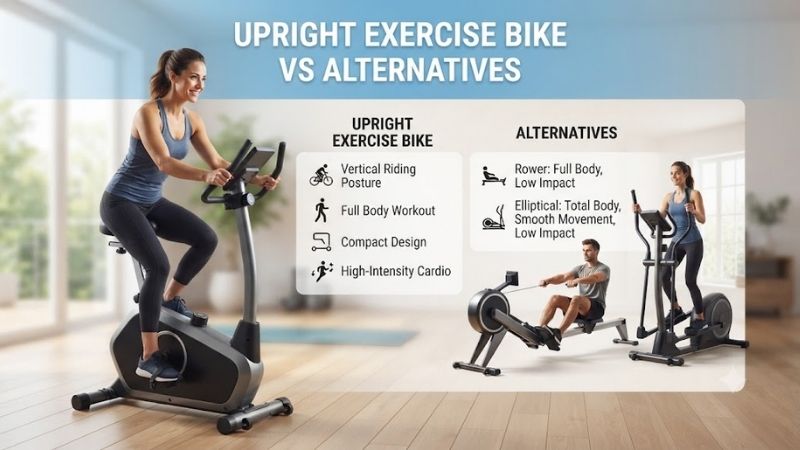
Traditional Upright Exercise Bikes
A traditional upright bike generally positions the rider above the crank assembly.
The rider sits on a saddle and holds stationary handlebars.
Many models use magnetic resistance and a console displaying workout information.
This arrangement can provide a familiar seated cycling motion without requiring the long frame of a recumbent bike.
Upright bikes may also include adjustable seats and, depending on the model, adjustable handlebars.
However, the user normally receives no integrated back support.
Saddle comfort and proper adjustment are therefore important.
Recumbent Exercise Bikes
A recumbent bike positions the rider behind the pedals.
The seat generally includes a backrest.
This arrangement provides a different distribution of body support.
Many people appreciate the supported posture, particularly during longer seated sessions.
However, recumbent bikes often require more floor length.
The rider’s legs extend forward rather than moving primarily below the body.
Seat travel and pedal distance are important fit considerations.
Indoor Cycling Bikes
Indoor cycling bikes often use a sport-oriented frame with a more forward-leaning position.
Many allow adjustments to saddle height, saddle fore-aft position, and handlebar placement.
They may also use heavier flywheels or resistance arrangements intended to support varied cycling workouts.
However, not every indoor cycling bike has identical geometry or supports standing pedaling.
The exact frame and manufacturer instructions determine approved use.
Indoor cycling equipment can appeal to people who prefer a more bicycle-like exercise position.
Air Bikes
Air bikes use fan resistance.
Many have moving handlebars connected to the drivetrain or another mechanism.
As the user pedals and moves the handles, the fan rotates and produces resistance.
Harder effort generally increases fan speed and aerodynamic drag.
This creates a different workout experience from a conventional magnetic upright bike.
However, air bikes can generate noticeable airflow noise.
The moving handles also influence the space required around the equipment.
Folding Exercise Bikes
Folding bikes are designed to reduce storage dimensions.
Many use an X-frame or similar folding arrangement.
Some offer upright and semi-recumbent riding positions.
However, folding designs may not reproduce the geometry of dedicated upright or recumbent machines.
Buyers should evaluate seat position, pedal path, stability, and folding safety.
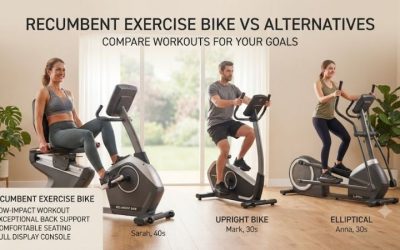
Upright Exercise Bike vs. Recumbent Bike
This is one of the most common comparisons for home exercise buyers.
Riding Posture
An upright exercise bike generally places the torso in a relatively vertical or moderately forward-leaning position.
The rider maintains posture through the seat, handlebars, and muscular control.
A recumbent bike provides integrated back support and positions the legs forward.
This difference influences how body weight is distributed.
However, neither position is inherently appropriate for every person.
Individual anatomy, comfort, and mobility should determine the choice.
Seat Comfort
Upright bikes typically use bicycle-style saddles.
Their comfort depends on shape, width, padding, adjustment, and rider positioning.
A thick saddle is not automatically more comfortable.
Recumbent bikes commonly use wider seats with backrests.
This may appeal to people who prefer a chair-like arrangement.
However, recumbent seat shape and adjustment still matter.
A poorly fitting backrest or seat position can be uncomfortable.
Back Support
Back support is the principal ergonomic distinction.
A recumbent machine integrates a backrest.
An upright bike generally requires the rider to maintain torso position without such support.
People with specific back-related concerns should not assume that one category provides medical benefits.
A professional assessment may be appropriate when a health condition influences equipment choice.
Leg Position
On an upright bike, the pedals rotate primarily below the rider.
On a recumbent bike, they rotate forward of the seat.
This changes hip and knee positioning throughout the pedal cycle.
Proper seat adjustment is necessary in either arrangement.
Entry and Exit
Many recumbent bikes use step-through frames that may make sitting and standing convenient for some users.
Upright bikes often require mounting a saddle and placing a foot over or around the frame.
The preferred arrangement depends on the rider’s mobility and balance.
Footprint
Recumbent bikes tend to be longer.
For example, the Schwinn 590R recumbent bike measures approximately 66.4 inches long and 28 inches wide.
An upright bike may occupy less floor length, although exact dimensions vary substantially.
For a small room, measuring the assembled footprint and access clearance is essential.
Who Should Choose Upright?
Choose upright if you prefer a conventional cycling arrangement and want a compact exercise machine.
Who Should Choose Recumbent?
Choose recumbent if integrated back support and a supported seating position are more important than minimizing floor length.
Upright Exercise Bike vs. Indoor Cycling Bike
The distinction between these categories is sometimes blurred by marketing terminology.
Riding Geometry
Traditional upright exercise bikes often emphasize comfortable seated cycling with a console and relatively accessible handlebars.
Indoor cycling bikes may provide a more forward-leaning geometry.
This can appeal to users who want a riding posture resembling certain outdoor cycling positions.
However, actual geometry varies.
Saddle Adjustment
Indoor cycling bikes frequently offer multiple saddle adjustments.
Some upright bikes have more limited adjustment options.
A larger adjustment range can help accommodate different body proportions.
However, the actual minimum and maximum settings matter more than the number of controls.
Handlebar Adjustment
Handlebar height and reach influence posture.
Some indoor cycling bikes provide several adjustments.
Other machines have fixed handlebars.
A buyer should verify whether the handlebars can support a comfortable position without excessive reaching.
Standing Pedaling
Some indoor cycling bikes are designed to support standing pedaling.
This is not a standard feature of every upright exercise bike.
Never stand on the pedals of a machine unless the manufacturer permits that riding style.
Resistance Systems
Indoor cycling bikes may use magnetic or friction-based resistance.
Traditional upright bikes frequently use magnetic resistance.
Neither resistance type defines the entire category.
Flywheel Characteristics
Flywheel mass and inertia influence pedaling feel.
However, a heavier flywheel is not automatically superior.
Drive ratio, resistance design, and overall construction also matter.
Workout Experience
An indoor cycling bike may be preferable for users who enjoy cycling-style interval sessions and riding-position variation.
A conventional upright bike may be more appealing for straightforward seated cardio.
Upright Exercise Bike vs. Air Bike
Air bikes differ from traditional upright machines in both resistance and, frequently, upper-body involvement.
Resistance Mechanism
An air bike uses a fan.
As the fan turns faster, aerodynamic resistance increases.
This creates an effort-responsive system.
A magnetic upright bike commonly allows the user to select resistance settings.
The difference affects how intensity is controlled.
Moving Handlebars
Many air bikes include moving handles.
This enables the upper body to participate in the movement.
However, the exact relationship between handles and pedals depends on the machine.
Some designs allow particular combinations of arm and leg movement.
Check the manufacturer’s intended use.
Workout Intensity
Air bikes can support varied exercise intensity through changes in effort.
However, they are not automatically more effective than upright bikes.
Actual workload depends on the user and equipment.
Noise
Air bikes produce fan sound.
Magnetic upright bikes may generate less airflow-related noise.
However, the complete machine determines actual sound output.
Floor Space
Air bikes often require additional operating room around moving handles.
An upright bike with stationary handlebars may fit more conveniently in a narrow space.
Which Should You Choose?
Choose an air bike when effort-responsive resistance and coordinated arm-and-leg movement are priorities.
Choose a conventional upright bike when you prefer seated pedaling with simpler controls and potentially less operating noise.
Upright Exercise Bike vs. Folding Bike
Folding bikes can solve storage problems, but the decision involves more than folded dimensions.
Fixed Frame vs. Folding Frame
A conventional upright bike generally maintains one assembled configuration.
A folding bike includes joints that permit changes to the frame shape.
Both can be well engineered.
However, folding locks must be secured correctly before exercise.
Riding Position
Some folding bikes provide a relatively upright position.
Others allow semi-recumbent adjustments.
These may differ from the fit offered by dedicated upright machines.
Stability
A folding bike should remain stable under normal operation.
A compact folding design is not automatically unstable.
However, frame geometry and locking mechanisms must be appropriate.
Storage
A folding machine can occupy less floor space between workouts.
However, the folded height and width may still be substantial.
Daily Convenience
Folding after every session requires effort.
A fixed upright bike may encourage convenient use when permanent space is available.
User Fit
Some folding machines have limited adjustment ranges.
Tall and short riders should verify compatibility.
Who Should Choose Folding?
Choose a folding bike when permanent floor space is unavailable and the folded configuration solves the storage problem.
Choose a fixed upright machine when consistent fit and ready-to-use convenience matter more.
Resistance Systems Compared
Resistance mechanism influences pedaling feel and how the user controls exercise intensity.
Manual Magnetic Resistance
Manual magnetic systems often use a dial to adjust resistance.
They can provide straightforward operation.
However, resistance ranges vary by machine.
Electronic Magnetic Resistance
Electronically controlled machines adjust resistance through a console.
Some offer preset workouts or connected applications.
These features can be useful for structured sessions.
Friction Resistance
Friction-based systems create resistance through mechanical contact.
They may require maintenance of contact surfaces.
The operating feel depends on the design.
Air Resistance
Air resistance depends on fan movement.
It responds to user effort.
However, fan noise is a practical consideration.
Hybrid Resistance
Some bikes combine resistance mechanisms.
These may provide specialized characteristics.
However, additional complexity does not automatically improve suitability.
Comfort, Ergonomics, and Rider Fit
Fit is one of the strongest predictors of whether a bike is practical for regular use.
Saddle Height
Seat height influences leg extension.
An excessively low saddle may leave the knees too bent throughout the pedal stroke.
An excessively high saddle may cause reaching or hip rocking.
Follow the manufacturer’s fit recommendations.
Saddle Fore-Aft Position
Some bikes allow forward or backward saddle adjustment.
This changes the relationship between the hips and pedals.
The setting should support comfortable movement.
Handlebar Position
Handlebar height and reach influence upper-body posture.
Avoid positions that require excessive reaching.
Pedal Design
Pedals may use straps, cages, or other retention features.
The appropriate design depends on the intended riding style.
Crank Length
Crank length influences the pedaling circle.
However, not every machine offers adjustable or alternative crank lengths.
Shared Household Use
When several people use the same bike, adjustment convenience becomes important.
Each rider should establish an appropriate position.
Space Requirements for Home Use
Upright Bike Footprint
Upright bikes often require less floor length than recumbent bikes.
However, exact dimensions vary.
Recumbent Bike Footprint
Recumbent designs usually extend farther forward.
They also require side clearance for entry and exit.
Indoor Cycling Bike Footprint
Indoor cycling bikes can be compact, but handlebar and saddle movement may affect operating clearance.
Air Bike Footprint
Moving handles may require extra side or front clearance.
Folding Bike Storage
Folded dimensions should be measured independently from operating dimensions.
Ceiling and Overhead Clearance
Ceiling height is generally less restrictive for seated cycling than for vertical climbing equipment.
However, overhead shelving and other obstacles still matter.
Noise and Apartment Compatibility
Magnetic Resistance Noise
Magnetic systems avoid direct friction-pad contact in many designs.
However, belts, bearings, and other parts still produce sound.
Friction Resistance Noise
Friction systems may create contact-related noise.
Wear and adjustment can influence operation.
Air Fan Noise
Air bikes generate airflow sound.
The sound often becomes more noticeable during harder efforts.
Floor Vibration
Pedaling forces and equipment movement may transmit vibration through the floor.
A suitable mat may protect flooring and reduce some vibration.
Shared Housing
Consider workout times, floor construction, and placement.
No bike should be assumed silent based solely on its resistance system.
Console Features and Workout Tracking
Basic Workout Data
Many bikes display time, speed estimates, distance, and other information.
These can be useful for monitoring consistency.
Resistance Levels
Resistance-level counts are not standardized.
A higher count does not guarantee greater maximum workload.
Power Measurement
Some bikes calculate or measure power in watts.
Accuracy depends on hardware and computation.
Heart Rate Monitoring
Some machines include grip sensors or support external monitors.
Verify compatibility.
Connected Applications
Bluetooth or other connectivity may support workout applications.
However, app compatibility varies.
Subscription Features
Some connected training systems require ongoing subscriptions.
Check what remains available without a paid membership.
Maintenance and Ownership Costs
Magnetic Bike Maintenance
Inspect pedals, frame connections, bearings, and drivetrain components.
Electronic systems may introduce additional service requirements.
Friction Bike Maintenance
Contact surfaces may wear and require attention.
Follow manufacturer instructions.
Air Bike Maintenance
Fans, chains, belts, and other components require appropriate inspection.
Folding Bike Maintenance
Folding joints and locking components should be checked regularly.
Replacement Parts
Check whether seats, pedals, electronics, and drivetrain parts are available.
Warranty
Review frame, mechanical, and electronic coverage separately where applicable.
Choosing the Right Bike for Your Budget
Entry-Level Bikes
Basic upright and folding bikes may offer manual resistance and simple displays.
These can be sufficient for straightforward home cycling.
Midrange Bikes
Midrange machines may provide more adjustments, electronic resistance, or connected features.
Evaluate whether these upgrades improve the intended workouts.
Premium Bikes
Premium models may include sophisticated tracking, interactive displays, and advanced resistance control.
However, they are not inherently more comfortable or suitable.
Total Ownership Cost
Consider electricity, replacement parts, subscriptions, accessories, and maintenance.
Value for Different Users
A simple upright bike may be good value for regular seated cycling.
A recumbent bike may justify its additional size when supported seating is essential.
An indoor cycling bike may be worth the cost for someone seeking particular riding-position adjustments.
Choosing an Exercise Bike for Different Users
Beginners
Prioritize comfortable fit, straightforward controls, and stable construction.
Older Adults
Ease of access and appropriate support may be important.
A recumbent design may be worth considering, but suitability depends on individual needs.
Indoor Cycling Enthusiasts
An indoor cycling bike may provide more appropriate riding geometry and adjustment.
Apartment Residents
A magnetic upright bike or folding design may be practical.
Noise and actual dimensions must still be checked.
Experienced Cardio Users
Resistance range, performance tracking, and fit may become more important.
Shared Household Users
A broad adjustment range can improve usability.
How to Choose the Best Bike for Your Situation
Start With the Riding Position
Determine whether you prefer upright, supported recumbent, or sport-oriented cycling.
Measure Available Space
Check the complete operating footprint.
Confirm Rider Fit
Examine seat adjustment, pedal position, and handlebar reach.
Evaluate Resistance
Choose a system that supports your intended effort levels.
Assess Noise
Consider the room and neighboring occupants.
Check Workout Tracking
Select only the features that are useful to your training.
Review Maintenance
Understand the ongoing care requirements.
Compare Total Cost
Consider both purchase and long-term ownership expenses.
Common Mistakes When Buying an Exercise Bike
Assuming Upright Bikes Are Always Better for Fitness
Suitability depends on the individual and training goals.
Choosing Based on Resistance Levels Alone
Level counts are not standardized.
Ignoring Saddle Comfort
Poor fit can reduce the practicality of regular cycling.
Confusing Upright and Indoor Cycling Bikes
These categories overlap but may have different intended riding positions.
Assuming Every Bike Supports Standing Pedaling
Standing use must be approved by the manufacturer.
Buying Folding Equipment Without Checking Storage Dimensions
Folded height and width still matter.
Overlooking Connected Subscription Costs
Some digital features require ongoing payments.
Frequently Asked Questions
Is an Upright Exercise Bike Better Than a Recumbent Bike?
Neither is universally better. Upright bikes offer a conventional cycling position and often a smaller footprint, while recumbent bikes provide integrated back support and a different seating arrangement.
Is an Upright Bike the Same as a Spin Bike?
Not exactly. Indoor cycling bikes often have sport-oriented geometry and may support different riding styles. Some features overlap, but actual designs vary.
Which Exercise Bike Is Best for Small Apartments?
A compact upright or folding bike can be practical, depending on available floor space. Noise, fit, and storage dimensions are also important.
Are Air Bikes Harder Than Magnetic Bikes?
Air bikes respond to effort through fan resistance, while magnetic bikes commonly use selectable settings. Either can support different intensity levels depending on design and user effort.
Can You Stand While Pedaling an Upright Exercise Bike?
Only if the manufacturer specifically supports standing pedaling. Some upright bikes are intended for seated use.
Which Bike Requires the Least Maintenance?
Requirements vary by model. Simple magnetic bikes may avoid friction-pad wear, but all exercise bikes still require appropriate inspection and care.
Conclusion
When comparing an upright exercise bike vs alternatives, the right choice depends on riding posture, comfort, resistance, space, and intended workouts. Upright bikes offer compact conventional cycling, recumbent models provide back support, indoor cycling bikes emphasize sport-oriented riding, air bikes offer effort-responsive movement, and folding bikes prioritize storage. Choose the design that fits your body and routine rather than selecting a category based on reputation alone.

Write Your Review
No reviews yet. Be the first to share your experience!