
Key takeaways
-
Choose air resistance when you want effort-responsive loading and suitable training data.
-
Choose magnetic resistance when selectable settings and relatively restrained mechanical sound are priorities.
-
Choose water resistance when you prefer the feel and sound of water-based loading.
-
Choose hydraulic resistance when a compact mechanism or lower initial cost is especially important.
-
Consider hybrid resistance if you need the particular adjustment characteristics offered by an air-magnetic combination.
Comparing an air rowing machine vs alternatives means understanding how fan resistance responds to each stroke and how that differs from magnetic, water, and hydraulic systems. Air rowers are popular for structured workouts, but noise, dimensions, and maintenance can influence suitability. This guide explains the mechanical differences and helps you choose based on actual training needs.
Quick Verdict: When Is an Air Rowing Machine the Best Choice?
An air rowing machine uses a fan flywheel to generate resistance as the user pulls the handle.
The faster the flywheel rotates, the greater the aerodynamic drag it produces. This allows resistance to respond dynamically to pulling effort rather than depending entirely on a preset electronic or mechanical setting.
That characteristic makes air rowers particularly attractive for users who want to alternate between gentle rowing and powerful strokes without repeatedly adjusting a control.
However, air resistance is only one part of the overall machine.
Frame geometry, flywheel construction, monitor quality, seat travel, maintenance support, and operating dimensions also influence whether an air rower is a good purchase.
For a buyer interested in structured rowing workouts, an air rower with reliable performance measurement can be a strong choice.
For someone prioritizing quiet apartment exercise, a magnetic rower may deserve closer consideration.
For someone who prefers fluid-resistance sound and particular frame aesthetics, a water rower may be more appealing.
Hydraulic machines can sometimes provide compact alternatives but may have different stroke mechanics and operating limitations.
The most useful recommendations are:
-
Choose air resistance when you want effort-responsive loading and suitable training data.
-
Choose magnetic resistance when selectable settings and relatively restrained mechanical sound are priorities.
-
Choose water resistance when you prefer the feel and sound of water-based loading.
-
Choose hydraulic resistance when a compact mechanism or lower initial cost is especially important.
-
Consider hybrid resistance if you need the particular adjustment characteristics offered by an air-magnetic combination.
The correct machine should also fit the user and exercise area.
Quick Comparison Table
| Feature | Air rowing machine | Magnetic rower | Water rower | Hydraulic rower |
|---|---|---|---|---|
| Resistance principle | Air drag | Magnetic braking | Water displacement and drag | Hydraulic cylinder loading |
| Response to effort | Naturally dynamic | Model-dependent | Naturally dynamic | Mechanism-dependent |
| User controls | Damper on many models | Manual or electronic settings | Water level and model-specific controls | Model-specific adjustments |
| Sound | Fan airflow | Generally mechanical drivetrain sound | Water movement | Cylinder and joint noise |
| Electrical power | Often unnecessary for resistance | Varies | Often unnecessary for resistance | Often unnecessary |
| Performance tracking | Strong on selected ergometers | Varies | Varies | Often basic |
| Routine care | Chain/cord, flywheel, rail | Belt, rail, electronics as applicable | Tank, water, rail | Cylinders and pivots |
| Storage | Model-dependent separation or folding | Folding or upright on selected models | Upright on approved designs | Compact models available |
| Main advantage | Responsive training | Resistance selection | Fluid-resistance experience | Potentially small footprint |
| Main trade-off | Noise and operating length | Inconsistent features across products | Water maintenance | Mechanical differences and usage limits |
How Air Resistance Works
Understanding the air flywheel helps explain why air rowers behave differently from conventional magnetic machines.
Fan Flywheel Mechanics
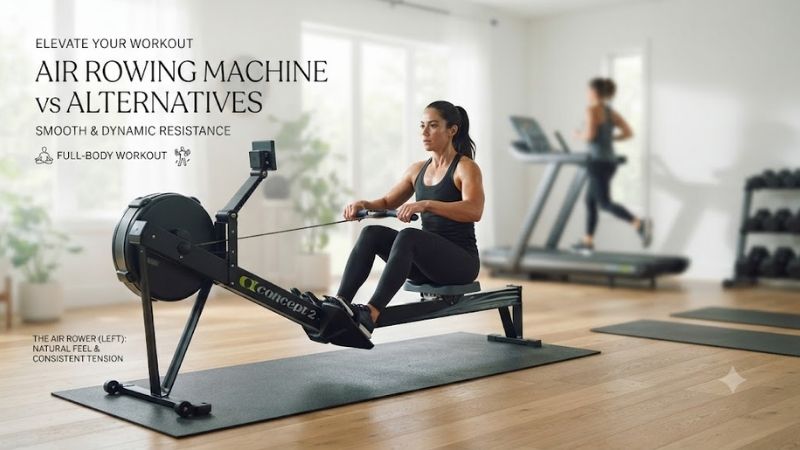
An air rower contains a rotating fan connected to the handle through a chain, belt, cord, or other drivetrain.
During the drive phase, the user’s pulling force accelerates the flywheel.
The blades move air, generating aerodynamic drag that opposes rotation.
As speed rises, the drag increases.
This creates a resistance system in which the user plays a direct role in determining workout intensity.
However, the exact force behavior depends on flywheel dimensions, airflow, drivetrain mechanics, and inertia.
Two different air rowers may not produce identical resistance simply because both use fans.
Why Harder Pulls Generate Greater Resistance
A person rowing gently accelerates the flywheel less aggressively than someone performing a powerful stroke.
Higher flywheel speed increases aerodynamic resistance.
Therefore, the machine naturally responds to the intensity of the drive.
This characteristic can be useful for intervals.
A user can transition between different effort levels without necessarily adjusting a resistance selector.
However, a harder pull still requires appropriate rowing technique.
An effort-responsive mechanism is not a reason to sacrifice controlled movement.
What Happens During Recovery?
During the recovery phase, the handle returns while the user prepares for the next drive.
The flywheel continues rotating but slows as energy is lost through aerodynamic drag and other mechanical effects.
The degree of slowdown depends on the machine and operating settings.
This flywheel deceleration is relevant to how some performance monitors estimate resistance and workload.
A user who rows at different stroke rates can therefore experience different flywheel behavior.
Flywheel Inertia and Rowing Feel
Rotational inertia describes how a spinning object resists changes in speed.
The flywheel’s mass distribution influences acceleration and deceleration.
However, flywheel weight alone does not establish the complete rowing sensation.
Airflow, drivetrain ratios, handle geometry, and other factors contribute.
A buyer should not assume that a heavier flywheel automatically creates a better rowing machine.
Damper Settings Explained
Many air rowers have dampers that change airflow into the flywheel.
On the Concept2 RowErg, the damper influences flywheel operating characteristics rather than selecting a fixed amount of weight.
A higher setting permits different airflow behavior.
This can change the feel of the stroke.
However, a high damper setting is not inherently superior, and selecting it does not automatically make a workout more effective.
The appropriate setting depends on training goals, technique, and user preference.
Understanding Drag Factor
Some monitors calculate drag factor by examining flywheel deceleration.
This provides information about the machine’s effective flywheel loading.
Drag factor can help users reproduce particular operating conditions on compatible equipment.
However, it is not universally standardized across all brands.
Two machines displaying the same drag factor or damper number should not automatically be assumed mechanically identical.
Air Rower vs. Magnetic Rower
This is one of the most relevant comparisons for home gym buyers.
Resistance During Gentle Workouts
An air rower allows a user to row at relatively modest effort by applying less force.
The flywheel turns and creates resistance appropriate to its speed and configuration.
A magnetic rower may instead provide selectable resistance settings.
For someone who prefers a predictable nominal resistance level, magnetic equipment can be convenient.
However, neither system inherently requires advanced fitness.
A beginner can use either type when the equipment fits properly and the workout is managed appropriately.
Resistance During Hard Intervals
Air resistance responds directly to stronger strokes.
This makes it attractive for exercises involving changes in effort.
Some magnetic machines also provide high resistance or electronically controlled intervals.
However, their workload capabilities vary.
The correct comparison should examine actual resistance behavior rather than assuming that all air machines outperform all magnetic machines.
Rowing Technique and Stroke Feel
Air rowers often use a central handle and sliding seat.
Many magnetic rowers use the same general geometry.
Therefore, the resistance system alone does not determine rowing technique.
Handle height, foot stretcher position, rail length, seat travel, and drivetrain engagement also matter.
A well-designed magnetic rower can support controlled rowing mechanics.
A poorly configured air rower can still feel uncomfortable.
Noise Differences
Air resistance produces noticeable airflow sound.
The volume may increase during harder rowing.
Magnetic machines avoid fan-resistance noise but can still generate sound through their drivetrain.
For noise-sensitive households, magnetic equipment may have an advantage.
However, direct model testing is required to establish actual sound differences.
Maintenance
Air rowers require attention to the flywheel, drivetrain, rail, and other moving parts.
Magnetic machines may require fewer airflow-related cleaning tasks but can contain electronics or other components.
No machine is completely maintenance-free.
Who Should Choose Each?
Choose air when responsive effort, performance tracking, and a traditional ergometer experience are important.
Choose magnetic when selectable settings, potentially quieter operation, or electronic programming better match your needs.
Air Rower vs. Water Rower
Air and water rowers both use fluid resistance, but the resulting mechanics differ.
Resistance Medium
Air rowers move air through fan blades.
Water rowers move water through a resistance tank.
Different fluid properties, paddle geometry, and drivetrain arrangements influence the experience.
One system should not be described as mechanically identical to the other.
Effort-Responsive Loading
Both systems can respond dynamically to pulling effort.
However, the way resistance develops during a stroke may differ.
A user may prefer the sensation of one system without that preference demonstrating greater accuracy or effectiveness.
Sound
An air rower produces fan noise.
A water rower produces water movement sound.
The preferred sound is subjective.
Noise-sensitive buyers should evaluate actual models rather than relying solely on resistance descriptions.
Maintenance
Air rowers may require cleaning of the flywheel housing and drivetrain.
Water rowers add tank and water-treatment requirements.
The buyer should consider whether fluid maintenance is acceptable.
Performance Monitoring
Air rowers with established monitor systems can provide useful training metrics.
Water rowers may also support detailed monitoring, depending on their equipment.
However, data should not be compared directly without understanding the measurement systems.
Long-Term Ownership
Both types can be durable when properly designed and maintained.
Replacement parts, support availability, and product construction are more useful indicators than resistance type alone.
Air Rower vs. Hydraulic Rower
Hydraulic rowers often target a different set of buyer priorities.
Frame Size
Some hydraulic rowing machines are relatively compact.
Traditional air rowers often require long rails to accommodate a complete seated rowing stroke.
This can make hydraulic designs attractive where floor length is restricted.
However, independent hydraulic arms may need significant side clearance.
Rowing Mechanics
Many air rowers use a central handle and sliding seat.
Some hydraulic rowers use two independent rowing arms.
These configurations can feel different.
A buyer interested in conventional ergometer mechanics should examine the stroke geometry carefully.
Resistance Consistency
Air resistance responds to flywheel speed.
Hydraulic resistance depends on cylinder design and operating conditions.
Temperature can affect hydraulic characteristics.
Some machines also have continuous-use restrictions.
Workout Tracking
Air rowers may offer sophisticated performance monitoring.
Basic hydraulic machines often provide simpler displays.
For data-focused training, this distinction may be significant.
Cost
Hydraulic machines can be attractive in lower-cost segments.
However, price should be weighed against stroke quality, maintenance support, and intended use.
Air Rower vs. Hybrid Air-Magnetic Machines
Hybrid rowers combine more than one resistance mechanism.
Why Combine Air and Magnetic Resistance?
A hybrid machine may use an air flywheel while adding magnetic braking.
This can allow manufacturers to modify workload characteristics beyond those available through airflow alone.
However, the engineering differs by model.
The presence of two systems does not automatically make the machine superior.
Electronic Resistance Control
Some hybrids support electronic resistance adjustments.
These can be useful for programmed workouts.
However, they may also introduce power and maintenance requirements.
Performance Feel
A hybrid system may produce a different resistance profile from a pure air rower.
Whether that is beneficial depends on the user.
Some may prefer the more direct effort-responsive characteristics of a conventional air ergometer.
Others may value electronic control.
Cost and Complexity
Additional components can increase purchase price and servicing complexity.
The buyer should determine whether the features justify those costs.
Performance Tracking and Training Accuracy
For many buyers, performance measurement is the strongest reason to choose a particular air rower.
Time and Stroke Rate
Basic monitors record workout duration and stroke frequency.
These values can help structure sessions.
Simulated Distance
An ergometer calculates distance rather than measuring movement through physical water.
The calculation depends on the machine’s design.
Comparisons across brands require caution.
Pace
Pace is often expressed as time per 500 meters.
This can be useful when tracking workouts on the same equipment.
However, equivalent displayed pace does not guarantee equivalent power output on unrelated machines.
Power
Power metrics estimate or calculate mechanical work rate.
Accuracy depends on the sensing and computation method.
A machine advertising watts should not automatically be assumed to provide laboratory-grade measurement.
Concept2 RowErg Example
The Concept2 RowErg uses a PM5 monitor and is widely used for structured indoor rowing training.
Its published standard dimensions are 96 inches long and 24 inches wide.
The manufacturer recommends approximately 9 × 4 feet of space for use.
These specifications illustrate both the strengths and physical requirements of a full-length air ergometer.
Connected Training
Some monitors support workout applications and wireless accessories.
Check compatibility before purchasing.
Subscription requirements and software functionality may change.
Noise and Apartment Use
Fan Noise
Air rowers generate airflow sound during exercise.
Harder pulling generally increases flywheel speed and can make the noise more noticeable.
Seat and Rail Noise
The sliding seat creates additional mechanical sound.
Roller condition and rail cleanliness may influence operation.
Chain or Cord Noise
The drivetrain may produce sound as the handle moves.
Maintenance requirements vary.
Floor Vibration
Leg drive transfers forces through the frame to the floor.
A suitable mat may reduce some vibration and protect flooring.
However, it cannot guarantee silent operation.
Choosing for Shared Housing
Consider workout times, floor construction, and proximity to neighboring rooms.
A magnetic rower may be worth considering when operating noise is a dominant concern.
Frame Construction and Rider Fit
Rail Length
Rail travel affects whether the rower accommodates the rider’s leg length.
Taller users should check inseam compatibility.
Seat Height
Seat height can influence entry and exit convenience.
The Concept2 RowErg, for example, offers standard and taller-leg configurations with different seat heights.
However, a higher seat is not automatically necessary for taller users.
Foot Stretchers
Foot placement should support a comfortable rowing position.
Check adjustment range and strap design.
Handle Geometry
Handle width and shape affect grip comfort.
A suitable handle should support controlled movement.
Maximum User Weight
The manufacturer’s rating is an operating limit.
Do not use it as a complete measure of durability.
Frame Stability
A rower should remain stable under normal use.
Unwanted frame movement requires inspection.
Storage and Space Requirements
Operating Footprint
A conventional air rower may require substantial floor length.
Measure the complete movement area rather than the base alone.
Concept2 Storage
The Concept2 RowErg can separate into two sections without tools.
With standard legs, its documented storage arrangement is approximately 25 × 33 × 54 inches.
This can reduce storage length significantly.
Folding Alternatives
Some air rowers use folding mechanisms.
Others require separation or permanent placement.
Check the exact design.
Ceiling Clearance
Vertical storage can require considerable height.
Never assume that a machine can be leaned against a wall.
Use the manufacturer’s approved method.
Daily Storage Convenience
A machine that must be moved or separated after every workout may be less convenient than a permanently installed one.
Consider how frequently you plan to exercise.
Maintenance and Serviceability
Flywheel Cleaning
Dust can accumulate in the flywheel housing.
Follow the manufacturer’s cleaning instructions.
Chain or Cord Maintenance
Inspect the drivetrain for wear and follow approved lubrication guidance where applicable.
Seat and Rail Care
Keep the rail clean and inspect the seat rollers.
Monitor Maintenance
Check battery or power requirements.
Replacement Parts
Availability of parts can influence long-term ownership value.
Warranty
Review coverage for the frame, mechanical components, and electronics.
Choosing an Air Rower for Your Budget
Basic Air Rowers
Entry-level machines may provide fan resistance with simpler monitors.
Evaluate construction and actual performance measurement.
Midrange Air Rowers
Midrange equipment may offer more complete monitoring and better component support.
However, price alone does not establish quality.
Premium Air Rowers
Premium machines may provide advanced displays, connectivity, or specialized construction.
Determine whether these features serve your intended workouts.
Total Ownership Cost
Consider replacement parts, accessories, maintenance, and optional connected services.
Long-Term Value
A serviceable machine with consistent workout data may be valuable for frequent users.
However, an expensive rower is unnecessary if simpler equipment meets the need.
Who Should Choose Each Alternative?
Choose Air for Performance-Focused Workouts
Air resistance is particularly attractive when effort-responsive loading and consistent rowing data matter.
Choose Magnetic for Noise-Sensitive Homes
A magnetic machine may be preferable when fan noise is undesirable.
Verify actual sound and workload capability.
Choose Water for Fluid Resistance and Design
Water machines may suit buyers who prefer water movement sound and particular frame aesthetics.
Choose Hydraulic for Limited Space
Compact hydraulic designs may be useful when a long rail cannot fit.
Check operating limits and movement mechanics.
Choose Hybrid for Specialized Resistance Control
Hybrid systems can be appropriate when specific electronic resistance features justify their added complexity.
Frequently Asked Questions
Is an Air Rowing Machine Better Than a Magnetic Rower?
Not universally. Air resistance responds dynamically to pulling effort, while magnetic systems may provide convenient selectable settings. Training priorities and operating conditions determine the better choice.
Are Air Rowing Machines Too Loud for Apartments?
Not necessarily, but they produce airflow sound. Suitability depends on the machine, building construction, workout intensity, and household noise tolerance.
Does a Higher Damper Setting Create a Better Workout?
No. A damper changes airflow characteristics, not a standardized fixed resistance weight. Appropriate technique and effort matter more than selecting the highest setting.
Are Air Rowers Suitable for Beginners?
Yes. The user can control exercise effort through the stroke. Proper technique, fit, and a manageable starting intensity are important.
Do Air Rowers Need Electricity?
Many air-resistance mechanisms operate without wall electricity. Monitors may use batteries or other power arrangements, depending on the model.
Which Air Rower Features Matter Most?
Resistance behavior, stroke geometry, frame stability, monitor reliability, operating dimensions, and replacement-part support are key purchasing considerations.
Conclusion
When comparing an air rowing machine vs alternatives, air resistance stands out for its effort-responsive loading and suitability for structured rowing workouts. Magnetic machines may better suit quiet indoor environments, water rowers offer a distinct fluid-resistance experience, and hydraulic models can solve specific space constraints. Choose based on fit, performance monitoring, noise tolerance, maintenance, and verified machine specifications.







Write Your Review
No reviews yet. Be the first to share your experience!