
Key takeaways
-
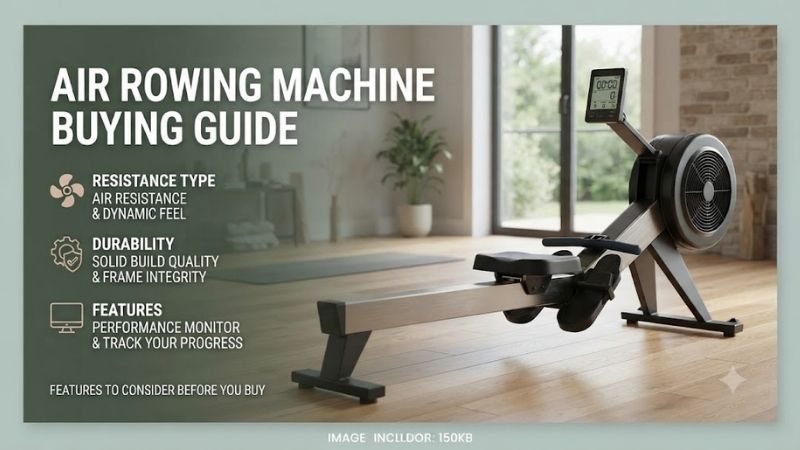
Resistance system: A responsive fan that changes its loading characteristics naturally as pulling effort increases.
-
Damper adjustment: A useful range of airflow settings that allows you to change stroke feel.
-
Rail length: Enough seat travel for comfortable leg extension.
-
Frame stability: Secure support that does not rock excessively during normal rowing.
-
Performance monitoring: Clear tracking of time, stroke rate, and consistent workout estimates.
-
Foot and handle fit: Adjustable footrests and comfortable grip positioning.
-
Storage: A manufacturer-approved arrangement suitable for your room.
-
Maintenance: Accessible drive components, replacement parts, and practical cleaning procedures.
-
Warranty: Clear coverage for the frame, moving components, and electronics.
An air rowing machine is a versatile cardio option for home gyms, combining lower-body drive, upper-body pulling, and core engagement. This buying guide covers key factors such as fan resistance, drag factor, comfort, performance monitors, and durability to help you choose an air rower that fits your space, budget, and fitness goals.
Quick Verdict: What Makes a Good Air Rowing Machine?
The best air rowing machine for your needs is one that provides a smooth, unrestricted rowing stroke, responsive resistance, stable construction, and dependable workout monitoring.
For many home users, a well-built machine with a properly designed air flywheel, adjustable damper, comfortable seat travel, and clear performance data offers better long-term value than a cheaper rower with an impressive feature list but poor rowing geometry.
Prioritize the following factors when shopping:
-
Resistance system: A responsive fan that changes its loading characteristics naturally as pulling effort increases.
-
Damper adjustment: A useful range of airflow settings that allows you to change stroke feel.
-
Rail length: Enough seat travel for comfortable leg extension.
-
Frame stability: Secure support that does not rock excessively during normal rowing.
-
Performance monitoring: Clear tracking of time, stroke rate, and consistent workout estimates.
-
Foot and handle fit: Adjustable footrests and comfortable grip positioning.
-
Storage: A manufacturer-approved arrangement suitable for your room.
-
Maintenance: Accessible drive components, replacement parts, and practical cleaning procedures.
-
Warranty: Clear coverage for the frame, moving components, and electronics.
How Air Resistance Works
The Relationship Between Pulling Effort and Fan Resistance
An air rowing machine uses a flywheel with fan blades to produce resistance. When you pull the handle, the drive system transfers force to the flywheel, causing it to rotate and move air through its housing.
The faster the flywheel spins, the more aerodynamic resistance it encounters. This gives air rowing machines an important characteristic: the resistance responds to the amount of effort you apply.
A beginner can perform relatively gentle strokes, while an experienced athlete can generate substantially greater workloads using the same machine. There is no need to change a traditional weight stack between these efforts.
This does not mean rowing faster always produces better exercise. Stroke technique, force application, and recovery timing determine how efficiently the user transfers energy into the flywheel.
A controlled stroke with effective leg drive can generate meaningful power at a relatively moderate stroke rate. Conversely, rapid strokes with poor coordination may produce little additional useful output.
What Happens During the Rowing Stroke?
A rowing stroke has four main phases: the catch, drive, finish, and recovery.
At the catch, your knees are bent, arms extended, and body positioned slightly forward from the hips. During the drive, your legs push against the footplates, moving the seat backward.
As the legs extend, your torso opens toward a slightly backward position. Your arms then complete the pull, bringing the handle toward the lower chest.
At the finish, the legs are extended comfortably, elbows move backward, and the handle is close to the torso.
During recovery, the movement reverses. The arms extend first, the torso returns toward a forward position, and the knees bend as the seat travels toward the front of the machine.
The recovery should be controlled rather than rushed. On an air rower, the flywheel continues spinning during this phase, gradually slowing before the next drive.
This combination of acceleration and deceleration creates the distinctive air-rowing sensation.
How the Flywheel Affects Exercise Feel
The flywheel stores rotational energy generated during the drive.
As the rower applies force, the flywheel accelerates. Between strokes, air resistance slows it.
The rate of deceleration influences how much effort is required to accelerate the flywheel during the following stroke.
Flywheel mass, blade design, airflow, bearings, and the drivetrain all contribute to this behavior.
A larger physical flywheel does not automatically produce superior resistance. What matters is how the complete system converts handle movement into predictable mechanical loading.
Does Air Resistance Feel More Natural?
Air rowers are often described as responsive because the load changes with effort.
For example, pulling more forcefully increases flywheel acceleration and creates greater aerodynamic resistance.
This can feel intuitive during interval workouts.
However, an indoor rowing machine does not perfectly duplicate rowing a boat on water. The seat, footplates, handle, and resistance mechanism operate differently from a boat and oars.
Air rowing is best understood as a useful indoor training movement with its own mechanical characteristics.
Understanding the Damper and Drag Factor
What Does the Damper Actually Do?
The damper is usually a lever or adjustable mechanism near the flywheel housing.
Its purpose is to change how much air enters the fan enclosure.
On a Concept2 RowErg, for example, the damper uses numbered positions from 1 through 10.
At a higher setting, more air enters the housing, and the flywheel generally loses speed more rapidly between strokes.
At a lower setting, airflow is reduced, allowing the flywheel to retain momentum more readily.
The damper therefore changes the feel of the stroke.
It should not be interpreted as a simple indicator of exercise difficulty or fitness level.
Why Setting 10 Is Not Automatically Better
A common mistake is moving the damper to its maximum position before starting a workout.
Some beginners assume this produces the most effective training.
However, a high damper setting can make each stroke feel unusually heavy and may encourage excessive force or inefficient technique.
The Concept2 training guidance suggests beginning around damper settings 3–5 while developing technique, then adjusting according to preferred drag and training demands.
Other rowing machines may use different damper scales or resistance mechanisms, so those numbers should not be transferred automatically.
A moderate setting can still support demanding workouts when the user rows with sufficient intensity.
Understanding Drag Factor
Drag factor describes the flywheel’s rate of deceleration between strokes as calculated by a compatible performance monitor.
On systems that measure it, this value can provide a more consistent representation of airflow resistance than the physical damper number.
Two machines set to the same damper position may produce different drag factors.
Dust buildup, fan housing condition, environmental conditions, and equipment design can influence airflow.
The advantage of measuring drag factor is that users can select a similar mechanical feel across compatible machines even when the damper positions differ.
Damper Position Versus Workout Intensity
A useful distinction is that damper setting affects how the rower feels, while workout intensity depends on the user’s power output.
A strong athlete can generate high power at a moderate damper setting.
A beginner may produce relatively little power at the highest damper position.
For this reason, buyers should prioritize a machine with consistent resistance characteristics rather than one advertising an unusually high resistance number.
Do All Air Rowers Display Drag Factor?
No. Drag-factor monitoring depends on the machine’s electronics and calculation system.
Premium training rowers commonly provide more developed performance information, while inexpensive residential machines may only show time, estimated distance, and stroke count.
If repeatable resistance and standardized training data matter to you, confirm whether the monitor calculates drag factor and explains how the value is determined.
Air Rowing Machine Types Compared
| Type | Resistance Design | Main Advantage | Main Limitation | Best Use |
|---|---|---|---|---|
| Traditional air rower | Fan-driven | Responsive effort-based resistance | Fan noise | General conditioning |
| Air-and-magnetic hybrid | Fan plus magnetic braking | Additional resistance control | Greater complexity | Varied home workouts |
| Commercial-style air rower | Performance-oriented fan | Developed monitoring and construction | Larger footprint | Frequent training |
| Folding residential air rower | Fan with folding frame | Compact storage | Hinges and locks require inspection | Multipurpose rooms |
| Split-frame air rower | Fan with detachable rail | Easier storage in sections | Requires separating components | Home gyms |
| Connected air rower | Fan plus digital ecosystem | Guided workouts and tracking | Higher cost and software requirements | Structured training |
Traditional Fan-Resistance Rowers
A traditional air rower uses a fan as its primary source of resistance.
The machine does not normally require external electricity to create the training load.
Some monitors use batteries or power generated through the flywheel.
This design appeals to users who want mechanically straightforward equipment suitable for steady cardio and intervals.
Air-and-Magnetic Hybrid Rowers
A hybrid rowing machine combines air resistance with magnetic braking.
The fan responds to rowing effort, while the magnetic mechanism may add selectable loading.
This allows manufacturers to create resistance characteristics that differ from conventional fan-only equipment.
However, the benefits depend on the implementation.
A hybrid system is not automatically more powerful or more realistic than a well-designed air-only rower.
Commercial-Oriented Air Rowers
Commercial-oriented models typically emphasize frame durability, serviceability, and dependable workout monitoring.
They may be suitable for frequent training, shared gyms, and performance comparison.
However, the term commercial is not a substitute for checking the manufacturer’s intended-use rating and warranty terms.
Folding and Split-Frame Rowers
Storage-oriented models reduce the amount of permanent space required.
A folding machine changes its frame geometry through hinges, while a split-frame model separates into sections.
These designs should be evaluated according to their full operating dimensions and their approved storage procedures.
Rail Length, Inseam, and Rowing Comfort
Why Rail Length Is a Priority
A rowing machine needs sufficient seat travel for the user to complete a comfortable stroke.
The catch requires knee flexion and forward positioning, while the drive requires substantial leg extension.
If the seat reaches the end of the rail before the legs have extended appropriately, the machine may force an abbreviated movement.
This can undermine the rowing experience regardless of how sophisticated the resistance system is.
Overall Length Is Not the Same as Seat Travel
The overall machine length includes the fan housing, structural supports, footplates, and other components.
Usable seat travel represents the distance through which the rider can actually move.
A long rower may not necessarily accommodate longer legs than another similarly sized machine.
When comparing products, look for usable rail length, seat-travel measurements, or supported inseam ranges.
A Real-World Example: Concept2 RowErg
The standard Concept2 RowErg measures 96 inches long and 24 inches wide, with a 54-inch monorail.
Its published guidance indicates that users with an inseam of approximately 38 inches or more may require an extra-long monorail.
This example illustrates why inseam compatibility is more informative than marketing labels such as suitable for tall users.
Those dimensions apply to the identified Concept2 model and should not be assumed for other machines.
Seat Height and Accessibility
Seat height influences how easy a rowing machine is to enter and exit.
A low seat may be comfortable during exercise but difficult for someone who has trouble lowering themselves close to the floor.
Some manufacturers offer elevated frames.
For example, Concept2 offers its RowErg with standard and tall leg configurations, providing different seat heights.
A higher seat does not necessarily mean a longer rail or different rowing resistance.
Footplate Fit
Footplates should securely accommodate the intended footwear.
The straps should hold the feet without causing uncomfortable pressure.
During the stroke, the feet should remain appropriately positioned while allowing natural ankle movement.
Poorly designed or unsuitable footplates can interfere with technique even when the rail is long enough.
Handle Reach
The user should be able to extend the arms comfortably at the catch.
A machine that forces excessive shoulder reaching or awkward wrist positions may be unsuitable.
Handle width, grip diameter, cable or chain alignment, and the position of the front pulley influence this experience.
Frame Construction and Weight Capacity
What to Look For in the Frame
A good air rower should feel stable during normal rowing.
The frame should not twist excessively or rock across the floor.
Common construction materials include steel and aluminum, sometimes combined in different sections of the same machine.
Neither material alone guarantees quality.
Joint design, structural geometry, manufacturing consistency, and assembly all matter.
Understanding Maximum User Weight
Manufacturers publish maximum supported user weights.
These values are essential purchasing constraints.
Never assume that a machine is suitable for users beyond its stated limit because it appears heavily built.
A high weight rating also does not automatically establish continuous commercial-use approval.
User Weight Versus Rowing Intensity
The forces acting on a rower depend on more than the user’s body weight.
Repeated accelerations, pulling force, and movement patterns all contribute to mechanical loading.
Buyers who expect frequent demanding intervals should consider whether a machine is intended for sustained recreational or more intensive usage.
Single-Rail and Dual-Rail Systems
Some rowing machines use a central monorail.
Others support the seat on parallel tracks.
Both arrangements can work well.
Seat movement quality depends on rail alignment, roller design, bearing condition, and frame rigidity rather than simply the number of tracks.
Assembly Quality
Many home rowers arrive partially disassembled.
Correct assembly is important for stability and smooth movement.
Follow the specified tightening sequence and torque instructions when provided.
After assembly, check that the seat travels smoothly, the footplates are secure, and the frame remains level.
Chain, Belt, and Handle Return Systems
Chain-Driven Air Rowers
Chain drives transfer force from the handle to the flywheel mechanism.
They are commonly found on established performance-oriented rowers.
Chains require inspection and, depending on design, periodic lubrication.
They may generate more mechanical sound than some belt-driven systems, although the overall machine determines actual noise.
Belt-Driven Air Rowers
Some air rowers use straps or belts instead of chains.
These systems may require different maintenance procedures and can reduce certain mechanical sounds.
However, a belt can still wear or become damaged.
Buyers should check whether compatible replacements are available.
Why the Return Mechanism Matters
After the drive, the handle must return smoothly toward the front of the rower.
The mechanism should maintain appropriate tension without abrupt pulling or excessive slack.
A faulty return system can disrupt rowing rhythm.
Before purchasing, consider whether the manufacturer supplies replacement cords, springs, elastic components, or other parts used in the handle-return assembly.
Performance Monitors: Which Metrics Matter?
Workout Time
Elapsed time is one of the most useful and universally understandable metrics.
It allows users to organize steady sessions and intervals without relying on potentially inconsistent distance estimates.
A clear timer should be easy to read while rowing.
Stroke Rate
Stroke rate is measured in strokes per minute.
It indicates how frequently the user completes the rowing cycle.
A higher stroke rate does not necessarily mean more work is being performed.
For example, controlled powerful strokes at a moderate cadence may generate more work than rapid incomplete strokes.
Distance Estimates
Indoor rowing distance is calculated from the machine’s measurement system.
The machine is stationary, so displayed distance represents a modeled performance value rather than actual movement across water.
Different brands may use different calculations.
For tracking progress, use the same equipment or a verified comparable platform.
Split Pace
Many performance-oriented monitors display time per 500 meters.
This is commonly called split pace.
A lower time indicates faster modeled rowing performance.
For example, a displayed 2:00/500m pace indicates that the current modeled speed corresponds to covering 500 meters in two minutes if maintained.
This metric is particularly useful when planning intervals.
Power in Watts
Power measures the rate of work.
Advanced monitors may calculate watts from flywheel behavior and their internal algorithms.
These values are useful for tracking workout intensity, but they are not necessarily identical across equipment brands.
Calorie Estimates
Calorie readings are estimates.
Their accuracy depends on the machine’s calculations and available user data.
A displayed calorie figure should not be interpreted as a precise measurement of actual energy expenditure.
Heart-Rate Integration
Some air rowers connect to compatible heart-rate chest straps or other sensors.
This can help users organize exercise around heart-rate ranges.
However, Bluetooth support alone does not guarantee compatibility with every heart-rate device.
Check the supported wireless profile and receiver functions.
Why the Monitor Matters for Long-Term Training
A reliable monitor can make a rower easier to use consistently.
It supports repeating workouts, reviewing progress, and comparing performance under similar conditions.
For a buyer who enjoys structured training, monitor quality may provide more lasting value than decorative features.
Concept2 PM5 Versus Basic Rowing Displays
The Concept2 PM5 is an example of a developed indoor-rowing performance monitor.
It provides workout data including pace, distance, stroke rate, and power calculations.
It also supports structured workouts and compatible wireless connections.
Its established measurement approach makes comparisons within the Concept2 ecosystem more meaningful.
A basic residential monitor may offer fewer metrics but can still be sufficient for recreational exercise.
If your main goal is completing a comfortable twenty-minute session several times per week, advanced racing data may not be necessary.
If you plan to compare personal records or participate in standardized indoor-rowing events, compatible performance monitoring becomes more important.
Air Rowing Machine Noise and Home Use
Why Fan Noise Increases With Effort
Fan resistance produces airflow sound.
As the flywheel rotates faster, the amount and character of the sound can change.
This is a normal part of air-rowing operation.
It does not automatically indicate a maintenance problem.
Fan Noise Versus Mechanical Noise
Besides the fan, sound can come from chains, belts, rollers, pulleys, and frame connections.
Rattling, grinding, or abrupt scraping may indicate a mechanical issue.
Distinguish normal airflow from unusual equipment noise.
Is an Air Rower Suitable for an Apartment?
An air rower can be appropriate for some apartments.
However, noise-sensitive households should recognize that fan-driven resistance is generally more audible than magnetic braking.
Floor vibration may also transfer through the building.
Can a Mat Reduce Noise?
A suitable equipment mat can protect floors and may reduce some vibration.
It cannot eliminate fan noise because that sound originates from air movement.
Choose a stable surface that supports the entire machine.
Placement Matters
Avoid positioning the rower where its moving components can contact furniture.
Also leave sufficient room for mounting and dismounting.
A machine placed too close to cabinets or walls may create avoidable contact noise.
Storage and Space Requirements
Measure the Complete Operating Area
Check the machine’s assembled length and width.
Then account for recommended clearance around the equipment.
For example, Concept2 specifies an approximately 8-by-2-foot assembled footprint for the standard RowErg and recommends approximately 9 by 4 feet with clearance for use.
This demonstrates why room planning should use more than the equipment’s narrow frame width.
Folding Designs
A folding rower can reduce the stored length of the equipment.
However, the folded configuration may become significantly taller.
Inspect hinges and locks regularly.
Split-Frame Storage
Some air rowers separate into two sections.
This can be helpful when floor space must be reclaimed between workouts.
The disconnected sections still need a suitable storage location.
Approved Upright Storage
Never assume a rower can be stored vertically simply because the frame can be balanced against a wall.
Only use the storage positions explicitly approved by the manufacturer.
Storage Safety
Exercise machines can be heavy and unstable when improperly positioned.
Keep stored equipment away from situations where it could tip or obstruct an exit.
Follow any manufacturer requirements for locking, securing, or disconnecting components.
Maintenance and Long-Term Ownership
Cleaning the Fan Housing
Airflow can draw dust and debris toward the fan enclosure.
Accumulated lint may affect airflow and resistance characteristics.
Clean the equipment according to the manufacturer’s instructions.
Do not insert objects into moving fan components.
Chain Maintenance
Chain-driven models may require periodic lubrication.
Use only the appropriate lubricant and follow the specified procedure.
Excessive or unsuitable lubrication can attract dirt.
Seat and Rail Care
The sliding rail should remain clean.
Debris can increase noise and cause rough seat travel.
Wipe the rail as recommended and inspect the rollers for wear.
Foot Straps and Handle Inspection
Repeated use can wear foot straps, handles, and drive connections.
Inspect them regularly.
Replace damaged components before continuing exercise.
Electronic Maintenance
Monitors may require battery replacement, charging, or firmware updates.
Confirm whether essential workout functions remain available without internet access.
Parts Availability
Replacement parts matter more than many buyers initially expect.
A repairable machine may provide better long-term value than a lower-priced product that cannot be serviced.
Before buying, investigate whether the manufacturer supports replacement chains, handles, rollers, foot straps, monitors, and frame components.
Air Rowing Machine Budget and Value
Entry-Level Machines
Entry-level air rowers typically emphasize basic resistance and simple workout tracking.
They may be suitable for occasional home use.
However, compare frame stability, rail length, and replacement-part availability carefully.
Midrange Models
Midrange rowers may offer more substantial construction, better displays, and improved storage systems.
For regular exercisers, these features may justify a higher price.
Premium and Performance-Oriented Equipment
Premium air rowers may offer established measurement systems, extensive training features, and strong service support.
The value becomes more convincing when the machine will receive frequent use.
Evaluate Total Cost of Ownership
Consider purchase price, shipping, maintenance supplies, replacement parts, subscriptions, and warranty coverage.
A cheaper machine with poor repair support may cost more over several years than a durable alternative.
Who Should Buy an Air Rowing Machine?
Beginners Seeking Full-Body Cardio
An air rower can support beginner workouts because resistance responds to effort.
Start with manageable sessions and emphasize technique.
Experienced Indoor Rowers
Performance-oriented users may value consistent monitoring, drag-factor information, and standardized workout formats.
Home Gym Owners
A rower complements strength-training equipment by providing a repeatable cardio option.
However, the required floor length must be considered.
Apartment Residents
Air rowers are possible in apartments, but fan noise and vibration should be evaluated honestly.
Tall Users
A long usable rail is particularly important for taller users.
Verify inseam accommodation before purchasing.
Users Wanting Quiet Exercise
If minimum noise is your highest priority, a magnetic rower may be preferable.
Common Mistakes to Avoid
Buying Based on Maximum Damper Setting
A damper is not a traditional difficulty scale.
Focus on usable resistance characteristics and correct rowing technique.
Ignoring Seat Travel
A machine that restricts leg extension may be unsuitable even if its resistance system is impressive.
Choosing by Flywheel Size Alone
Fan geometry, airflow, bearings, and drivetrain design all influence the rowing experience.
Comparing Incompatible Workout Data
Distance, pace, and calories may be calculated differently between brands.
Overlooking Maintenance
Fan cleaning, chain or belt inspection, and rail care are important for reliable operation.
Paying for Unused Connected Features
A large display is not essential if you prefer independent exercise.
Ignoring Operating Clearance
Stored dimensions do not indicate how much room is required during exercise.
Frequently Asked Questions
Is an Air Rowing Machine Better Than a Magnetic Rower?
Air rowers provide responsive fan resistance, while magnetic rowers generally offer quieter braking and selectable adjustment settings. The better choice depends on your exercise goals and environment.
What Damper Setting Should Beginners Use?
On a Concept2 RowErg, beginning around settings 3–5 is a reasonable starting point for learning technique. Other machines may use different systems, so follow the manufacturer’s guidance.
Are Air Rowers Good for Building Muscle?
Air rowing challenges the legs, back, arms, and trunk. It can improve muscular endurance but does not replace progressive strength training for maximizing muscle growth.
How Much Space Does an Air Rowing Machine Need?
Many traditional machines require a long floor area. Measure the exact equipment and include manufacturer-recommended clearance.
Are Air Rowers Loud?
They produce audible fan noise, particularly during demanding exercise. Mechanical and floor-transmitted sound can add to overall noise.
Can You Use an Air Rower Every Day?
Regular rowing can be appropriate when training intensity, technique, and recovery are managed appropriately. Beginners should increase workload gradually.
Do Air Rowers Need Electricity?
Traditional fan resistance operates mechanically. Monitors may use batteries, generated energy, or separate power sources.
What Is the Difference Between Damper Setting and Drag Factor?
Damper setting controls airflow. Drag factor, when supported, reflects flywheel deceleration and helps characterize resistance behavior.
Is a More Expensive Air Rower Always Better?
No. Higher-priced machines may offer better monitoring, serviceability, and construction, but the best purchase depends on fit, training needs, and budget.
How Long Should an Air Rower Last?
Lifespan depends on construction, frequency of use, maintenance, and parts support. Avoid assuming a specific lifespan without model-level evidence.
Conclusion
This air rowing machine buying guide emphasizes fit, responsive fan resistance, dependable monitoring, stability, and maintenance support. Choose a rower that accommodates your full stroke, fits your exercise space, and provides the features you will actually use. Prioritize long-term value over resistance numbers or unnecessary extras.



Write Your Review
No reviews yet. Be the first to share your experience!