
Key takeaways
-
Full operating dimensions and safe clearance.
-
Sufficient seat travel for comfortable leg extension.
-
Manufacturer-approved storage configuration.
-
Manageable equipment weight and transport features.
-
Stable frame construction and suitable weight capacity.
-
Fan-noise tolerance in the intended room.
-
Useful performance monitoring.
-
Accessible maintenance and replacement parts.
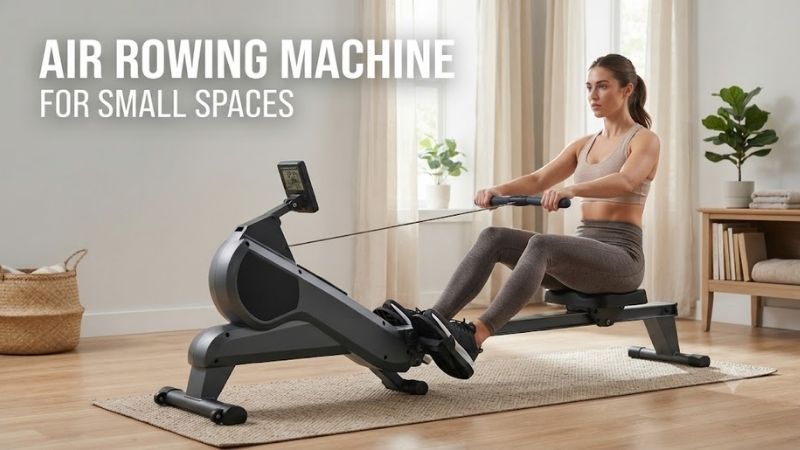
An air rowing machine for small spaces can provide responsive full-body exercise without permanently occupying a large home-gym area. However, air rowers often require a long operating footprint, and their fan mechanisms create more sound than many magnetic systems. The right compact setup should accommodate a full rowing stroke, offer practical storage, and fit safely within your room.
Quick Verdict: Are Air Rowers Suitable for Small Homes?
Yes. Air rowing machines can work in bedrooms, apartments, and shared exercise spaces when the equipment fits the available floor area and can be stored safely.
For most small-space buyers, a conventional air rower with a manufacturer-approved split-frame, folding, or other compact storage system provides a useful balance of training function and space efficiency.
The most important purchasing priorities are:
-
Full operating dimensions and safe clearance.
-
Sufficient seat travel for comfortable leg extension.
-
Manufacturer-approved storage configuration.
-
Manageable equipment weight and transport features.
-
Stable frame construction and suitable weight capacity.
-
Fan-noise tolerance in the intended room.
-
Useful performance monitoring.
-
Accessible maintenance and replacement parts.
The smallest rower is not necessarily the best choice. A slightly longer machine that accommodates your body and stores conveniently may provide better practical value.
Understanding Air Rowing Machines
How Air Resistance Works
An air rowing machine uses a flywheel or fan that rotates as the user pulls the handle.
The fan moves air through its enclosure, creating aerodynamic resistance.
As the fan accelerates, greater force is required to continue increasing its speed.
This allows the machine to respond naturally to the user’s rowing effort.
Why Air Rowers Are Popular for Training
Air resistance accommodates a range of intensities without relying on a traditional fixed-weight system.
Users can row gently for warmups or accelerate the fan aggressively during demanding intervals.
This makes air rowers attractive for general conditioning and structured indoor-rowing workouts.
Why Air Rowers Are Not Always Compact
A conventional rowing stroke requires significant seat travel.
The machine also needs room for the flywheel housing, footplates, drive mechanism, and frame supports.
These components make many air rowers longer than other home cardio machines.
Reducing the frame length excessively may restrict the user’s rowing position.
What Compact Really Means
An air rower can be compact in several ways.
It may have a shorter assembled frame, fold for storage, separate into two sections, or use a manufacturer-approved vertical storage arrangement.
These options are not identical.
Choose according to the exact space available and the machine’s intended storage method.
Quick Comparison: Small-Space Air Rower Designs
| Design | Main Advantage | Main Limitation | Best For |
|---|---|---|---|
| Split-frame air rower | Separates into sections for storage | Requires assembly and disassembly | Multipurpose rooms |
| Folding air rower | Reduces stored length | Hinges and locks need inspection | Apartments |
| Compact nonfolding air rower | Simple permanent setup | May have limited rail travel | Small dedicated gym areas |
| Approved upright-storage rower | Reduces floor footprint | Requires vertical clearance and secure storage | Narrow rooms |
| Commercial-style air rower | Developed monitoring and long rail | Often substantial in size | Performance-focused users |
| Budget residential air rower | Accessible equipment cost | Basic monitoring and construction | Recreational home workouts |
How Much Space Does an Air Rowing Machine Need?
Operating Length
Many conventional air rowers occupy approximately six to eight feet in length.
For example, the Concept2 RowErg has an operating footprint approximately 96 inches long and 24 inches wide.
This illustrates why exact dimensions matter when evaluating a small room.
A machine that appears relatively narrow may still occupy most of the available floor length.
Operating Clearance
The published footprint does not necessarily include all recommended operating clearance.
Users need room to mount and dismount and to move safely through the rowing stroke.
Follow the manufacturer’s space recommendations.
Width and Surrounding Furniture
Air rowers are often relatively narrow.
However, placing equipment tightly between furniture can make access inconvenient.
Leave enough room for safe entry, exit, and maintenance.
Storage Dimensions
Always measure the proposed stored configuration.
A folding rower may become taller when its rail is raised.
A split-frame machine creates separate pieces that each require safe storage.
Folding Versus Split-Frame Storage
Folding Air Rowers
Some residential air rowers use folding frames.
A hinge allows the machine to change shape, reducing its storage footprint.
However, the folding mechanism must be correctly secured before exercise.
Split-Frame Air Rowers
Some performance-oriented rowers separate into two sections.
The Concept2 RowErg is a well-known example.
This storage method avoids a conventional hinged folding rail, but the separated pieces still occupy space.
Users must follow the manufacturer’s assembly procedure before exercising.
Upright Storage
Some air rowers support upright storage.
However, not all machines are approved for this orientation.
Never assume a rower can be stored vertically simply because it can be balanced temporarily against a wall.
Choosing the Right Storage Method
Folding is convenient when the user wants to reduce the frame’s length quickly.
Split-frame storage may be appropriate when the machine can remain in two sections between workouts.
Upright storage can work well in rooms with adequate ceiling height.
The safest choice is the method expressly approved for the exact machine.
Rail Length and User Comfort
Why the Rail Must Accommodate Your Legs
Rowing involves bending and extending the knees as the seat travels along the rail.
A machine must allow a comfortable full stroke.
If the rail is too short, taller users may be forced to limit their leg extension.
Seat Travel Versus Machine Length
Overall length includes the fan housing and other structural components.
It does not directly indicate usable seat travel.
When possible, compare actual rail movement or manufacturer-supported inseam measurements.
Seat Height
Air rowers can have different seat-height configurations.
For example, Concept2 offers standard and taller-leg RowErg versions.
A higher seat may make mounting and dismounting easier for some users.
However, seat height should be considered together with the entire rowing position.
Footplate Adjustment
The foot straps should secure the feet without excessive pressure.
Adjustable footplates accommodate different shoe sizes and help establish comfortable positioning.
Understanding Air Resistance and Dampers
Resistance Changes With Rowing Effort
On an air rower, resistance responds to fan acceleration.
A powerful stroke can generate substantial resistance even when the damper is not set near its maximum.
What the Damper Does
On machines such as the Concept2 RowErg, the damper controls airflow into the flywheel housing.
This changes the drag characteristics.
It does not operate like a traditional weight stack.
Why Higher Damper Settings Are Not Always Better
A higher damper setting can create a heavier-feeling stroke, but it is not automatically necessary for an effective workout.
Excessive drag can make technique difficult for some users.
Choose settings according to the equipment guidance and workout goals.
Understanding Drag Factor
Some performance monitors calculate or display a drag factor.
This provides information about the resistance characteristics of the flywheel system.
It can help users establish more repeatable settings than relying solely on the damper position.
However, the specific calculation and availability depend on the machine’s monitoring system.
Air Rowing Machine Noise in Apartments
Fan Noise
Air rowers create sound as the fan moves air.
The noise generally increases with vigorous rowing.
This is a normal characteristic of the resistance mechanism.
Mechanical Noise
The chain or belt, seat rollers, and handle return system may also contribute to sound.
Wear, dirt, and incorrect assembly can increase unnecessary noise.
Floor Vibration
Repeated rowing force may transfer through the floor.
A suitable equipment mat can help protect flooring and reduce some vibration.
It cannot eliminate fan noise.
When a Magnetic Rower May Be Better
If minimal operating noise is the highest priority, a magnetic rowing machine may be more appropriate.
Air rowers offer other training advantages, but they should not be purchased with the expectation of near-silent operation.
Performance Monitoring: What Matters?
Stroke Rate
Stroke rate measures the number of complete strokes performed per minute.
It is useful for controlling cadence during workouts.
However, higher stroke rate does not automatically mean greater power.
Pace and Distance
Some air rowers calculate distance and pace based on flywheel behavior.
These values can support structured training.
However, calculations differ across manufacturers.
Power Measurement
Advanced performance monitors may estimate mechanical power.
These figures are most useful when the monitor has a consistent measurement method.
Competition-focused users should verify the equipment and monitoring system specified by their training or event format.
Concept2 PM5
The Concept2 PM5 is an established indoor-rowing monitor.
It provides workout metrics such as pace, distance, stroke rate, and calculated power.
Its broad training ecosystem is especially useful for users who want comparable results within that platform.
Basic Residential Monitors
Budget air rowers may show time, stroke count, speed, and estimated calories.
These functions can be sufficient for recreational workouts.
Do not assume their distance or calorie algorithms match premium monitors.
Frame Construction and Stability
Weight Capacity
The manufacturer’s maximum user-weight rating is an important purchasing constraint.
Stay within that limit.
A high weight capacity does not independently establish commercial-grade durability.
Frame Rigidity
The machine should remain stable throughout normal rowing.
Excessive frame movement may indicate an uneven floor, incorrect assembly, or equipment damage.
Drive Mechanism
Air rowers commonly use chains, belts, or straps.
Each has different maintenance requirements.
Follow manufacturer instructions rather than assuming one mechanism is always superior.
Seat Rollers
The seat should move smoothly along the rail.
Unusual binding or scraping may indicate debris, misalignment, or component wear.
Inspect and maintain the seat system according to the manual.
Choosing an Air Rower for Different Spaces
Bedroom
A folding or split-frame rower may be convenient when the machine cannot remain assembled permanently.
However, fan noise and access clearance should be considered.
Living Room
A machine with approved compact storage can be moved out of the way between sessions.
Protect the floor and ensure the stored equipment cannot tip.
Small Home Office
An air rower may fit in a home office if enough operating space is available.
The machine should not block doors, desks, or other frequently used furniture.
Apartment
Noise and vibration are important.
Even when the machine fits physically, fan sound may make it unsuitable for certain living arrangements.
Small Dedicated Gym
If the equipment can remain assembled, prioritize comfortable rail length and monitoring rather than the smallest possible storage footprint.
Comparing Air Rowers With Other Compact Cardio Equipment
| Equipment | Main Advantage | Main Limitation |
|---|---|---|
| Air rowing machine | Responsive resistance and full-body movement | Long operating footprint and fan noise |
| Magnetic rowing machine | Relatively quiet resistance and adjustable settings | Different resistance behavior |
| Upright exercise bike | Generally compact floor footprint | Primarily seated pedaling |
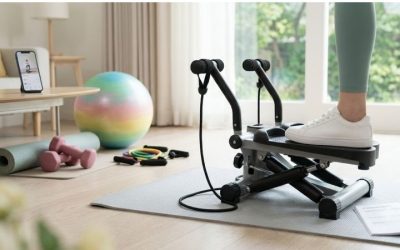
| Mini stepper | Very small floor footprint | Different movement and hydraulic limits |
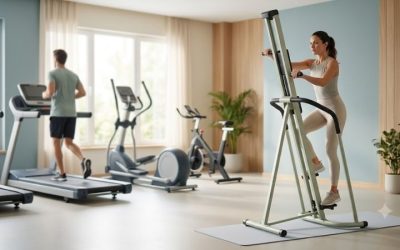
| Compact elliptical | Standing cardio movement | Stride length may be restricted |
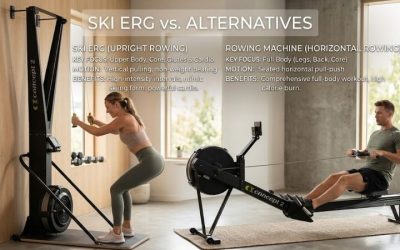
| Ski erg | Upright pulling exercise and narrow floor area | Significant height or mounting requirements |
Maintenance Considerations
Fan Cleaning
Dust and debris can accumulate around the fan enclosure.
Clean according to the manufacturer’s instructions.
Do not insert tools or fingers into moving components.
Chain or Belt Inspection
Inspect the drive system for wear.
Follow the approved lubrication and replacement procedures.
Rail Cleaning
Keep the seat rail clean and check roller operation.
Avoid applying unsuitable lubricants that may attract debris or damage components.
Monitor Maintenance
Check battery condition, charging requirements, and wireless connection functionality where relevant.
Storage Hardware
Inspect folding locks, split-frame connections, and any manufacturer-approved storage mechanisms.
Common Buying Mistakes
Selecting the Shortest Rower
A very short machine may not accommodate a comfortable full stroke.
Ignoring Fan Noise
Air rowers are not the best choice for every noise-sensitive apartment.
Assuming Folding and Splitting Are the Same
These are different storage methods with different handling requirements.
Comparing Incompatible Performance Metrics
Workout distances and power figures from different brands may not be directly comparable.
Overlooking Maintenance
Air rowers require periodic fan, drive, rail, and frame inspection.
Buying Without Measuring the Room
Measure operating dimensions, stored dimensions, and access clearance before purchasing.
Frequently Asked Questions
Can an Air Rowing Machine Fit in a Small Apartment?
Yes, if the operating footprint, storage configuration, and noise level are suitable.
Are Air Rowers Foldable?
Some are. Others separate into multiple sections or use different approved storage arrangements.
Can You Store an Air Rower Upright?
Only when the manufacturer explicitly permits that storage position.
Are Air Rowers Too Loud for Apartments?
Not necessarily, but fan noise can be disruptive. Consider the room and neighboring spaces before purchasing.
Is a Compact Air Rower Good for Tall Users?
Some are. Check usable seat travel and supported inseam measurements rather than overall machine length alone.
Is Concept2 RowErg Good for Small Spaces?
It requires a long operating footprint, but its two-section storage design can help when the exercise area must be cleared between workouts.
Conclusion
The best air rowing machine for small spaces should provide enough rail travel for a comfortable full stroke, stable construction, practical storage, and useful workout monitoring. Prioritize exact room measurements and fan-noise tolerance before choosing between folding, split-frame, or permanent setups.





Write Your Review
No reviews yet. Be the first to share your experience!