
Key takeaways
-
Comfortable full-stroke rowing geometry.
-
A manufacturer-approved compact storage method.
-
Safe and stable upright positioning when permitted.
-
A suitable user-weight and inseam range.
-
Reliable tank construction and clear maintenance instructions.
-
A manageable water-filling and moving procedure.
-
Basic workout monitoring without unnecessary equipment bulk.
A water rowing machine for small spaces can provide fluid resistance and a traditional rowing experience without requiring a dedicated exercise room. However, water rowers are often longer than their compact appearance suggests, and storage depends on tank positioning, frame design, and manufacturer instructions. This guide explains how to choose a model that fits your room while preserving comfortable rowing geometry.
Quick Verdict: Can a Water Rower Work in a Small Room?
Yes. A water rowing machine can work well in a bedroom, apartment, or multipurpose home office when the room accommodates the full operating footprint and provides a safe storage location.
For most small-space buyers, the most useful features are an approved upright-storage design, adequate seat travel, manageable equipment weight, and a tank that is easy to maintain.
The ideal machine should provide:
-
Comfortable full-stroke rowing geometry.
-
A manufacturer-approved compact storage method.
-
Safe and stable upright positioning when permitted.
-
A suitable user-weight and inseam range.
-
Reliable tank construction and clear maintenance instructions.
-
A manageable water-filling and moving procedure.
-
Basic workout monitoring without unnecessary equipment bulk.
The most important consideration is that a water rower must be comfortable at its full operating length, even if it occupies very little space when stored vertically.
Understanding Compact Water Rowing Machines
How Water Resistance Works
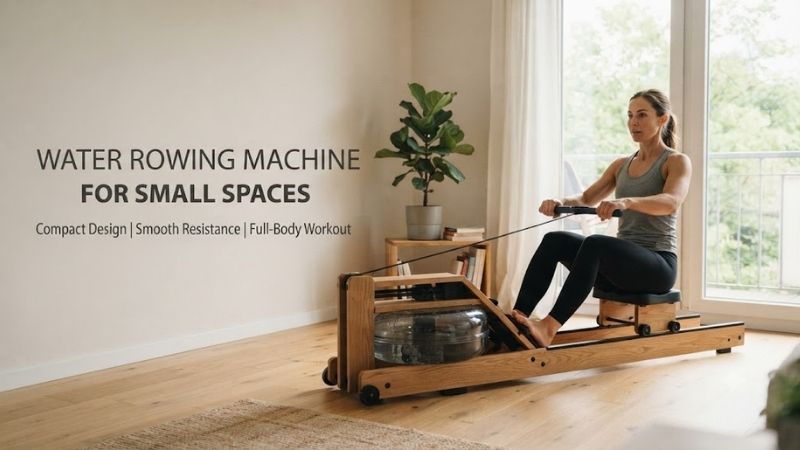
Water rowers use an impeller rotating inside a tank.
When the user pulls the handle, the drive mechanism turns the impeller through water, creating fluid resistance.
As the user applies greater effort and accelerates the mechanism, the resistance responds.
This differs from a conventional magnetic rower with a manually selected resistance setting.
Water quantity can influence the resistance characteristics, but the adjustment method depends on the exact machine.
Why Water Rowers Are Often Long
A conventional rowing stroke requires the seat to travel backward as the legs extend.
The rower also needs space for the tank, footplates, handle, frame stabilizers, and drive components.
These elements create an elongated machine even when the footprint is narrow.
Shortening the frame excessively can reduce seat travel and make the equipment unsuitable for taller users.
Why Upright Storage Is Popular
Some water rowers can be placed vertically when not in use.
This changes the equipment from a long horizontal platform into a tall stored structure occupying relatively little floor area.
For apartment residents, this can be more practical than leaving the machine fully extended.
However, upright storage must be explicitly approved by the manufacturer.
Water-tank stability, machine balance, ceiling clearance, and access by children or pets must all be considered.
Quick Comparison: Compact Water Rower Designs
| Design | Main Advantage | Main Limitation | Best For |
|---|---|---|---|
| Wooden water rower with upright storage | Traditional appearance and small stored footprint | Long operating length | Living rooms and bedrooms |
| Metal-frame upright-storage water rower | Conventional fitness-equipment construction | May be heavy when filled | Dedicated gym corners |
| Folding water rower | Changes frame geometry for storage | More moving frame connections | Multipurpose rooms |
| Short-frame water rower | Smaller operating length | Potentially reduced seat travel | Buyers with shorter inseams |
| Connected water rower | Guided workouts and tracking | Additional screen, power, and cost | Structured exercise enthusiasts |
| Basic water rower | Simple monitoring and controls | Limited connected functionality | Independent home workouts |
How Much Space Does a Water Rowing Machine Need?
Operating Length
Many conventional water rowing machines occupy approximately six to seven feet or more in length.
Some premium models exceed seven feet.
These figures are broad planning references, not substitutes for exact manufacturer dimensions.
The length of the machine should be evaluated alongside the available space for mounting, dismounting, and moving safely.
Operating Width
Water rowers are frequently much narrower than they are long.
Nevertheless, buyers should leave space beside the machine for entering and exiting the seat.
A narrow rower positioned tightly between furniture may be inconvenient even if the frame technically fits.
Ceiling Clearance
Ceiling height matters particularly when the machine is stored upright.
A long water rower can become a tall stored object.
Measure the full vertical storage height and follow any additional clearance instructions.
Avoid storing equipment where it could contact light fixtures or ceiling fans.
Clearance Around the Tank
Some water-rowing machines have their tank positioned at the front of the frame.
Others use different tank and drive arrangements.
Allow enough access for water filling, treatment, and inspection.
A machine wedged tightly against furniture may be difficult to maintain.
Choosing the Right Storage Design
Upright Storage
Approved upright storage is one of the most practical features for a small-space water rower.
The machine can be placed vertically between workouts, freeing up the floor area used during exercise.
However, the procedure varies by manufacturer.
Some models are designed to remain stable in the approved upright position, while others may have additional securing requirements.
Never assume a water rower can be stood upright simply because the frame shape makes it physically possible.
Folding Water Rowers
Some models use a folding rail or frame.
A folding arrangement can reduce stored height or length depending on its design.
However, folding introduces hinges and locks that must remain secure during rowing.
Check the manufacturer’s instructions for storage, moving, and unfolding.
Freestanding Storage
Some water rowers remain fully assembled horizontally between workouts.
This requires more permanent floor space but avoids repeated lifting or folding.
For a small dedicated exercise room, this may be more convenient than moving the machine after every session.
Wall-Adjacent Storage
A vertical rower may fit beside a wall or in a corner.
However, do not assume that wall placement alone makes the equipment secure.
Follow the manufacturer’s storage guidance and any required attachment or stabilization procedures.
Rail Length and User Fit
Why a Full Stroke Matters
At the catch, the knees bend while the arms reach forward.
During the drive, the legs extend and the seat travels backward.
A machine needs sufficient seat travel for this movement to occur comfortably.
If the rail is too short, the user may have to shorten the stroke.
Check Inseam Recommendations
Manufacturers may specify a supported maximum inseam.
For example, some connected water rowers provide model-specific limits around the upper 30-inch range or greater.
Those limits should be checked for the exact configuration.
The same brand may sell machines with different rail lengths and supported user dimensions.
Seat Height
Water rowers often have relatively low seats.
This can be inconvenient for users who struggle with sitting close to the floor.
A taller seat may improve accessibility for some users, but body fit and frame stability remain essential.
Footplate Design
Foot straps should secure the feet without creating excessive pressure.
The footplate position must also allow comfortable ankle and knee movement through the stroke.
Buyers should not focus exclusively on frame dimensions while ignoring foot support.
Water Tank Design and Maintenance
Tank Materials
Water tanks are commonly manufactured from transparent or translucent durable materials.
The tank should be designed to withstand normal operating conditions.
Inspect the manufacturer’s warranty and replacement procedures.
Water Filling
Every machine has a permitted filling range.
Do not overfill the tank in an attempt to create unlimited resistance.
Overfilling can violate operating instructions and may increase the risk of leaks or damage.
Water Treatment
Manufacturers often specify purification or treatment procedures to maintain water quality.
Follow the exact product instructions.
Do not introduce household chemicals without manufacturer approval.
Leak Inspection
Check visible tank connections and surrounding surfaces periodically.
If water appears around the tank or its fittings, stop using the machine until the issue is properly addressed.
Moving a Water-Filled Rower
Water adds weight to the equipment.
A machine that is manageable when empty may become substantially heavier after filling.
Follow the manufacturer’s specific moving and storage procedures.
Do not assume that draining is always required or always unnecessary.
Wooden Versus Metal Water Rowers
Wooden Frames
Wooden water rowers often appeal to buyers who want exercise equipment that blends into a living room.
Oak, cherry, and other hardwood designs may provide a furniture-like appearance.
However, wood requires appropriate environmental conditions and care.
Do not expose the frame to excessive moisture or conditions prohibited by the manufacturer.
Metal Frames
Metal-framed water rowers have a more conventional fitness-equipment appearance.
They may use steel or aluminum components.
Their practical advantages depend on the actual design, construction, and rated capacity rather than material alone.
Which Is Better for Small Spaces?
Neither material is inherently more space-efficient.
Operating dimensions, storage methods, seat travel, and equipment weight matter more than frame appearance.
Choose the material according to your room, maintenance preferences, and desired construction.
Noise Considerations in Apartments
Water Movement
The rotating impeller produces an audible water sound.
Some users find this pleasant, but it is not silent.
The sound changes with rowing intensity.
Mechanical Noise
Seat rollers, belts, handle mechanisms, and frame connections can also create noise.
Good maintenance and correct assembly help avoid unnecessary rattling or scraping.
Floor Vibration
Repeated rowing movements may transmit vibration through the floor.
A suitable exercise mat may help reduce some vibration.
However, it will not eliminate the sound of water movement or guarantee inaudible exercise.
Basic Versus Connected Water Rowers
Traditional Workout Monitors
A basic water rower may display elapsed time, stroke rate, distance estimates, and other training information.
For independent exercise, these functions may be sufficient.
Connected Workout Platforms
Premium models can integrate touchscreens, guided sessions, and interactive workouts.
This may improve engagement for users who enjoy structured exercise.
However, the equipment may require external power and ongoing membership payments.
App Compatibility
Some simpler water rowers connect to compatible smartphone applications.
Before buying, verify which functions are supported.
Basic activity tracking should not be confused with automatic resistance adjustment.
Matching a Water Rower to Your Room
| Room Situation | Priority Features | Main Concern |
|---|---|---|
| Small bedroom | Approved upright storage, quiet placement | Storage height |
| Home office | Convenient repositioning, manageable footprint | Desk and chair clearance |
| Living room | Attractive frame, compact storage | Appearance and safe positioning |
| Apartment | Stable floor contact, approved storage | Noise and vibration |
| Small dedicated gym | Adequate full-length rowing space | Comfortable seat travel |
| Shared household | Broad user fit and rated capacity | Repeated adjustment and moving |
Common Buying Mistakes
Assuming All Water Rowers Store Vertically
Some do, but others require different storage procedures.
Verify manufacturer approval for the exact model.
Choosing a Short Rail Without Checking Fit
Compact dimensions do not compensate for restricted seat travel.
Ignoring the Weight of Water
The filled tank increases the machine’s handling weight.
This matters when moving equipment between rooms.
Overfilling the Tank
Exceeding the permitted water level is not a safe way to create extra resistance.
Treating Water Resistance as Maintenance-Free
Water tanks require appropriate inspection and treatment.
Buying a Touchscreen for a Basic Exercise Routine
Large displays can be useful but are not necessary for ordinary rowing workouts.
Frequently Asked Questions
Can You Use a Water Rowing Machine in an Apartment?
Yes, provided the operating footprint, floor stability, noise, and storage arrangements are suitable.
Can All Water Rowers Be Stored Upright?
No. Only use vertical storage when approved by the manufacturer.
Do You Need to Empty the Tank Before Storage?
Follow the exact manufacturer’s instructions. Requirements differ by model and storage method.
Are Compact Water Rowers Good for Tall Users?
Some are, but supported inseam and usable seat travel are more important than compact marketing labels.
Are Water Rowers Quieter Than Air Rowers?
Water rowers generally avoid conventional fan noise, but water movement and mechanical sounds remain audible.
Can You Fold a Water Rowing Machine?
Some models fold. Others store upright without folding. These are different mechanisms.
Conclusion
A water rowing machine for small spaces should provide sufficient seat travel, approved storage, stable construction, and a tank that is practical to maintain. Prioritize full operating dimensions and safe storage arrangements before choosing based on appearance, connected workouts, or price alone.







Write Your Review
No reviews yet. Be the first to share your experience!