
Key takeaways
What's inside
Best mini exercise bike choices are decided by one measurement almost nobody checks: the height of the unit against the clearance under your desk. Get that wrong and your knees hit the desk on every revolution, which ends the purchase within a week. Clearance decides everything here. Knees hitting the desk ends the habit.
As an Amazon Associate we earn from qualifying purchases at no extra cost to you. Product prices and availability are accurate as of the date shown and are subject to change.
As an Amazon Associate we earn from qualifying purchases at no extra cost to you. Product prices and availability are accurate as of the date shown and are subject to change.


By Chris Parker
🛒 Best Price Today on Amazon
Prime members get fast, free shipping on everything above, plus member-only deals. New members get a 30-day free trial — cancel anytime.
Start 30-Day Prime Free Trial →See Today’s Amazon DealsHow to Choose the Best Mini Exercise Bike
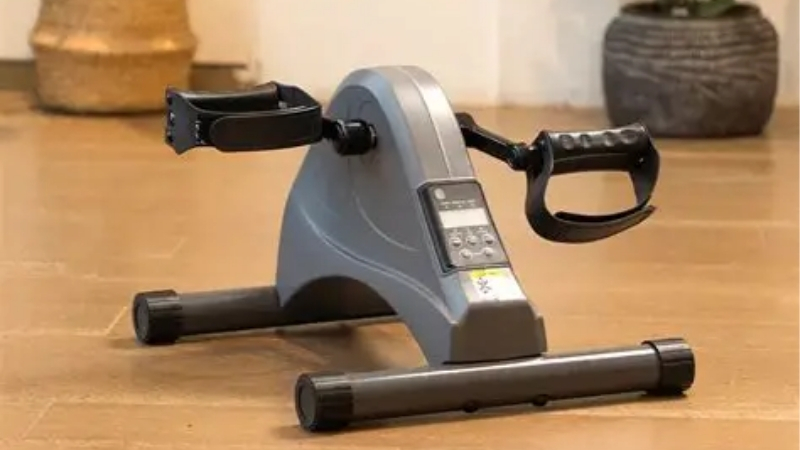
A pedal exerciser is a flywheel, a resistance dial and two pedals in a small frame. Three things decide whether it gets used: the height under your desk, whether it slides across the floor, and whether the resistance is smooth enough to pedal without thinking about it. Three things, all measurable beforehand.
Pedal Height and Desk Clearance
Measure from the floor to the underside of your desk, then subtract the unit height and the pedal arc. Low-profile units sit around 10 in (25 cm) tall, which generally works under a desk of 27 in (69 cm) or more, but taller users need more room than that. Measure with your own chair in place. Raised seats eat into the clearance.
Chair height changes the answer too. A high office chair with the seat raised eats into the clearance, while a lower chair frees it up. Check with your actual chair at your actual desk before ordering, since the numbers on the listing assume nothing about either. Seat height changes the answer completely.
Resistance Type and Smoothness
Magnetic resistance is quiet, contact-free and adjusts with a dial, which is what you want when the unit lives under a desk during calls. Friction or strap resistance is cheaper, noisier and fades as it warms, which is noticeable over a long working day. Magnetic is the requirement for calls. Friction fades as the unit warms.
Smoothness matters more than the number of levels. A unit that pulses through the stroke pulls attention away from what you are doing, which defeats the point. Look for a weighted flywheel rather than a wide resistance range, since the top settings rarely get used. Smoothness beats a wide resistance range.
Stability, Footprint and Flooring
The most common complaint about the best mini exercise bike category is the unit sliding forwards under the desk. Rubber feet help, straps around the frame help more, and a non-slip mat underneath solves it properly, particularly on hard floors or low-pile carpet. Sliding is the number one complaint here.
The footprint is small at roughly 20 x 16 in (51 x 41 cm), but the unit needs somewhere to live when it is not in use. Weight matters here: models around 20 lb (9 kg) stay put but are awkward to move daily, while lighter ones slide more. Storage between sessions needs a plan. Heavier units stay put but move badly.
Top Picks: Pedal Units for Desks and Chairs
The six below cover low-profile desk units, seated ellipticals and simple pedal exercisers. Measure your desk clearance before comparing any of them. Each entry names a genuine drawback, since every unit here trades height, weight or resistance quality against price. Measure before comparing any best mini exercise bike listing.
| Unit | Resistance | Profile | Best for |
|---|---|---|---|
| DeskCycle 2 | Magnetic | Low | Low desks |
| Cubii JR1 | Magnetic | Low, elliptical | Smooth motion |
| Sunny Under Desk | Magnetic | Standard | Budget |
| YOSUDA Under Desk | Magnetic | Standard | Value pick |
| Vaunn Pedal Exerciser | Friction | Very low | Arms and legs |
| Non-slip mat | None | Flat | Stopping slide |
DeskCycle 2
The DeskCycle is the reference low-profile unit, designed specifically to fit under lower desks where taller pedal exercisers do not. The magnetic resistance is smooth and quiet enough for calls, and the adjustable pedal height gives a little extra room for taller users. Low profile is the whole point of it.
It costs several times the basic pedal exercisers, which is a lot for what is still a small flywheel. It is also heavy to move daily. Measure your desk and chair before ordering, since even a low-profile unit does not fit every workstation. Weight makes it awkward to move daily. Low profile is what you are paying for.
Cubii JR1
A seated elliptical moves the feet forwards rather than in a circle, which lowers the knee lift and suits desks with limited clearance. The motion is smooth and quiet, and for people who found a pedal unit hit the desk, this shape is often the answer. The stroke feels unusual for a week or two. Low knee lift is the reason to pick it.
It is heavier and pricier than a plain pedal exerciser, and the elliptical stroke feels unusual at first. It also does not work for arms. Check the stride and unit height against your setup, since the low knee lift is the main reason to choose it. It does nothing for arm work. Check the stride against your desk.
Sunny Under Desk Bike
Sunny’s under-desk units cover the basics with magnetic resistance and a straightforward dial at a much lower price. For someone testing whether pedalling during work will actually happen, it answers the question without committing to a premium unit on day one. Price is the argument in its favour. It is a taller unit than the low-profile ones.
The frame is taller than the low-profile options, which rules it out under lower desks, and it slides more readily on hard floors. Check the height against your clearance carefully, and plan on a non-slip mat underneath from the start. Height rules it out under lower desks. Plan on a mat from the start.
YOSUDA Under Desk Bike
YOSUDA sits in the value bracket with a heavier frame than the cheapest units, which is the single most useful feature in this category since weight is what stops a unit sliding. The magnetic resistance is smooth enough for use during calls. Extra weight is what stops it sliding. The display is basic rather than detailed.
Extra weight makes it harder to move in and out from under the desk daily, and the display is basic. Measure your desk clearance first, since this is a standard-profile unit rather than a low one and will not fit every workstation. Measure the clearance before ordering. Standard profile suits higher desks only.
Vaunn Pedal Exerciser
The simplest format is a light frame with friction resistance and no electronics beyond a basic display. It sits very low, weighs almost nothing and can be placed on a table for arm pedalling, which none of the heavier units here manage. It sits lower than anything else here. Arms as well as legs is its advantage.
Friction resistance is noisier, fades as it warms and is less pleasant than magnetic. The light frame slides unless strapped or matted. Buy it for the flexibility of using it for arms as well as legs, rather than for the pedalling experience itself. Friction resistance fades as it warms. Straps or a mat stop it sliding.
Non-Slip Mat
Sliding is the number one complaint in this category and a mat is the cheapest fix. A rubber-backed mat under the frame stops the unit creeping forwards on hard floors and low-pile carpet, and it protects the floor from the feet at the same time. It is the cheapest fix in this category. Hard floors are where it matters most.
Mats collect dust under a desk and need occasional cleaning, and a thin one will not stop a very light unit on a slick floor. Check the mat size against the unit footprint, and consider a strap around the frame if sliding continues. Dust collects under a desk quickly. Match the mat size to the footprint.
Frequently Asked Questions
These four questions cover what people ask before buying a pedal unit for a desk. They are about fit, noise and stability, since those decide whether the unit gets used during the working day or ends up pushed into a corner. Fit answers most of them. Clearance decides the best mini exercise bike choice.
Will the best mini exercise bike fit under my desk?
Measure floor to desk underside, then compare against the unit height plus the pedal arc. Low-profile units around 10 in (25 cm) tall generally suit desks of 27 in (69 cm) or more. Test with your own chair, since seat height changes the answer. Test it before the return window closes. Desk height varies more than you expect.
Is it quiet enough for calls?
Magnetic units generally are, since nothing contacts anything. Friction resistance is noticeably louder and gets louder as it warms. If you take calls at your desk, treat magnetic resistance as the requirement rather than as an upgrade worth considering. Friction gets louder as it warms up. Calls make magnetic the sensible default.
How do I stop it sliding?
A rubber-backed mat under the frame solves most cases, and a strap around the frame handles the rest. Heavier units slide less to begin with. Hard floors and low-pile carpet are where the problem shows up most, so plan for a mat on either. Straps handle the remaining movement. Heavier units slide less to begin with.
Does pedalling at a desk actually count?
It adds gentle movement to a sedentary day rather than replacing structured training. Public guidance is 150 to 300 minutes of moderate activity per week plus two muscle-strengthening days (WHO, 2020). Speak to a doctor before starting if you have knee or hip concerns. It supplements training rather than replacing it.
See More:
Final Thoughts
The best mini exercise bike is whichever one fits under your desk with your own chair, runs quietly enough for calls and stays put while you pedal. Measure the clearance first, choose magnetic resistance, and budget for a non-slip mat as part of the purchase. Then pedal without thinking about it. That is what the best mini exercise bike is for.


Write Your Review
No reviews yet. Be the first to share your experience!