
Key takeaways
What's inside
Best cheap home exercise bike choices are decided by the room long before they are decided by the ride. A machine that occupies 5 sq ft permanently, transmits vibration into a suspended floor and cannot be moved by one person is a completely different proposition in a first-floor flat than it is in a garage with a concrete slab.
As an Amazon Associate we earn from qualifying purchases at no extra cost to you. Product prices and availability are accurate as of the date shown and are subject to change.


As an Amazon Associate we earn from qualifying purchases at no extra cost to you. Product prices and availability are accurate as of the date shown and are subject to change.
By Chris Parker
🛒 Best Price Today on Amazon
Prime members get fast, free shipping on everything above, plus member-only deals. New members get a 30-day free trial — cancel anytime.
How to Choose the Best Home Exercise Bike
The best home exercise bike is the one that survives contact with your actual living space. Three constraints do the eliminating: how much floor it claims permanently, how much noise reaches the people around you, and whether the ceiling is high enough to stand up on the pedals. Ride quality comes fourth.
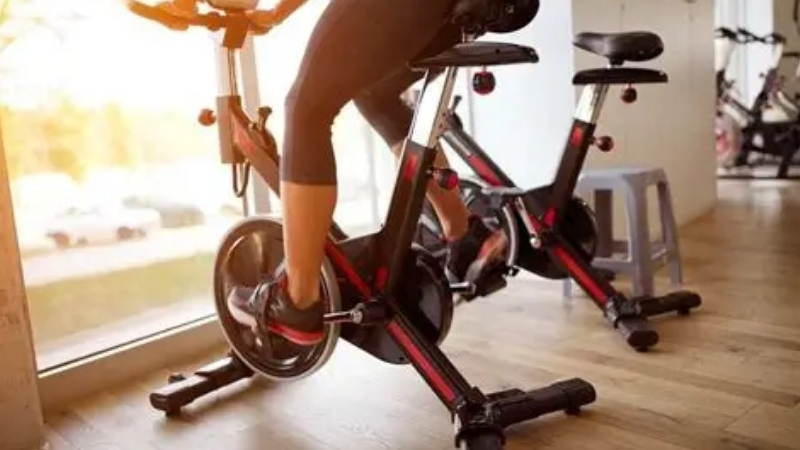
Footprint, Folded Size and Ceiling Clearance
Footprint on the best home exercise bike is three separate numbers. A full indoor cycle occupies roughly 40-48 in by 20-24 in (102-122 x 51-61 cm), which is 5-8 sq ft (0.5-0.7 sq m), plus clearance to get on and off. That space is claimed permanently, because these machines do not move easily.
Folding upright bikes cut the stored footprint by roughly half and can live behind a door, while under-desk pedal units need almost nothing at all. Recumbents are the opposite: longer than an indoor cycle, though lower, so they suit a room with length rather than one with a spare corner.
Ceiling height is the constraint people discover after delivery. Riding out of the saddle adds roughly 10-12 in (25-30 cm) to your standing height, so an 8 ft (244 cm) ceiling is fine for most riders and a sloped loft wall is not. Measure floor area, ceiling height and the doorway before ordering.
Noise, Vibration and the Floor Underneath
Two different kinds of noise leave the best home exercise bike, and they travel in different ways. Mechanical noise comes from the drive and the resistance system, and a belt drive with magnetic resistance is close to silent, while a felt pad develops a squeak as it wears and a chain rattles from the day it arrives.
Structural noise is the one that reaches neighbours. Pedalling transmits low-frequency vibration into a suspended timber floor far more readily than into concrete, and no amount of quiet engineering stops it. A dense rubber mat under the frame is the standard fix, and it costs a fraction of upgrading the bike.
Why Small Spaces Are Still Underserved
Almost every indoor cycle on the market is designed on the assumption of a garage, a basement or a dedicated spare room. That is where the category grew, and it is why the default machine is heavy, wide and expects to stay exactly where it was assembled for the rest of its life.
The genuinely compact end is thinner than it should be. Folding uprights exist in reasonable numbers but almost all of them carry light flywheels and frames that cannot handle standing efforts, so the choice for a small flat is currently between a good ride that never moves and a modest ride that stores away.
Until that gap closes, the honest approach is to decide which compromise you would rather live with. If a corner can be permanently surrendered, buy the better machine. If it cannot, buy the folding one and accept that seated steady riding is what it does well, rather than expecting interval training from it.
Top Picks: 6 Home Exercise Bikes by Space and Noise
These six are ordered from smallest footprint to largest, because in a home setting that is usually the binding constraint. The best home exercise bike here depends on whether the machine can stay out permanently, so the table lists both the working footprint and what happens when you are not using it.
| Bike | Type | Stored Footprint | Noise Level | Out of Saddle |
|---|---|---|---|---|
| DeskCycle Under Desk Bike | Pedal exerciser | Fits under a desk | Near silent | Not possible |
| Exerpeutic Folding Upright | Folding upright | Folds to roughly half | Very quiet | Not advised |
| Marcy Recumbent ME-709 | Recumbent | Long, low, permanent | Very quiet | Not possible |
| Joroto X2 | Indoor cycle | Permanent | Very quiet | Limited |
| Sunny Health SF-B1805 | Indoor cycle | Permanent | Quiet | Some frame flex |
| Schwinn IC4 | Indoor cycle | Permanent, heavy | Quiet | Stable |
DeskCycle Under Desk Bike Pedal Exerciser
The smallest footprint of anything that counts as an exercise bike. It slides under a desk or a table, weighs little enough to move with one hand, and produces almost no noise, which makes it the only option here that works in a studio flat with no spare floor area to give up at all. It also costs the least.
It is a pedal unit rather than a bike, so there is no seat, no riding position and no possibility of standing efforts, and the achievable intensity is low. Treat it as a way to accumulate easy movement during the day rather than as training equipment, and set expectations accordingly.
Exerpeutic Folding Magnetic Upright Bike
The best compromise for a small flat that still wants a proper riding position. Eight magnetic resistance levels keep it silent, the 300 lb (136 kg) capacity is generous for the price, and the frame folds to roughly half its working size so it can live behind a door between sessions.
The flywheel is light, so the pedal stroke is not smooth under heavy resistance, and the folding frame is not built for standing on the pedals. Folding joints also develop play over several years of repeated use. This is a bike for steady seated cardio, and it does that job quietly.
Marcy Recumbent Exercise Bike ME-709
A recumbent trades height for length, which suits rooms with a spare wall rather than a spare corner. The supported seat and backrest make long steady sessions considerably more comfortable, and eight magnetic levels with a 300 lb (136 kg) capacity keep the mechanics simple and completely silent.
It cannot be folded, so the floor it occupies is permanently gone, and the low intensity ceiling means interval work is not realistic. Standing on the pedals is impossible by design. If back or joint discomfort is the reason you are considering it, speak to a doctor or physiotherapist first.
Joroto X2
Magnetic resistance and a belt drive make this one of the quietest indoor cycles available at a sensible price, which matters more in a flat than almost any performance figure. Nothing touches the flywheel, so the noise level does not deteriorate over the years the way a friction pad bike does.
It claims a permanent footprint of the usual indoor cycle size and is heavy enough that repositioning it is a two-person job. The flywheel around 35 lb (16 kg) is lighter than ideal for slow climbing efforts, and out-of-saddle riding produces more frame movement than on a heavier machine.
Sunny Health and Fitness SF-B1805
A 40 lb (18 kg) flywheel with magnetic resistance and a belt drive, which is the combination that keeps an indoor cycle quiet in a shared building. The heavier flywheel smooths the pedal stroke noticeably compared with lighter magnetic bikes, and there is no consumable pad to start squeaking after a year.
Resistance steps are coarse rather than micro-adjustable, the console is basic, and the frame flexes when you stand and push hard. It occupies its floor space permanently. On a suspended upstairs floor, a dense rubber mat underneath is close to essential rather than optional.
Schwinn IC4
The most stable machine here and the only one that genuinely tolerates standing efforts without complaint, thanks to a heavier frame and a 330 lb (150 kg) capacity. Magnetic micro-adjustment plus Bluetooth broadcast means it pairs with third-party apps without committing you to a closed ecosystem or a monthly fee.
Stability comes from mass, so this is the hardest bike here to move and the least appropriate for a room that has other jobs to do. It needs a real footprint and a floor that can take the load. On a timber upper floor, put a dense rubber mat under it before the first ride rather than afterwards.
Frequently Asked Questions
Practical questions about the best home exercise bike are nearly always about the building rather than the machine. These four cover the space required, what neighbours actually hear, whether flooring protection is necessary and how much ceiling height standing efforts really need.
How much space does an exercise bike need?
An indoor cycle occupies roughly 40-48 in by 20-24 in (102-122 x 51-61 cm), so 5-8 sq ft (0.5-0.7 sq m), plus about 2 ft (60 cm) at one side to mount and dismount comfortably. Folding uprights halve the stored figure. Measure the clear floor area rather than estimating it from memory.
Will my neighbours downstairs hear it?
On a suspended timber floor, probably. The mechanical noise from a magnetic belt-drive bike is minimal, but the low-frequency vibration from pedalling passes into the structure regardless of how quiet the machine is. A dense rubber mat under the frame reduces it substantially and costs far less than a quieter bike.
Do I need a mat under the bike?
On carpet, timber or vinyl, yes. It stops the feet marking or indenting the floor, catches sweat before it reaches the surface underneath, and dampens vibration into the structure. On a concrete slab it is optional, though it still protects the finish and makes the bike easier to keep clean.
What ceiling height do I need to stand on the pedals?
Add roughly 10-12 in (25-30 cm) to your standing height to find the minimum. Most riders are comfortable under a standard 8 ft (244 cm) ceiling, but sloped loft walls and basement pipework frequently are not. If you never ride out of the saddle, the seated height is the only figure that matters.
See More:
- Best home pull-up bar
- Best at home pull up bar
- Best in house pull up bar
- Best rated ab roller
- Best yoga travel mat
Final Thoughts
The best home exercise bike is chosen on footprint and noise before ride quality. If a corner can be surrendered permanently, a magnetic belt-drive indoor cycle is the better machine. If not, a folding upright stores away quietly. Measure the floor, ceiling and doorway first.


Write Your Review
No reviews yet. Be the first to share your experience!