
Key takeaways
What's inside
Best home pull-up bar shopping comes down to two numbers most listings bury: how far the bar projects from the wall or doorframe, and how much weight the mount is actually rated to hold. This guide compares six Amazon options by footprint, mounting method, grip layout and the honest limitations each one carries.
As an Amazon Associate we earn from qualifying purchases at no extra cost to you. Product prices and availability are accurate as of the date shown and are subject to change.


As an Amazon Associate we earn from qualifying purchases at no extra cost to you. Product prices and availability are accurate as of the date shown and are subject to change.
By Chris Parker
🛒 Best Price Today on Amazon
Prime members get fast, free shipping on everything above, plus member-only deals. New members get a 30-day free trial — cancel anytime.
How to Choose the Best Home Pull-Up Bar
Choosing the best home pull-up bar is less about brand names than about matching the mount to your building. A renter with soft painted trim and a strict lease has a completely different shortlist from a homeowner with exposed studs in a garage. Work through the four filters below in order.
Mounting Method and Load Rating
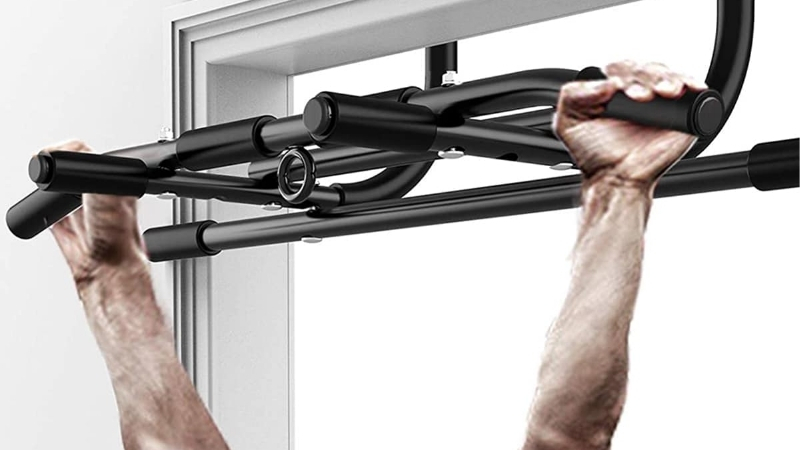
There are four mounting families: leverage doorway bars that hook over the trim, telescoping bars that wedge inside the frame, wall or ceiling bars bolted into studs and joists, and freestanding power towers. Each family trades installation effort against how much load and movement it will tolerate over time.
Leverage bars install in under a minute and leave no holes, which is why they dominate rental listings. Bolted bars need a stud finder, a drill and lag bolts, but they are the only style that reliably handles heavier lifters, weighted vests or slow controlled negatives without shifting under load.
Footprint, Clearance and Ceiling Height
Footprint is the number that eliminates most candidates for the best home pull-up bar. A leverage doorway bar adds nothing to your floor plan but steals 8-10 in (20-25 cm) of headroom under the frame. A power tower, by contrast, occupies roughly 42 x 27 in (107 x 69 cm) of floor permanently.
Standard interior doorframes top out near 80 in (203 cm), so a doorway bar puts your hands at roughly 78-84 in (198-213 cm). Anyone over about 6 ft (183 cm) will need to bend the knees. Measure the real dimensions of the doorway, wall or floor area you plan to use before you order anything.
Almost every doorway model sold as the best home pull-up bar lists 300 lb (136 kg) as its ceiling. That figure assumes a static hang rather than a kip or a drop, and it includes any weighted vest or dip belt you add. Bolted wall units are commonly listed at 500 lb (227 kg) or more.
Price Tiers and What Gets Cut at the Bottom
The market for the best home pull-up bar splits cleanly into three tiers, and the middle is where the choice is widest. Budget doorway hooks cluster at the bottom, sturdier multi-grip frames and bolted steel sit in the middle, and freestanding towers with dip stations and knee-raise pads sit at the top.
Below the mid tier you start trading materials rather than features. Thinner tube walls, painted rather than powder-coated finishes, plastic end caps carrying load, and foam that compresses within a season are the usual cuts. None of that is dangerous for a lighter user, but it does shorten the working life.
The gap the market has not closed is compact hardware. Most manufacturers still design for garages with open wall space, so genuinely small, removable options for flats and shared houses remain thin on the ground. Worth knowing before you assume the highest-rated listing suits a narrow hallway or a spare bedroom.
Top Picks: 6 Pull-Up Bars for Doorways, Walls and Floors
Our best home pull-up bar shortlist covers every mounting method, from no-tools doorway hooks through bolted steel to a freestanding tower. Stock and pricing at the budget end move constantly, so treat the tiers as guidance rather than fixed figures, and check current listing dimensions against your own measurements.
| Model | Mount Type | Fits / Footprint | Listed Limit | Best For |
|---|---|---|---|---|
| Iron Gym Total Upper Body | Leverage doorway | Frames 24.5-32 in (62-81 cm) | 300 lb (136 kg) | First bar, renters |
| Perfect Fitness Multi-Gym | Leverage doorway | Frames 24-32 in (61-81 cm) | 300 lb (136 kg) | Grip comfort |
| Garren Fitness Maximiza | Telescoping in-frame | Frames 26-36 in (66-91 cm) | 300 lb (136 kg) | Trim-free doorways |
| Ultimate Body Press Doorway | Leverage, raised | Approx. 12 in (30 cm) drop | 300 lb (136 kg) | Taller lifters |
| Titan Fitness Wall Mounted | Stud-bolted wall | Projects approx. 21.5 in (55 cm) | 500 lb (227 kg) | Garages, weighted work |
| Sportsroyals Power Tower | Freestanding | Approx. 42 x 27 in (107 x 69 cm) | 330 lb (150 kg) | No drilling allowed |
Iron Gym Total Upper Body Workout Bar
The Iron Gym is the default first bar for a reason. It hooks over the door trim in about thirty seconds, comes off just as fast, and is listed at 300 lb (136 kg). Three grip positions cover wide, narrow and neutral, and the frame doubles as a push-up and dip stand once it is off the frame and on the floor.
It needs a trim strip roughly 3.5 in (9 cm) wide to bear against, so modern flush frames are a problem. The foam sleeves compress within months and the bracket can mark painted trim. Do not kip, swing or drop off it, because this design assumes slow, controlled vertical loading only. Padding the brackets with felt helps.
Perfect Fitness Multi-Gym Doorway Pull Up Bar
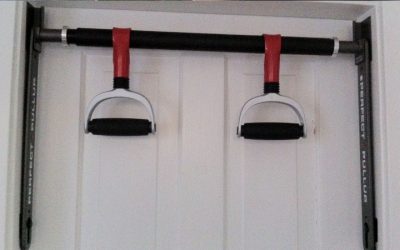
Perfect Fitness took the same leverage concept and spent the money on the contact points. The grips are contoured foam that fill the palm better than plain tubing, and the door-side pads spread pressure across a wider area, which reduces the dented-trim problem that affects cheaper hooks over time.
It carries the same 300 lb (136 kg) rating and the same 24-32 in (61-81 cm) doorframe constraint. Grip width is fixed and slightly narrower than some users want for wide pull-ups, and like every leverage design it is not rated for kipping, muscle-ups or any swinging movement under load.
Garren Fitness Maximiza Pull Up Bar
If your doorframe has no usable trim, a telescoping in-frame bar solves the problem leverage designs cannot. The Maximiza sits on two brackets screwed into the frame, then telescopes to fit openings from roughly 26-36 in (66-91 cm) and lifts straight out when you want the doorway clear again.
You do have to drill four small pilot holes, which rules it out under some tenancy agreements. It also sits high in the frame, so headroom is tight for taller users, and the bar removes rather than folds, meaning you need somewhere to store it. Listed at around 300 lb (136 kg), the doorway-bar standard.
Ultimate Body Press Doorway Pull Up Bar
The distinguishing feature here is clearance. The bar hangs roughly 12 in (30 cm) below the top of the frame, which is what taller lifters need to reach a full dead hang without folding their knees on every rep. Two mounting bars spread load across the frame rather than one narrow strip.
That extra drop eats more headroom than a flush design, so a low ceiling or a short doorway makes it awkward. Assembly takes longer than a one-piece hook, and the long straight bar section offers fewer hand positions than a multi-grip frame at broadly similar money. Check your ceiling height before choosing it.
Titan Fitness Wall Mounted Pull Up Bar
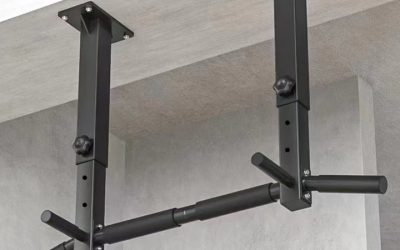
Once you are willing to drill, the equation changes completely. Bolted into studs, this bar is listed at 500 lb (227 kg) and projects about 21.5 in (55 cm) from the wall, which is enough room for chest-to-bar work and a weighted vest without your knees hitting the drywall. That clearance also suits hanging knee raises.
It is permanent, needs a stud finder and lag bolts, and puts real shear load into your framing, so an interior partition wall is not always suitable. Grip options are limited compared with a doorway frame, and the mounting height you pick is fixed the moment the holes go in. Simulate it with a broom handle first.
Sportsroyals Power Tower Dip Station
A power tower is the answer when drilling is off the table and you have floor space to spare. This one adjusts through several height settings to roughly 91 in (231 cm), adds dip handles and a knee-raise back pad, and is generally listed around 330 lb (150 kg) total capacity. Assembly takes about an hour.
The footprint is the price you pay: roughly 42 x 27 in (107 x 69 cm) of permanently occupied floor, and it is heavy enough that repositioning it alone is awkward. Lighter towers can rock during explosive reps, so keep movements controlled and re-check the bolts after the first week.
Frequently Asked Questions
A few questions come up repeatedly when readers are choosing the best home pull-up bar, and most of them are about the building rather than the hardware. Damage, load ratings, noise and ceiling height decide more purchases than grip design ever does, so here are the short, practical answers to each.
Will a doorway pull-up bar damage my door frame?
It can. Leverage bars concentrate load onto a narrow strip of trim, and soft pine or freshly painted moulding will dent or mark over time. A strip of felt or a folded towel under the contact pads spreads the pressure. If your trim is decorative or your lease is strict, choose a telescoping or freestanding option instead.
How much weight capacity do I actually need?
Add your bodyweight to anything hanging off you. A 200 lb (91 kg) lifter in a 30 lb (14 kg) vest is already at 230 lb (104 kg) before any dynamic force is generated. The 300 lb (136 kg) doorway standard leaves reasonable margin for controlled reps but very little for swinging, so bolted mounts are safer once load is added.
Can I train on a pull-up bar in an apartment?
Pull-ups themselves are quiet. The noise comes from the bar shifting on the frame and from feet landing on a hard floor. Step down rather than dropping, put a mat under the doorway, and skip kipping entirely. A leverage bar in a flat is usually fine at reasonable hours; a power tower on a suspended floor transmits more through the structure.
What ceiling height do I need for a wall-mounted bar?
Leave at least 6 in (15 cm) between the top of your head at lockout and the ceiling. For most people that means mounting around 84-90 in (213-229 cm) under a ceiling of about 8 ft (244 cm). Anything lower and you end up pulling with your head tilted forward, which is exactly where form starts to break down.
See More:
Final Thoughts
The best home pull-up bar is the one that matches your walls, your headroom and your tolerance for drilling, not the one with the highest star count. Renters are best served by a leverage or telescoping doorway bar, homeowners by a bolted mount, and anyone avoiding holes by a freestanding tower. Measure before you order.






Write Your Review
No reviews yet. Be the first to share your experience!