
Our Top Picks
 MARFULA Adjustable Balance Beam 8 ft Gymnastic BeamHeight: 9 inch - 17 inch96 x 4 x 17 inches33.1 PoundsCheck on Amazon
The best balance beams depend on who will use them and where: choose a low, wide 8-foot beam for children and beginners, a folding 6-foot beam for limited space, or a full-height competition-style beam only when advanced training and a properly padded room justify the footprint.
Quick comparison: which balance beam fits your training?
| Beam type | Typical height | Top width | Common length | Approx. floor area | Best for |
|---|---|---|---|---|---|
| Low foam beam | 2–4 inches | 4–6 inches | 4–8 feet | 6 x 3 feet | Young children, first balance drills, apartments |
| Folding home beam | 6–12 inches | 4–6 inches | 6–8 feet | 10 x 6 feet | Home practice, intermediate skills, storage-conscious buyers |
| Adjustable training beam | 8–24 inches | 4–6 inches | 6–12 feet | 16 x 8 feet | Families sharing a beam, progressing gymnasts |
| Competition-style beam | 48 inches | 4 inches | 16 feet | 24 x 12 feet or more | Advanced routines in a dedicated training area |
The floor-area figures include a practical landing and walking margin rather than only the beam’s physical dimensions. A 6-foot beam may technically fit in a 6-foot room, but it will not leave useful space for mounting, dismounting, or recovering from a step.
MARFULA Adjustable Balance Beam 8 ft Gymnastic Beam adjustable height for Kids and Teenage of all gymnastic levels, Gymnastic Training Beam Gymnastic Equipment for athlete Home and Gym Club Use
Picked as a relevant option in this category.
View on Amazon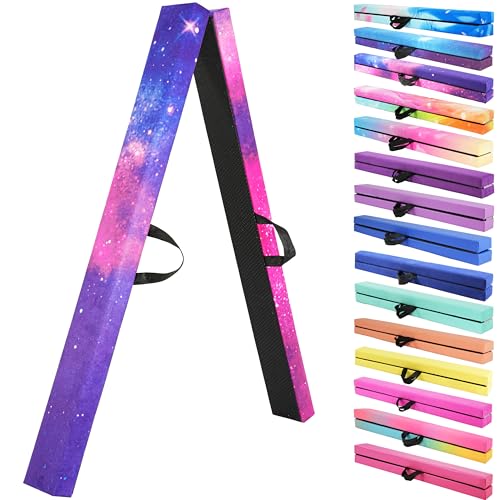
FC FUNCHEER 8FT Folding Balance Beam -Gymnastics Floor Beam - Gymnastics Equipment- Anti-Slip Bottom - Suede Cover - Carry Bag for Kids/Adults Home & Gym Center
Chosen because it specifies Gymnastics Equipment- Anti-Slip Bottom and Suede Cover.
View on Amazon
EL&IT·Wings 6ft Gymnastic Balance Beam,Adjustable High and Low Level Floor Beam - Highly Stable - Gym Practice Training Equipment for Kids Children Girls Home (Starry)
Chosen because it specifies Adjustable High and Low Level Floor Beam and Highly Stable.
View on AmazonBeam height: the most important safety and skill decision
Low beams sit directly on the floor or on short feet. They are the most forgiving option for children, beginners, and drills such as straight-arm walks, passé holds, scale positions, and turns. A fall usually involves a short step down rather than a drop, so users can concentrate on body position.
Raised beams create a more realistic gymnastics experience, but height should follow skill and supervision—not ambition. A beam 6 to 12 inches high is often a useful middle ground for home training. Adjustable models are valuable when several people train because a child can begin low while an experienced user practices at a higher setting.
A 48-inch competition-height beam requires more than an appropriate skill level. It needs substantial side clearance, a properly level floor, landing mats, and a room tall enough for the gymnast’s hands and feet during dismounts. For most homes, a low or moderately raised beam offers more usable practice and fewer storage problems.
Width and surface: narrow is not automatically better
Competition beams have a 4-inch top surface, but many home beams use a 4- to 6-inch top. That extra inch or two makes a noticeable difference during early balance work, especially for younger children or users returning after a long break.
Look at the complete cross-section, not just the top measurement. A beam with a firm wooden or composite core and a thin, resilient covering gives clearer foot feedback. A fully soft foam beam is more comfortable for kneeling and floor drills, but it may compress beneath an adult’s weight and feel less precise for turns.
Suede-like coverings provide grip without feeling sticky. Vinyl is easier to wipe clean and can be practical for shared family use, although it may feel less like a competition surface. Avoid coverings with loose seams, exposed staples, or wrinkles: these can catch toes and tend to be the first parts to deteriorate.
Length: choose usable repetitions, not the biggest number
A 4-foot beam is compact, but it limits a routine to a few steps. It works well for static balances, preschool movement, and small rooms. A 6-foot beam supports walks, half turns, jumps, and short combinations while remaining manageable to store.
An 8-foot beam is a strong all-purpose choice for children and many adults. It allows more repetitions before stepping off and gives a gymnast enough runway for linked skills. Twelve- and 16-foot beams are more suitable for dedicated spaces because they consume room even when not in use.
For adults, length matters more than it does for small children. A tall user may need several steps to establish rhythm, and a short beam can make every routine end abruptly. If the room allows it, an 8-foot model is usually a better adult home-training compromise than a 4- or 6-foot beam.
Folding designs versus fixed beams
When folding beams win
Folding beams are practical when the same room is used for schoolwork, exercise, or family activities. A 6- or 8-foot beam that folds in half may reduce its storage length to roughly 3 or 4 feet. Check the folded thickness and weight as carefully as the folded length; a beam that fits under a bed is less useful if one person cannot safely carry it there.
The hinge is the key ownership point. It should close tightly, remain aligned, and have a smooth cover over the joint. The center seam should not create a raised ridge under the top padding. Folding legs should lock positively, and the beam should not twist when a user walks across the fold.
When fixed beams win
A fixed beam is usually more rigid and can provide a more consistent feel from end to end. It is preferable for frequent practice, repeated jumps, and adults who place more load on the structure. The trade-off is storage: an 8-foot fixed beam may need a wall rack, ceiling hooks, or a permanent training area.
Do not assume every folding beam is less stable. A well-built model with wide feet and reliable locking hardware can outperform a narrow fixed beam with undersized supports. Stability depends on the base design, floor contact, weight distribution, and whether the beam rocks under diagonal pressure.
Base stability and padding checklist
- Wide feet: Feet should extend far enough sideways to resist tipping when the user lands off-center.
- Non-slip contact: Rubber pads or grippy feet help protect hard flooring and reduce sliding. Inspect them for flattening and dust buildup.
- Level adjustment: Adjustable feet are helpful on uneven floors, but each adjustment point adds hardware that can loosen.
- Rigid supports: Metal or solid-wood legs should not flex noticeably during a controlled step or small jump.
- Landing padding: The beam itself is not a substitute for a landing mat. Use a suitable mat beside the beam for dismounts and accidental steps.
- Edge clearance: Leave enough room to step down without striking furniture, walls, radiators, or sharp corners.
Padding thickness is a compromise. Around 1/2 inch of firm padding can preserve a defined beam shape, while thicker foam feels softer but may create an unstable, sinking surface. For toddlers and introductory movement, comfort may matter more. For serious skill practice, a firm surface and separate landing mat usually work better than an extremely soft beam.
Decision matrix for common home situations
| Your situation | Recommended specification | Why | Typical market range |
|---|---|---|---|
| Child under about 7, beginner | Low foam, 4–6 feet, 4–6-inch top | Low consequence of stepping off and easy entry | $40–$120 |
| One intermediate child, limited room | Folding, 6 feet, 6–12 inches high | Useful skill length with manageable storage | $100–$250 |
| Adult or taller teenager | Firm 8-foot beam, 4–6-inch top, stable base | Enough length for connected drills and a consistent surface | $180–$450 |
| Several users at different levels | Adjustable height, 6–8 feet, replaceable padding | Adapts as skill and user size change | $250–$700 |
| Dedicated gymnastics room | Fixed or competition-style, 12–16 feet, 48-inch height | Supports full routines but demands mats and clearance | $600–$2,000+ |
Calculate whether the beam fits your room
Measure the beam’s length, then add at least 2 feet at each end for stepping on and off. Add 3 feet on each side as a starting point for safe movement. For example, an 8-foot beam needs approximately:
8 feet + 2 feet + 2 feet = 12 feet of length
beam width plus 6 feet of side clearance = approximately 7 feet of width
That produces a practical starting area of about 12 by 7 feet, or 84 square feet. A raised beam or one used for jumps may need more room and thicker mats. Measure with doors open and account for cabinets, low ceilings, and nearby furniture rather than relying on the room’s advertised dimensions.
Durability, cleaning, and common mistakes
The top covering, hinge, foot pads, and adjustment hardware usually show wear before the main core. Wipe vinyl after use with a damp cloth and mild soap; use the covering manufacturer’s guidance for suede-like materials and avoid soaking foam. Let the beam dry fully before folding it, since trapped moisture can encourage odors and weaken adhesives.
Check screws, hinge fasteners, leg locks, and rubber feet regularly. Stop using the beam if it rocks, the cover separates, a hinge develops play, or a leg no longer locks securely. Do not drag a heavy fixed beam across the floor, because that can loosen feet and damage the covering.
Common buying mistakes include choosing a competition-width beam for a first-time child, ignoring the folded dimensions, placing a raised beam on a slippery rug, and treating a soft beam as a landing surface. A separate mat, clear space, and adult supervision remain important, particularly for jumps, handstands, dismounts, and any skill beyond the user’s established level. For persistent pain, previous injury, or uncertainty about appropriate progression, consult a qualified gymnastics coach or healthcare professional.
Bottom line
For most families, the best balance beams are low or moderately raised models measuring 6 to 8 feet long, with a firm 4- to 6-inch top, non-slip feet, reliable padding, and a folding design that genuinely fits the storage area. Choose a low foam beam for early confidence, a stable folding beam for versatile home practice, and a competition-style beam only when you have the room, mats, supervision, and training need to use it safely.


Write Your Review
No reviews yet. Be the first to share your experience!