
An indoor cycling bike for small spaces can deliver studio-style cardio without requiring a dedicated fitness room. However, a compact footprint means little if the saddle, handlebars, or pedals do not fit your body. This guide explains how to evaluate bike geometry, resistance, noise, clearance, and storage for comfortable home workouts.
Quick Verdict: The Best Small-Space Bike Is One That Fits the Rider
For most buyers, a compact indoor cycling bike should combine a stable frame, adjustable saddle and handlebars, smooth resistance, and a footprint that leaves enough room to mount and dismount safely.
Magnetic resistance is particularly attractive in apartments because it generally avoids the contact noise associated with traditional friction-pad braking. A belt-driven drivetrain can also help limit mechanical noise, although no exercise bike should be considered completely silent.
If several people will share the bike, four-way saddle and handlebar adjustment may be worth more than a large console. For buyers who enjoy studio-style workouts, appropriate flywheel behavior, secure pedals, and an accessible emergency stopping mechanism are important.
The best purchase is not the smallest available frame. It is the smallest model that still provides comfortable cycling geometry and stable operation for the intended rider.
Why Indoor Cycling Bikes Are Popular for Small Homes
Compact Equipment Does Not Necessarily Mean Limited Exercise
Indoor cycling bikes use a stationary frame and rotating pedal mechanism, allowing the rider to exercise within a relatively small floor area. Unlike rowing machines, they do not need a long sliding rail. Unlike treadmills, they do not require a motorized running deck. Their equipment footprint can therefore be practical in bedrooms, apartments, and home offices.
That does not mean every indoor cycle is especially small. Premium connected bikes can include substantial flywheels, broad stabilizers, and large integrated displays. Their overall weight may also be considerable.
The important advantage is that the rider generally remains in one position while pedaling. With an appropriate machine, a compact home can accommodate meaningful cardio workouts without dedicating an entire room to exercise.
However, indoor cycling is not identical to relaxed upright stationary cycling. Many studio-style bikes support a forward-leaning posture and, when specifically designed for it, standing efforts. These characteristics place additional importance on frame rigidity, handlebar reach, and ceiling clearance.
How Indoor Cycles Differ From Folding Exercise Bikes
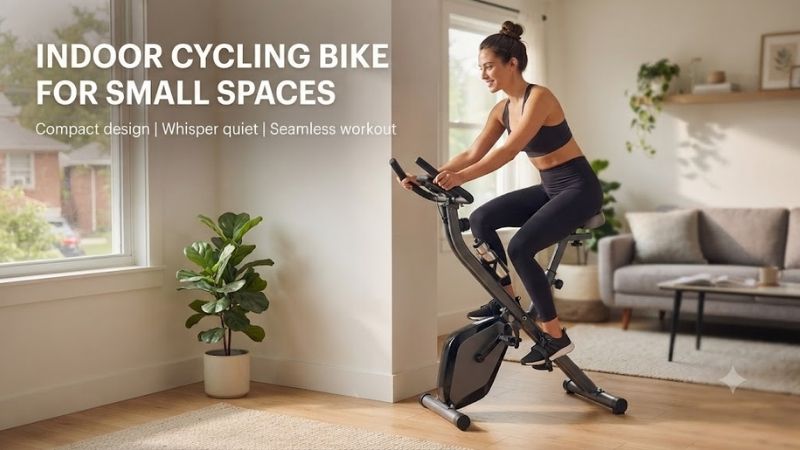
Buyers searching for compact cycling equipment often encounter folding X-frame bikes alongside conventional indoor cycles.
A folding bike can be extremely convenient when the equipment must disappear between workouts. However, many folding models use a more upright or semi-recumbent position with a different relationship between the saddle and crank.
A studio-style indoor cycle is generally designed around a more conventional cycling posture. It may provide greater adjustment flexibility and a frame intended to tolerate more vigorous pedaling.
The two categories should not be considered interchangeable merely because both have pedals and adjustable resistance.
If your priority is relaxed seated movement while watching television, a folding exercise bike may be sufficient. If your goal is instructor-led cycling classes, cadence-based training, or standing intervals, a purpose-built indoor cycle is the more relevant category.
How Much Floor Space Do You Actually Need?
Use Assembled Dimensions as the Starting Point
The machine’s assembled length and width establish its basic footprint.
For example, the Schwinn IC4 has published dimensions of approximately 54.6 inches long, 30.7 inches wide, and 51.8 inches high. Its footprint is shorter than that of most conventional rowing machines, yet it still occupies a substantial area of floor space.
Those measurements describe the bike itself. They do not necessarily include the full operating clearance needed for safe use.
A room that accommodates the frame only by placing furniture directly against both sides may not provide enough space to mount, dismount, or perform standing efforts comfortably.
Why Side Clearance Matters
Most riders mount an indoor cycling bike from the side. They need room to position themselves beside the frame, step across or onto the pedal area, and reach the saddle without colliding with furniture.
This makes side clearance important even when the central frame is relatively narrow.
If the bike is placed between a bed and a wall, consider which side will remain accessible. Also check whether the saddle-adjustment controls and water-bottle holder can be reached easily.
A machine that forces the rider into an awkward mounting position may become inconvenient for daily use.
How to Plan Around Furniture
Start by measuring the available floor rectangle. Then mark the footprint with removable tape.
Stand beside the marked area and imagine mounting the bike. Check whether nearby drawers, doors, desks, or cabinets remain usable.
If the bike will face a television, consider whether the handlebars and display place the screen at a comfortable viewing angle. A machine positioned sideways merely to fit the room may create an inconvenient exercise experience.
Finally, leave enough room for basic maintenance. Pedal access, leveling feet, and frame connections should not be permanently blocked by furniture.
Ceiling Clearance: The Detail Buyers Often Miss
Standing Workouts Change Height Requirements
An indoor cycling bike may appear short enough to fit beneath almost any residential ceiling. However, the bike’s equipment height is not the same as the height required during exercise.
When a rider stands out of the saddle, the head moves higher than in a seated position. The elevated pedals and frame also affect the final height above the floor.
This is particularly important in attic rooms, converted basements, or bedrooms with sloped ceilings.
The Schwinn IC4, for example, specifies a minimum ceiling height equal to the user’s height plus 20 inches. This is a model-specific recommendation, but it illustrates why overhead clearance must be evaluated rather than inferred from the bike’s published height.
Why Ceiling Fans and Light Fixtures Matter
Even when the ceiling itself is high enough, nearby fixtures may reduce usable headroom.
A ceiling fan, pendant light, or low shelf can interfere with the rider’s movement.
Choose a location that provides clear space throughout the manufacturer’s approved riding positions.
Do not assume that avoiding standing workouts makes it acceptable to ignore stated clearance requirements. Follow the specific equipment guidance.
Understanding Indoor Cycling Bike Fit
Why Fit Matters More Than Resistance
An indoor cycling bike must accommodate the relationship between your hips, knees, feet, shoulders, and hands.
If the saddle is too low, the knees may remain excessively bent throughout the pedal stroke. If it is too high, you may stretch toward the pedals or rock your hips.
An unsuitable handlebar position can create additional pressure through the wrists and shoulders.
These problems cannot be solved by increasing resistance, installing an expensive tablet, or choosing a heavier flywheel.
For a small-space bike, fit becomes especially important because compact frames may have narrower adjustment ranges.
Saddle Height and Leg Extension
Begin with the manufacturer’s recommended saddle-height procedure.
The goal is controlled pedaling with comfortable knee movement, without locking the knee at the bottom of the stroke.
Adjust the saddle gradually and pedal slowly to assess the position.
If you need to rock your hips to reach the bottom of the pedal circle, the saddle may be too high. If the knees remain sharply bent, it may be too low.
These observations are general fitting clues rather than a substitute for individualized bike fitting.
Saddle Fore-Aft Adjustment
Moving the saddle forward or backward changes the rider’s position relative to the crank.
This can influence comfort and the relationship between the torso and handlebars.
A bike with horizontal saddle adjustment provides more flexibility than one with only height adjustment.
However, the adjustment should be performed according to the manufacturer’s guidance rather than used simply to compensate for an unsuitable handlebar reach.
Handlebar Height and Reach
Handlebar positioning affects the amount of forward lean.
A higher handlebar position can support a more upright torso, while lower positions may suit riders who prefer an aggressive cycling posture.
Fore-aft handlebar adjustment allows the reach to be refined further.
This feature is valuable in shared households because people with different torso and arm proportions may require different positions even when their overall heights are similar.
Four-Way Adjustment for Multi-User Homes
Four-way adjustment generally means the saddle or handlebars can move vertically and horizontally.
For a bike shared by several people, these controls can greatly improve the chance of finding comfortable individual positions.
A model with fewer adjustments is not necessarily unusable, but its fixed geometry becomes more important.
If multiple users have substantially different heights or body proportions, prioritize adjustment range before connected workout features.
Magnetic Versus Friction Resistance
How Magnetic Resistance Works
Magnetic resistance systems use magnetic braking to create resistance against a rotating component.
The rider applies effort to turn the pedals while the braking system opposes that rotation.
Depending on the design, resistance may be controlled manually through a knob or electronically through the console.
Because many magnetic systems operate without continuous contact between a friction pad and the flywheel, they can provide relatively quiet braking.
This is especially useful when cycling in a shared apartment.
Friction Resistance and Its Trade-Offs
Traditional friction bikes use a pad pressed against the flywheel.
Increasing pressure increases braking resistance.
The design can be mechanically straightforward and may be economical to manufacture.
However, contact surfaces experience wear, and the pad may eventually require replacement.
Some friction systems also produce rubbing noise, particularly when components become worn or incorrectly adjusted.
For buyers prioritizing an inexpensive traditional cycling experience, friction resistance can still be appropriate.
Which Is Better for a Small Apartment?
Magnetic resistance is often the more convenient choice when low noise and minimal braking-system maintenance are priorities.
However, the complete bike matters. A poorly assembled magnetic model can still make noise through the pedals, drivetrain, and frame.
Similarly, a well-maintained friction bike may be acceptable in some homes.
The correct decision depends on noise tolerance, budget, resistance preferences, and maintenance expectations.
Belt Drive, Chain Drive, and Flywheel Behavior
Why the Drivetrain Influences Noise
Most indoor cycles use a belt or chain to transfer pedaling force to the flywheel.
Belt drives can be relatively quiet and often require less routine lubrication than chains.
Chains can be durable and familiar to riders accustomed to outdoor bicycles, but they generally require appropriate cleaning and lubrication.
Neither design automatically guarantees smoother pedaling.
Bearing quality, alignment, tension, and maintenance all influence the final experience.
Flywheel Weight Is Not a Universal Quality Score
Flywheel inertia contributes to the way a bike feels while pedaling.
However, inertia depends on mass distribution and rotational design, not merely total weight.
A heavier flywheel can retain more momentum in some configurations, while a lighter flywheel combined with suitable gearing and magnetic resistance may still provide smooth operation.
For example, the Schwinn IC4 uses a 40-pound flywheel, but that number should not be interpreted as a minimum requirement for a good indoor cycle.
Compare the whole drivetrain and resistance system rather than using flywheel weight as the only purchasing criterion.
What Smooth Pedaling Should Feel Like
During ordinary operation, resistance should feel predictable and the crank should rotate without unusual sticking or jerking.
Unexpected grinding, clicking, or severe vibration may indicate a mechanical issue.
A good compact bike should remain stable throughout controlled seated pedaling and approved standing efforts.
Frame Stability and Standing Workouts
Standing pedaling changes the forces acting on an indoor cycle. The rider is no longer fully supported by the saddle, and more load can transfer through the pedals and handlebars.
A machine intended for standing workouts should have a stable frame, secure pedals, and appropriate stabilizers.
Its maximum user-weight rating must accommodate the rider.
However, a high published capacity does not automatically establish that every form of standing or high-intensity exercise is permitted. Always follow the manufacturer’s approved usage guidance.
If the bike rocks during ordinary exercise, check the floor, leveling feet, and assembly.
Avoid using the handlebars to force an unstable bike into position. The problem should be corrected before continuing.
Pedals, Cycling Shoes, and Emergency Stopping
Choosing Pedals for Your Routine
Many indoor cycles provide toe cages for ordinary athletic shoes. Others use clipless systems compatible with particular cycling cleats.
Dual-sided pedals may offer both arrangements.
This is useful in households where some riders own cycling shoes and others prefer sneakers.
However, cleat compatibility is specific. SPD-compatible pedals, for example, require the appropriate cleat configuration.
Do not assume that every cycling shoe works with every indoor bike.
Why Emergency Stopping Matters
Some indoor cycling designs mechanically link pedal motion with flywheel movement.
Because the flywheel retains momentum, the pedals may continue moving until the mechanism slows or stops.
Many bikes include an emergency braking function accessible through the resistance control.
Learn how it works before beginning demanding sessions.
Never attempt to stop a moving flywheel by touching it directly.
The bike’s specific stopping behavior must be understood from its manual.
A Practical Feature Comparison
| Feature | Essential for Most Buyers? | Why It Matters |
|---|---|---|
| Stable frame | Yes | Supports safe pedaling |
| Adjustable saddle | Yes | Determines lower-body fit |
| Adjustable handlebars | Highly valuable | Helps accommodate reach |
| Magnetic resistance | Situation-dependent | Often quieter |
| Belt drive | Useful | May reduce mechanical noise |
| Transport wheels | Useful | Improves repositioning |
| Emergency brake | Important on applicable designs | Supports controlled stopping |
| Bluetooth | Optional | Adds compatible workout tracking |
| Built-in touchscreen | Optional | Provides integrated training content |
| Dual-sided pedals | Optional | Supports different footwear |
| Large flywheel | Not automatically | Must be evaluated with total drivetrain |
Should You Pay for Connected Workout Features?
Connected indoor cycles may offer guided classes, performance history, cadence tracking, and other training tools.
These features can make exercise more engaging for someone who enjoys structured workouts.
However, a connected bike does not automatically provide better resistance or fit. A large display may also increase machine cost and weight.
If you already own a tablet, a basic magnetic bike with a device holder may provide a convenient alternative.
Check how the bike communicates with fitness applications. Some models broadcast workout information but do not permit automatic resistance adjustments.
Membership fees also matter. Consider the ownership cost over several years and verify which functions remain available without a subscription.
Storage, Portability, and Daily Convenience
Traditional indoor cycling bikes generally do not fold like lightweight X-frame exercise bikes.
Therefore, permanent placement is usually the simplest arrangement.
Transport wheels may allow the equipment to be tilted and rolled to another location, but this still requires effort. Some bikes are substantially heavier than their compact appearance suggests.
The Schwinn IC4, for instance, has a published assembled weight of 113.6 pounds. This illustrates why a bike can have a manageable footprint yet be inconvenient to move every day.
Before purchasing, decide whether the bike can remain in place or must be repositioned frequently.
If daily storage is essential, consider whether a folding exercise bike would better match your routine, while recognizing that its geometry and exercise capabilities may differ.
Which Small-Space Buyer Needs Which Features?
For apartment residents, magnetic resistance and stable floor contact are especially valuable.
For riders following studio-style classes, secure pedals, appropriate standing-workout construction, and an accessible resistance control matter more.
For beginners, uncomplicated controls and comfortable adjustment may be sufficient.
For shared households, four-way adjustment and suitable capacity become higher priorities.
For people working out in bedrooms, quiet operation and convenient equipment placement should be evaluated alongside ventilation.
For users who train frequently, repair support and drivetrain durability may justify a larger budget.
Common Mistakes to Avoid
A common mistake is choosing a compact frame before checking the rider-height or inseam range. A bike that fits the room but not the person is not a successful purchase.
Another mistake is assuming magnetic resistance makes the entire machine silent. Pedal bearings, belts, and floor vibration still matter.
Some shoppers focus heavily on flywheel weight without evaluating the drivetrain or resistance system. Others pay for connected applications they rarely use.
A particularly important oversight is ceiling clearance. Buyers who intend to perform standing workouts must consider their height above the pedals rather than the equipment height alone.
Finally, cyclists sometimes overlook emergency stopping instructions. Understanding how the flywheel and pedal mechanism behave is essential before attempting demanding workouts.
Frequently Asked Questions
Are Indoor Cycling Bikes Suitable for Small Apartments?
Yes. Their footprints are relatively compact compared with many large cardio machines, but fit, noise, mounting clearance, and ceiling height still matter.
Is Magnetic Resistance Better for Indoor Apartments?
It is often attractive because the braking mechanism generally produces less contact-related noise than friction systems. Overall bike quality remains important.
Can You Stand on Any Indoor Cycling Bike?
No. Standing efforts should only be performed when the manufacturer permits them.
How Much Ceiling Clearance Do I Need?
Follow the model’s published requirements. The Schwinn IC4, for example, specifies rider height plus 20 inches.
Are Heavy Flywheels Better?
Not automatically. Inertia, drivetrain quality, bearings, and resistance design all influence ride quality.
Do Indoor Cycling Bikes Need Electricity?
Some manually controlled bikes can generate resistance without an outlet. Electronically controlled and connected models often require power.
Are Indoor Cycling Bikes Better Than Upright Exercise Bikes?
Neither is universally better. Indoor cycles emphasize studio-style riding, while conventional upright exercise bikes often prioritize relaxed seated cardio.
Should I Buy a Bike With Bluetooth?
Bluetooth is useful when compatible tracking or guided workouts matter to you. It is not required for basic indoor cycling.
Conclusion
An indoor cycling bike for small spaces should combine appropriate rider fit, stable construction, controlled resistance, and enough exercise clearance. Measure the room and ceiling, compare adjustment ranges, and consider noise before buying. Choose reliable hardware before paying for advanced connected features.



Write Your Review
No reviews yet. Be the first to share your experience!