
Choosing an indoor cycling bike means finding the right balance between riding comfort, resistance quality, frame stability, and workout features. A heavier flywheel or larger touchscreen does not automatically make a bike better. This indoor cycling bike buying guide explains the technical differences and practical trade-offs that matter most.
Quick Verdict: Buy for Fit and Riding Quality First
The right indoor cycling bike should accommodate your body comfortably, provide smooth and controllable resistance, and remain stable during the workouts it is designed to support.
For most home users, a magnetic bike with a belt-driven system, adjustable saddle and handlebars, secure pedals, and accessible resistance controls offers a practical balance. However, buyers who enjoy traditional friction resistance or who prioritize a lower initial price may prefer other configurations.
Connected features can add convenience, but they should come after the fundamentals. A premium training application cannot correct uncomfortable handlebar reach, unstable pedals, or an unsuitable saddle position.
Before comparing brands, establish how you intend to ride. A beginner performing seated cardio has different requirements from someone following demanding studio-style intervals several times per week.
What Makes an Indoor Cycling Bike Different?
The Purpose of Studio-Style Cycling Geometry
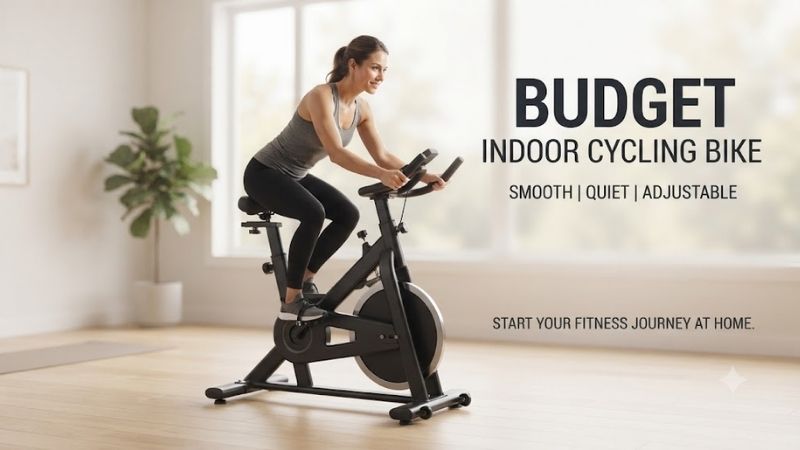
Indoor cycling bikes are designed around a riding position that often resembles conventional road cycling more closely than the position on a recreational upright exercise bike.
The saddle is usually narrower, the handlebars provide multiple grip positions, and the rider may lean forward more substantially.
Some models are also intended for standing efforts, allowing users to vary body position during intervals.
This design can be attractive for people who enjoy structured indoor cycling classes. However, it places additional importance on bike fit because the rider spends more time supporting the torso through the saddle, pedals, and handlebars.
A bike that feels acceptable during a five-minute demonstration may create unnecessary wrist, shoulder, or saddle discomfort during a longer session if it is incorrectly adjusted.
Indoor Cycling Versus Ordinary Upright Exercise
Conventional upright exercise bikes often emphasize a more relaxed riding position and console-based resistance programs. Indoor cycles generally place greater emphasis on manual or electronically controlled cycling effort, cadence, and riding posture.
This does not mean that one type delivers inherently superior cardiovascular exercise. Both can support appropriate training.
The better choice depends on preferred posture, workout style, and practical fit.
Someone who enjoys following studio classes and varying cadence may appreciate an indoor cycle. Someone who wants comfortable seated pedaling while reading may prefer a conventional upright model.
Understanding Magnetic and Friction Resistance
How Magnetic Resistance Changes Pedaling Effort
Magnetic indoor cycles use a braking system that opposes flywheel rotation.
The resistance may be adjusted manually or electronically depending on the machine.
On many models, the braking mechanism does not require a friction pad to remain in contact with the flywheel. This can reduce one source of operating noise and eliminate routine pad wear.
For home users, especially those in shared living spaces, this is a meaningful advantage.
However, a magnetic bike still contains bearings, pedals, belts, and frame connections. Its complete noise level depends on the quality and condition of these components.
Friction Resistance and Its Practical Advantages
A friction-resistance bike uses a pad or other contact material pressed against the flywheel.
Increasing pressure creates more resistance.
This design can be mechanically straightforward and may allow continuous manual adjustment rather than movement between predetermined electronic settings.
However, the contact surface experiences wear. It may need replacement, and resistance can change as the pad condition changes.
Friction systems may also generate rubbing noise, although actual sound levels depend on the materials and maintenance.
A well-designed friction bike can still provide useful exercise. The important question is whether its control method and maintenance requirements fit your preferences.
What Resistance-Level Numbers Really Mean
Some electronically controlled indoor cycles advertise a hundred resistance levels or another large number.
These settings describe selectable positions within the manufacturer’s system. They do not establish a universal mechanical workload.
For example, a displayed resistance level of fifty on one bike should not automatically be treated as equivalent to level fifty on another.
Even when two bikes offer the same maximum number, their resistance curves may differ.
Buyers should therefore focus on whether the system provides manageable low resistance, sufficient progression, and consistent control.
Resistance Consistency During Training
Consistency matters when repeating workouts.
If a bike uses calibrated or displayed resistance settings, the rider may be able to return to familiar positions more easily.
On a basic friction bike with an unmarked knob, reproducing an exact previous setting may be difficult.
This does not prevent useful exercise, but it becomes relevant for riders who follow structured power or cadence workouts.
If precise performance tracking is important, investigate whether the bike measures power or merely estimates workload from its settings.
Flywheel Weight and Rotational Inertia
Why Flywheels Matter
A flywheel stores energy while rotating.
That stored energy influences how the pedals behave as the rider accelerates or changes cadence.
A system with greater rotational inertia may retain momentum more strongly between pedal strokes.
However, inertia depends on more than total flywheel weight. The distribution of the mass, gearing, and overall mechanical arrangement all contribute.
Why a Heavy Flywheel Is Not Always Better
Traditional indoor cycling bikes often advertise substantial flywheels.
A heavier flywheel may provide a familiar momentum-driven feel, but it is not automatically required for smooth pedaling.
Some newer magnetic bikes use different flywheel and drivetrain arrangements to achieve controlled resistance with less physical mass.
A bike should be evaluated as a complete mechanical system rather than ranked solely by advertised flywheel pounds.
Flywheel Weight and Beginner Comfort
Beginners sometimes assume that a heavier flywheel will make exercise easier.
That is not necessarily true. The behavior depends on resistance, momentum, and drivetrain design.
What matters more is whether the pedals move predictably at a comfortable cadence and whether the user can stop the machine according to the manufacturer’s instructions.
When Flywheel Specifications Are Useful
Flywheel data is most useful when comparing similar machines with broadly similar mechanical designs.
It becomes less informative when comparing completely different resistance systems.
If one product uses magnetic braking with a particular transmission ratio and another uses friction resistance, weight alone cannot describe their ride quality.
Belt Drive Versus Chain Drive
The Appeal of Belt-Driven Bikes
Many residential indoor cycles use belt drives.
A belt transfers pedaling effort to the flywheel without requiring the routine chain lubrication familiar to outdoor cyclists.
This can reduce maintenance demands and certain mechanical noises.
However, belts still need appropriate tension and alignment. A worn or incorrectly installed belt can slip, squeak, or interfere with smooth pedaling.
Chain Drive Characteristics
Some indoor cycles use chains.
A chain can be durable and familiar, but it requires manufacturer-appropriate lubrication and inspection.
Chain noise may also be more noticeable than that of some belt systems.
Neither drivetrain automatically establishes superior performance. Maintenance support and the quality of the complete assembly remain important.
Which Should a Home Buyer Choose?
For buyers prioritizing quiet operation and uncomplicated maintenance, a well-designed belt-driven bike is often attractive.
For those who prefer traditional mechanical construction and accept routine service, a chain-driven bike can also be reasonable.
The decision should be based on the entire bike, not merely one drivetrain component.
Bike Fit: The Most Important Purchase Decision
Why Saddle Height Matters
Saddle height affects knee extension throughout the pedal stroke.
A seat that is too low may create excessive knee bending, while one that is too high can force overreaching or cause the hips to rock.
The correct height allows controlled pedaling and comfortable movement without locking the knee.
Begin with the manufacturer’s fitting instructions and make small adjustments.
If discomfort persists despite reasonable adjustments, a professional bike-fitting assessment may help.
Saddle Fore-Aft Adjustment
Horizontal saddle adjustment changes the rider’s position relative to the crank.
It can also influence the distance to the handlebars.
However, it should not be used carelessly as a substitute for proper handlebar adjustment.
A good bike offers enough independent adjustment to accommodate the rider’s body proportions.
Handlebar Height
Higher handlebars may allow a more upright torso, while lower positions create a more forward-leaning arrangement.
The preferred position depends on comfort, flexibility, and training style.
A beginner should not feel compelled to choose an aggressive position simply because it resembles professional cycling.
Handlebar Reach
The handlebars should be reachable without excessive shoulder extension or locked elbows.
Long periods of awkward reach can make a bike uncomfortable.
Fore-aft handlebar adjustment is especially useful for riders with different torso lengths.
Why Four-Way Adjustment Matters
Four-way adjustment generally refers to vertical and horizontal movement.
A bike offering these controls for both the saddle and handlebars provides more opportunities to establish an appropriate fit.
This is particularly valuable for households with multiple riders.
However, adjustment range matters more than the label. A machine offering four-way adjustment but only limited movement may still fail to fit certain users.
Saddle Comfort and Riding Posture
Indoor cycling saddles are often narrower than those found on conventional recreational exercise bikes.
This supports a different seated posture, but beginners may initially find the pressure distribution unfamiliar.
A wider saddle is not automatically more comfortable because the correct width depends on anatomy and riding position.
Similarly, excessive padding may compress unevenly and affect stability.
Before purchasing a replacement seat, confirm that the original is correctly adjusted. Saddle angle, height, and reach can influence perceived comfort.
Some bikes accept standard bicycle saddles; others use proprietary mounting systems. Replacement compatibility should be verified.
Padded cycling shorts may provide additional comfort during longer sessions, but they should not be used to conceal persistent fit problems.
Pedals, Cleats, and Foot Security
Toe Cages for Everyday Shoes
Many indoor cycles include toe-cage pedals.
These allow riders to use ordinary athletic shoes and secure the feet with adjustable straps.
They are convenient for beginners and shared households.
Clipless Pedals
Some bikes support cycling shoes through clipless systems.
SPD is one common format, but compatibility must be confirmed.
A shoe designed for one cleat standard may not work with another pedal system.
Dual-Sided Pedals
Dual-sided pedals provide two options, such as a toe cage on one side and a clipless mechanism on the other.
This arrangement is useful when different household members prefer different footwear.
Why Pedal Installation Matters
Bicycle pedal threads have specific directions and sizes.
Incorrect installation can damage crank arms and create serious mechanical problems.
Follow the manufacturer’s assembly procedure and check pedal security periodically.
Emergency Stopping and Flywheel Control
Some indoor cycles use a mechanically linked drivetrain that allows the flywheel to continue moving the pedals while it rotates.
This makes emergency stopping particularly important.
Many bikes include a resistance knob or dedicated braking mechanism that can stop the flywheel.
Learn the approved procedure before exercising.
Never attempt to slow a spinning flywheel by grabbing it with your hands.
The exact drivetrain and stopping behavior differ among machines, so the manufacturer’s manual should be considered authoritative.
For buyers planning demanding intervals, a clearly accessible braking system is more important than entertainment features.
Frame Stability and Rated Capacity
Why Standing Efforts Require Attention
Standing pedaling transfers different forces through the frame than ordinary seated cycling.
A machine intended for standing workouts should remain stable under those approved conditions.
Look for substantial stabilizers, appropriate frame geometry, secure handlebars, and a manufacturer-stated weight limit.
Weight Capacity
The published maximum user weight is an essential constraint.
Do not exceed it.
A high rating does not automatically mean that every workout style is approved or that the bike is intended for continuous commercial use.
Floor Leveling
Even a good frame can rock on an uneven surface.
Adjustable leveling feet may help correct minor differences.
Use a firm, stable floor and follow the manufacturer’s instructions.
Assembly and Structural Inspection
Before use, check that major frame connections, saddle locks, handlebar locks, and pedals are secure.
Unusual movement or repeated noise should be investigated.
These fundamentals affect every workout and deserve more attention than decorative features.
Understanding Workout Metrics
Cadence
Cadence describes pedal revolutions per minute.
It helps riders maintain a consistent rhythm and follow structured workouts.
A higher cadence does not automatically indicate greater power because resistance also influences workload.
Power in Watts
Power represents the rate of mechanical work.
Some indoor cycles measure or estimate watts.
However, devices may use different measurement systems.
A calculated watt figure is not necessarily equivalent to one produced by a calibrated power meter.
Buyers who care about precise power-based training should investigate the model’s measurement method.
Distance and Speed
Stationary-bike distance and speed are typically modeled values.
They should not automatically be treated as equivalent to outdoor riding.
Calorie Estimates
Calorie figures depend on assumptions and available inputs.
They are best viewed as rough estimates rather than exact measurements.
Heart Rate
Some bikes connect to compatible heart-rate straps or other sensors.
This can provide additional information for structured exercise.
However, wireless connection support varies by device.
Connected Training and Subscriptions
Connected exercise platforms can provide guided classes, workout history, performance displays, and structured sessions.
For someone who enjoys instructor-led training, these features may support a more consistent routine.
However, the equipment itself must still provide appropriate fit and reliable resistance.
Bluetooth compatibility should be evaluated feature by feature. A bike may transmit cadence to an application while requiring manual resistance changes.
Premium platforms may also charge ongoing membership fees.
Before purchasing, calculate the combined equipment and subscription cost over several years.
Confirm whether the bike continues to provide essential exercise functions without an active membership or internet connection.
Buying by Budget
| Buyer Priority | Features Worth Paying For | Features That May Be Optional |
|---|---|---|
| Beginner fitness | Comfortable fit, safe stopping, stable frame | Large touchscreen |
| Quiet home exercise | Magnetic resistance, good drivetrain | Extensive entertainment features |
| Studio-style classes | Cadence tracking, secure pedals, adjustments | Proprietary display |
| Performance training | Consistent power data, reliable controls | Decorative accessories |
| Shared household | Broad adjustment, suitable capacity | Single-user premium features |
| Budget purchase | Durable frame, service support | Subscription ecosystem |
Entry-Level Bikes
Entry-level models can offer useful training when they provide adequate fit and mechanical reliability.
However, avoid choosing the cheapest product if it lacks secure adjustment or essential safety functions.
Midrange Bikes
Midrange equipment may add magnetic resistance, more adjustment options, and improved monitoring.
These upgrades can be worthwhile for regular use.
Premium Bikes
Premium models may feature electronic resistance, integrated displays, and advanced connected training.
Their value depends on whether the user actually benefits from those systems.
Maintenance and Long-Term Ownership
Routine maintenance includes cleaning sweat from approved surfaces, checking pedal security, inspecting saddle and handlebar locks, and monitoring drivetrain condition.
Friction pads may wear and require replacement.
Belt systems should be serviced according to manufacturer guidance, while chain systems may need cleaning and lubrication.
Electronic models may require software updates or manufacturer-approved power components.
Before purchasing, confirm whether compatible pedals, saddles, resistance components, and other parts remain available.
Warranty coverage also matters. Frame coverage may differ from mechanical, electronic, and labor protection.
A slightly higher purchase price can provide better long-term value when the equipment is repairable and supported.
Common Buying Mistakes
The first mistake is selecting a bike primarily by flywheel weight. Inertia and ride quality depend on the complete system.
A second mistake is assuming the largest number of resistance levels represents the hardest or best workout.
Another common problem is neglecting fit. An unsuitable saddle or handlebar position may make regular exercise unpleasant.
Buyers can also overpay for connected features without investigating subscription costs or actual app compatibility.
Some overlook emergency braking, assuming all stationary bikes stop in the same way.
Finally, shoppers sometimes ignore after-sales support. Replacement components can determine whether a bike remains useful over time.
Frequently Asked Questions
What Is the Best Type of Indoor Cycling Bike for Home Use?
A stable bike with appropriate fit, smooth resistance, secure pedals, and practical controls is suitable for many home users. Magnetic resistance is often attractive for quieter operation.
Is Magnetic Resistance Better Than Friction?
Magnetic systems typically avoid brake-pad wear and can be quieter. Friction systems can be simpler and economical. The preferred choice depends on budget and training needs.
Does a Heavier Flywheel Make a Bike Better?
Not necessarily. Mass distribution, drivetrain gearing, bearings, and resistance design all influence the experience.
What Does Four-Way Adjustment Mean?
It generally refers to vertical and horizontal positioning of the saddle or handlebars, allowing the rider to refine fit.
Do I Need Clipless Cycling Shoes?
No. Bikes with toe cages can accommodate conventional athletic shoes. Clipless systems are optional when compatible.
Is an Indoor Cycling Bike Good for Beginners?
Yes, when appropriately adjusted and used at a manageable intensity.
Can Indoor Cycling Improve Cardiovascular Fitness?
Regular indoor cycling can support cardiovascular conditioning when exercise intensity and frequency are appropriate.
Are Connected Cycling Bikes Worth the Cost?
They can be worthwhile for users who regularly follow guided workouts, but effective cycling does not require a subscription.
Conclusion
This indoor cycling bike buying guide prioritizes comfortable geometry, stable construction, reliable resistance, and safe operation. Compare saddle and handlebar adjustment, pedal compatibility, workout tracking, and maintenance support before purchasing. The best choice suits your riding style without unnecessary cost.
Write Your Review
No reviews yet. Be the first to share your experience!