
Key takeaways
What's inside
Best affordable exercise bike decisions come down to two mechanical choices that listings bury under console features: how heavy the flywheel is, and whether resistance comes from a magnet or a felt pad pressing on metal. Those two determine how the bike rides, how loud it is, and how long it lasts before a part needs replacing.
As an Amazon Associate we earn from qualifying purchases at no extra cost to you. Product prices and availability are accurate as of the date shown and are subject to change.




As an Amazon Associate we earn from qualifying purchases at no extra cost to you. Product prices and availability are accurate as of the date shown and are subject to change.
By Chris Parker
🛒 Best Price Today on Amazon
Prime members get fast, free shipping on everything above, plus member-only deals. New members get a 30-day free trial — cancel anytime.
How to Choose the Best Affordable Exercise Bike
The best affordable exercise bike is not the one with the largest screen or the longest feature list. Four specifications predict how it will feel in month twelve: flywheel mass, resistance mechanism, drive type and user weight capacity. Everything else on the listing is a preference rather than a decision.
Flywheel Weight and Drive Type
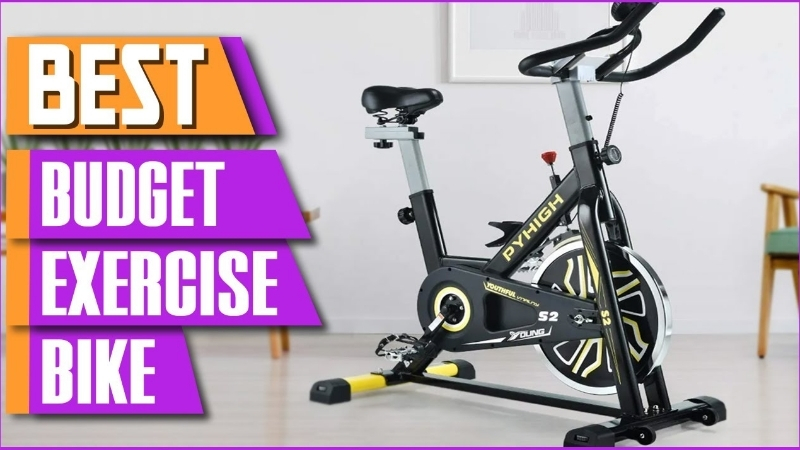
Flywheel mass controls smoothness. Budget indoor cycles run roughly 30-49 lb (14-22 kg), and the heavier end carries momentum through the dead spot at the top of the pedal stroke so the ride feels continuous rather than pulsed. Below about 30 lb (14 kg) most riders notice the stutter immediately.
Drive type decides noise and maintenance. A belt drive runs quietly and needs essentially nothing done to it, while a chain drive is louder, needs occasional lubrication and eventually stretches. Almost every bike worth buying now uses a belt, and a chain at this price is usually a sign of an older design.
Magnetic Versus Felt Pad Resistance
Felt pad resistance works by pressing a brake pad onto the spinning flywheel. It is cheap, infinitely variable and completely non-repeatable, since there are no numbered levels to return to. It is also a wear item: the pad thins, starts to squeak, and eventually needs replacing, usually after a year or two of regular use.
Magnetic resistance never touches the flywheel, so nothing wears out, the bike stays quiet and the levels are numbered and repeatable, which matters if you follow structured sessions. It costs more, and on cheaper implementations the steps between levels can be coarse enough that the right effort sits between two of them.
Footprint, Ceiling Height and Where It Lives
The best affordable exercise bike options are nearly all indoor cycles, occupying roughly 40-48 in by 20-24 in (102-122 x 51-61 cm) of permanent floor, and they are heavy enough that they do not get moved casually. Folding upright bikes cut that considerably but trade away flywheel mass and the ability to ride out of the saddle with any confidence.
Ceiling height is the one nobody checks. Standing on the pedals adds roughly 10-12 in (25-30 cm) to your height, so a low ceiling or a sloped loft wall rules out climbing efforts. Measure the actual floor area, the ceiling height and the doorway the box has to pass through before ordering.
Where Magnetic Resistance Sits in the Market
Magnetic resistance used to define the upper tier and has now moved firmly into the middle of the market, which is the single biggest change in this category. That means a bike with no wear parts in the resistance system is no longer a premium purchase, and the entry point for one has fallen a long way.
Below that middle band the trade is specific rather than vague. You get a felt pad instead of a magnet, a lighter flywheel, a lower user weight limit, a basic console with no connectivity, and a frame that flexes noticeably when you stand up. None of that is dangerous, and all of it is felt daily.
The practical read is that the best affordable exercise bike sits in the mid tier, where choice is widest and compromises are smallest. If you intend to ride three or more times a week, paying up to magnetic resistance removes the pad replacement cycle and the squeak entirely, and that alone usually justifies the difference within two years.
Top Picks: 6 Affordable Exercise Bikes by Mechanism
The six below are ordered by what drives them rather than by price, because the best affordable exercise bike for structured interval work is not the one for steady riding while watching something. The table lists flywheel mass and resistance type, which are the two figures that predict the ride.
| Bike | Flywheel | Resistance | Drive | User Capacity |
|---|---|---|---|---|
| Schwinn IC4 | 40 lb (18 kg) | Magnetic, micro-adjust | Belt | 330 lb (150 kg) |
| Sunny Health SF-B1805 | 40 lb (18 kg) | Magnetic | Belt | Around 300 lb (136 kg) |
| Joroto X2 | Around 35 lb (16 kg) | Magnetic | Belt | Around 280 lb (127 kg) |
| Sunny Health SF-B1002 | 49 lb (22 kg) | Felt pad friction | Belt | 275 lb (125 kg) |
| YOSUDA Indoor Cycling Bike | 35 lb (16 kg) | Felt pad friction | Belt | 270-330 lb (122-150 kg) |
| Exerpeutic Folding Upright | Light | Magnetic, 8 levels | Belt | 300 lb (136 kg) |
Schwinn IC4
The most complete package at the top of the affordable band. A 40 lb (18 kg) flywheel with magnetic resistance across a hundred micro-adjustment steps gives repeatable efforts, the frame supports up to 330 lb (150 kg), and Bluetooth broadcast means it pairs with third-party training apps rather than a closed system.
It is the heaviest and most expensive bike here, and it needs a real footprint rather than a corner. The console is basic and shows metrics rather than running workouts, so the screen has to come from your own tablet. Dual-sided pedals take cleats or trainers, which is convenient rather than exceptional.
Sunny Health and Fitness SF-B1805
Magnetic resistance with a 40 lb (18 kg) flywheel and a belt drive, at a price clearly below the Schwinn. For anyone who wants numbered, repeatable resistance levels and a quiet bike without paying for connectivity, this covers the mechanical essentials and leaves the entertainment to whatever device you already own.
The resistance steps are coarser than a micro-adjust system, so the effort you want sometimes sits between two settings. The console is minimal, there is no app connectivity, and the frame flexes more than the Schwinn when you stand and push hard. Check the stated user capacity against your bodyweight before buying.
Joroto X2
A magnetic belt-drive bike with a flywheel in the region of 35 lb (16 kg), aimed squarely at people who want silent operation in a shared house. The lighter flywheel is less noticeable in seated riding than the specification suggests, and the absence of a friction pad means nothing wears out over time.
Momentum through the pedal stroke is not as smooth as the 40-49 lb (18-22 kg) bikes, and it shows most during slow, heavy climbing efforts. Stated user capacity is lower than the Schwinn, so heavier riders should check it carefully. Out-of-saddle sprinting produces more frame movement than on a heavier machine.
Sunny Health and Fitness SF-B1002
The heaviest flywheel here at 49 lb (22 kg), which is the whole argument for it. That mass gives the smoothest, most road-like pedal feel of any bike on this list, and the belt drive keeps it quiet despite the weight. It is a genuinely good ride at a price well below the magnetic options.
Resistance comes from a felt pad pressing on the flywheel, which means it wears, squeaks when it gets low and needs replacing periodically. There are no numbered levels, so repeating an exact effort is guesswork. User capacity is 275 lb (125 kg), the lowest here, and worth checking before ordering.
YOSUDA Indoor Cycling Bike
The volume seller at the entry point, with a 35 lb (16 kg) flywheel, belt drive and a felt pad brake. It includes a tablet holder, a basic LCD console and a bottle cage, and the assembly is straightforward enough for one person to complete in under an hour with the supplied tools.
Everything about it is the entry tier done competently rather than exceptionally. The pad is a consumable, the console shows estimates rather than measured power, and the frame flexes when you stand. Different versions state different weight limits, so read the specification for the exact variant you are buying.
Exerpeutic Folding Magnetic Upright Bike
The answer when floor space rules out an indoor cycle entirely. Eight magnetic resistance levels, a 300 lb (136 kg) user capacity and a frame that folds down to roughly half its footprint mean it can live behind a door between sessions rather than occupying a corner permanently.
It is an upright bike rather than a cycling trainer, so the flywheel is light, the ride is not smooth at high effort and standing on the pedals is not something the frame is built for. Treat it as a device for steady, seated cardio, which it does quietly and takes up almost no space doing.
Frequently Asked Questions
The recurring questions about the best affordable exercise bike are all mechanical: whether flywheel weight is marketing, whether magnetic resistance justifies its cost, and what the weight limits really mean. These four answers cover the specifications that decide how a bike feels after the first month.
Does flywheel weight really matter?
Yes, up to a point. Mass carries momentum through the top of the pedal stroke, so heavier flywheels feel smoother and more like riding outdoors. The difference between 20 lb (9 kg) and 35 lb (16 kg) is obvious; between 40 lb (18 kg) and 49 lb (22 kg) it is subtle and mostly noticed at low cadence.
Is magnetic resistance worth paying for?
If you ride three or more times a week, usually yes. Nothing contacts the flywheel, so there is no pad to replace, no squeak developing over time and less noise overall, and numbered levels let you repeat an effort exactly. For occasional steady riding, a felt pad system is perfectly adequate and costs less.
Belt drive or chain drive?
Belt, on almost every count. It runs quieter, needs no lubrication, does not stretch and keeps the surrounding floor clean. Chain drives at this price are generally older designs, and the maintenance they need is the sort that gets forgotten until the bike starts making a noise you cannot ignore.
What user weight capacity do I need?
Look for a stated limit comfortably above your bodyweight rather than close to it, because the figure assumes seated riding rather than standing efforts that load the frame dynamically. Limits here run from 275 lb (125 kg) to 330 lb (150 kg), and exceeding them affects stability and frame life rather than causing sudden failure.
See More:
- Best home pull-up bar
- Best at home pull up bar
- Best in house pull up bar
- Best rated ab roller
- Best yoga travel mat
Final Thoughts
The best affordable exercise bike is chosen on flywheel mass and resistance mechanism, not console features. For steady riding, a 49 lb (22 kg) flywheel with a felt pad is smoothest for the money. For structured intervals, magnetic resistance is worth the step up.


Write Your Review
No reviews yet. Be the first to share your experience!