
Key takeaways
What's inside
Best workout dumbbells are the ones you can still load in two years, not the ones that feel impressive in week one. This guide compares six sets on load ceiling in lb and kg, increment size, weight-change time and the floor space each one occupies, so the set you buy still fits both your room and your training two years from now.
As an Amazon Associate we earn from qualifying purchases at no extra cost to you. Product prices and availability are accurate as of the date shown and are subject to change.

#1 Pick

#2 Pick

#3 Pick

#4 Pick
#5 Pick

#6 Pick

#7 Pick

As an Amazon Associate we earn from qualifying purchases at no extra cost to you. Product prices and availability are accurate as of the date shown and are subject to change.
By Chris Parker
🛒 Best Price Today on Amazon
Prime members get fast, free shipping on everything above, plus member-only deals. New members get a 30-day free trial — cancel anytime.
How to Choose the Best Workout Dumbbells for Your Room
Most buying regret in this category traces back to two decisions: a load ceiling set too low, and a set that never really fitted the space it was bought for. Work through the three filters below in order and the shortlist of best workout dumbbells usually collapses to two or three realistic options very quickly.
Load Ceiling and Weight-Change Time
A 50 lb (22.7 kg) ceiling covers pressing and curls for a long time, but rows, goblet squats and Romanian deadlifts run into it quickly. Anyone training consistently for a year should expect to want 70 lb (32 kg) or more on pulling movements sooner than they currently think they will.
Change time shapes what you can programme. Twist-handle and dial systems switch loads in two to four seconds, keeping drop sets viable; quick-lock steel designs take ten to fifteen seconds; plate-loaded spinlock handles take two to three minutes per pair, which effectively rules out supersets and circuit work.
Footprint and Floor Loading in a Small Room
An adjustable pair in cradles occupies around 20 x 12 in (51 x 30 cm) and stands 9 to 10 in (23 to 25 cm) high, low enough to slide under most bed frames. A compact block design drops that to roughly 12 x 6 in (30 x 15 cm) per dumbbell, which is the difference in a small bedroom.
Then add the training area itself. A single dumbbell movement needs about 6 x 6 ft (183 x 183 cm) of clear floor, and overhead pressing needs 8 ft (244 cm) of ceiling for taller lifters. Measure the actual corner and ceiling height you plan to use before ordering anything at all.
Where Build Quality Fails and What the Market Offers
Failures cluster in predictable places: plastic selector housings crack after a knock, dials jam when a plate is not fully seated, and threaded collars back off during high-rep work. Steel-plate designs with fewer moving parts fail least often, though they are also the slowest sets here to adjust between working sets.
The current market makes the choice clearer than it used to be. Mid-tier is where steel plates, sensible increments and multi-year frame warranties overlap, and below that line plastic replaces steel while 5 lb steps replace 2.5 lb ones, which quietly caps how far the best workout dumbbells can take you before a rebuy.
Top Picks: Best Workout Dumbbells by Training Style
Six sets covering budget to premium and apartments to garages, chosen so the best workout dumbbells for one room are not assumed to suit another. Figures are manufacturer specifications for range, increment and mechanism, and cost is given as a tier rather than a number, because discounting here is constant.
| Set | Range per dumbbell | Increment | Change time |
|---|---|---|---|
| NUOBELL 80 lb Classic | 5–80 lb (2.3–36 kg) | 5 lb (2.3 kg) | 2–3 seconds |
| Ironmaster Quick-Lock 75 lb | 5–75 lb (2.3–34 kg) | 2.5 lb (1.1 kg) | 10–15 seconds |
| PowerBlock Pro EXP | 5–50 lb, expandable to 90 lb | 2.5 lb with adders | 5–10 seconds |
| Bowflex SelectTech 1090 | 10–90 lb (4.5–41 kg) | 5 lb (2.3 kg) | 2–3 seconds |
| Amazon Basics Rubber Hex | Fixed pairs | Not applicable | None |
| Yes4All Spinlock | Plate-loaded to ~52.5 lb | Plate dependent | 2–3 minutes |
NUOBELL 80 lb Classic: Best Balance of Speed and Ceiling
5 to 80 lb (2.3 to 36 kg) in 5 lb steps, changed by twisting the handle in the cradle. The outer shape stays identical at every load, so a set at 25 lb and a set at 70 lb feel the same in the hand, and changes are fast enough to keep drop sets practical.
The 5 lb increment is genuinely coarse for lateral raises and rear delt work, where smaller jumps matter most. It also has to be docked in its cradle to adjust, so mid-set changes mean walking back to the stand, and it sits at the top of the mid tier on cost.
Ironmaster Quick-Lock 75 lb: Best Long-Term Durability
All-steel handles loaded with individual plates from 5 to 75 lb (2.3 to 34 kg) in 2.5 lb steps, secured by a locking screw. There is no housing to crack and no dial to jam, and the set tolerates being placed down firmly far better than any moulded design in this comparison.
Ten to fifteen seconds per change is the trade you accept. Supersets and drop sets become impractical, the dumbbell lengthens as plates are added, and the plate trees take up more floor space than a simple pair of cradles. It is a set built for straight sets, not circuits.
PowerBlock Pro EXP: Best for the Smallest Spaces
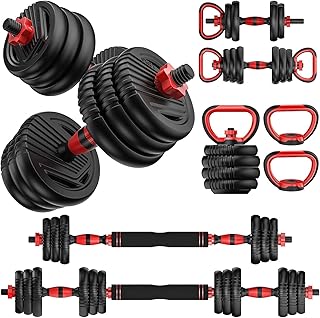
A block roughly 12 x 6 x 9 in (30 x 15 x 23 cm) starting at 5 to 50 lb (2.3 to 22.7 kg) and expanding to 70 and then 90 lb with kits. Small adder weights give 2.5 lb steps, and the cube shape stores where a long adjustable simply will not physically fit.
Your hand sits inside a cage, which affects wrist clearance on curls and feels unfamiliar for the first few sessions. Pin changes are slower than a twist handle, and the flat-sided profile is awkward for floor presses and renegade rows compared with a round-ended dumbbell.
Bowflex SelectTech 1090: Best High Ceiling with Fast Changes
10 to 90 lb (4.5 to 41 kg) per hand in 5 lb steps via a dial at each end, at around 17.5 in (44 cm) long. It gives close to barbell loading on rows and squats while keeping two-second weight changes, which very few sets anywhere near this range actually manage.
Length is the real cost: at 17.5 in it interferes on floor presses and close-grip work, and the 10 lb starting weight is too heavy for most shoulder isolation. Dropping is not permitted, and at 90 lb that restriction takes real discipline to respect at the end of a hard set.
Amazon Basics Rubber Hex: Best Zero-Maintenance Option
Fixed rubber-encased pairs have no mechanism at all to fail. They sit flat for renegade rows, tolerate rough handling, and will comfortably outlive every adjustable set here. For a programme built on three or four familiar loads, buying selected pairs is often the smarter and cheaper purchase.
Space and cost per pound are the obvious problems. Covering 10 to 50 lb in pairs needs a rack about 4 ft (122 cm) wide and puts well over 400 lb (181 kg) into a single corner of the room, which is worth thinking about carefully on an upper floor.
Yes4All Spinlock: Best Budget Route to 50 lb
Threaded steel handles with loose plates, reaching roughly 52.5 lb (23.8 kg) per hand depending on the kit. Nothing moulded can crack, extra plates are inexpensive to add later, and the total outlay is a fraction of a dial system that reaches the same top-end load.
Two to three minutes per weight change is the honest limitation, and collars work loose during higher-rep sets, so they need periodic retightening mid-session. Plates also rattle on the handle, which makes controlled eccentric work noisier than it should be in a shared building.
Frequently Asked Questions
These four come up most often from people setting up a first serious home training space rather than replacing an existing set, and the answers tend to decide which of the best workout dumbbells above is actually worth paying extra for.
How heavy should my first set go?
For most beginners a 50 lb (22.7 kg) ceiling is enough for six to twelve months of pressing and curling. If rows, squats and hinges are central to your plan, buying to 70 or 80 lb (32 to 36 kg) upfront avoids a full replacement a year later at a higher total cost.
Are adjustable dumbbells worth it over fixed pairs?
They win on space and on covering many loads at once. Fixed hex pairs win on durability, feel and rough handling. A common compromise is one adjustable pair for the working range plus a single heavy fixed pair for rows and carries, which covers both needs without a rack.
Can I use these on an upstairs floor?
Usually yes, with sensible precautions. Use a mat rated for equipment, place the weights rather than dropping them, and keep the set near a load-bearing wall. Noise travels further than weight does, so quiet placement matters at least as much as the total load in the room.
How much space do I really need?
About 6 x 6 ft (183 x 183 cm) of clear floor for the movements themselves, plus storage space for the set. Overhead pressing needs roughly 8 ft (244 cm) of ceiling for taller lifters. Measure the room before ordering rather than after the delivery arrives at the door.
See More:
- Hot yoga mat best
- Best dumbbells exercises
- Best back exercises using dumbbells
- Best exercise upright bike
- Best exercise stationary bike
Final Thoughts
The best workout dumbbells for a home room are decided by load ceiling first, change speed second and footprint third. Buy heavier than feels necessary if pulling movements matter to you, accept slower changes in exchange for steel construction, and confirm ceiling height and floor area before ordering anything.


Write Your Review
No reviews yet. Be the first to share your experience!