
Key takeaways
What's inside
Best home gym dumbbells come down to two numbers: the size of the weight jump and the floor area the cradles occupy. Everything else is preference. This guide explains why 2.5 lb steps outlast 5 lb steps, what each mechanism breaks first, and lists six sets with their honest limits. Both numbers appear in the table below.
As an Amazon Associate we earn from qualifying purchases at no extra cost to you. Product prices and availability are accurate as of the date shown and are subject to change.


As an Amazon Associate we earn from qualifying purchases at no extra cost to you. Product prices and availability are accurate as of the date shown and are subject to change.
By Chris Parker
🛒 Best Price Today on Amazon
Prime members get fast, free shipping on everything above, plus member-only deals. New members get a 30-day free trial — cancel anytime.
How to Choose the Best Home Gym Dumbbells
Adjustable sets replace a rack of fixed weights, but they trade durability and shape for that convenience. Picking the best home gym dumbbells means weighing increment size against ceiling weight, cradle footprint against handle length, and adjustment speed against how much plastic sits in the mechanism.
Weight Range and Increment Size
Increment size is the single number that decides how long a set stays useful. Steps of 2.5 lb (1.1 kg) let you add small amounts to curls, lateral raises and rows week after week. Sets moving only in 5 lb (2.3 kg) jumps stall those lifts long before the ceiling weight matters.
Ranges cluster in three bands. Entry sets run 5 to 50 lb (2.3 to 22.7 kg) per hand, mid sets reach 52.5 lb (23.8 kg), and heavier options go to 80 or 90 lb (36 or 41 kg). Most people press and row past 50 lb within a couple of years of consistent training.
Expandability changes the maths. Some systems start at 50 lb and accept kits that take them to 70 or 90 lb per hand for a fraction of a second full purchase. Fixed-range sets have no upgrade path, so the ceiling you buy is the ceiling you keep.
Footprint: Cradle Size, Handle Length and Where They Live
Footprint for the best home gym dumbbells has two parts. The cradles need roughly 3 sq ft (0.28 sq m) of floor or a shelf rated for the combined weight, which for a 50 lb pair plus cradles runs near 118 lb (54 kg). That is a permanent claim on the room, not a temporary one.
Handle length is the footprint nobody checks. Dial-type dumbbells stay around 16.9 in (43 cm) long whether loaded to 5 lb or 52.5 lb, so light sets feel oversized and the ends clash during bench pressing. Block-style sets start near 12 in (30 cm) and grow only as weight is added.
Then add the training area: about 6 x 6 ft (1.8 x 1.8 m) of clear floor, plus your height and roughly 20 in (50 cm) of ceiling for standing overhead work. Measure the actual space and the shelf you intend to use before ordering anything at this weight.
Adjustment Mechanism and What Breaks First
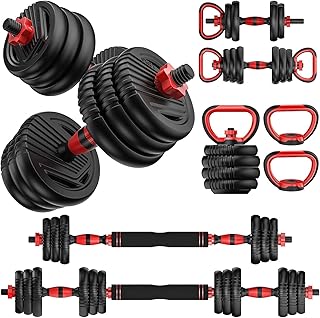
Three mechanisms dominate. Dials rotate at each end and disengage unwanted plates, changing weight in about three seconds. Selector pins slide through a block and take two to three seconds. Spinlock collars thread on and off by hand and take 30 to 60 seconds per side.
Failure modes follow the mechanism. Dial systems carry the most plastic and the most moving parts, and the CPSC recalled over 3.7 million dial-type units in June 2025 after reports of plates separating from handles. Pin systems have fewer failure points; spinlocks have almost none but are slow.
What Adjustable Dumbbells Are Not Allowed To Do
No adjustable dumbbell should be dropped. The mechanisms are not built for impact, dropping voids cover on most sets, and a plate breaking loose is exactly the failure that triggered the 2025 recall. If your training involves setting weight down hard, use fixed dumbbells or a kettlebell.
They are also poor tools for anything requiring a tight, compact shape at light load, such as high-rep lateral raises with a long dial handle. Farmer carries over rough ground and any explosive movement belong on solid cast iron rather than on a selectorised mechanism.
The market still leans toward large-space buyers, which is worth knowing when you shop. Most listings photograph well in a wide garage and say little about handle length or cradle depth, so the compact end of this category remains thinner on genuinely good options than the price range suggests.
Top Picks: Best Home Gym Dumbbells Compared
Six best home gym dumbbells sets below, judged on range, increment size, footprint and the specific way each design fails. Fixed cast iron is included deliberately, because for some rooms and some training styles it remains the better answer despite the space it demands.
| Set | Range per hand | Increment | Mechanism |
|---|---|---|---|
| PowerBlock Elite EXP | 5-50 lb (2.3-22.7 kg) | 2.5 lb (1.1 kg) with adders | Selector pin |
| NUOBELL 80 | 5-80 lb (2.3-36 kg) | 5 lb (2.3 kg) | Twist handle |
| Bowflex Results Series 552 | 5-52.5 lb (2.3-23.8 kg) | 2.5 lb then 5 lb | Dual dial |
| Core Fitness Adjustable | 5-50 lb (2.3-22.7 kg) | 5 lb (2.3 kg) | Slide selector |
| CAP Rubber Hex Set | Fixed pairs | Per pair purchased | None |
| Yes4All Spinlock | Plate dependent | Plate dependent | Threaded collar |
PowerBlock Elite EXP: Best Overall
A selector-pin block running 5 to 50 lb (2.3 to 22.7 kg) per hand in a cube of roughly 12 x 6 x 6.25 in (30 x 15 x 16 cm) at Stage 1. It grows physically as load is added, expansion kits reach 70 and 90 lb (32 and 41 kg), and the mechanism is steel and high-impact polymer with no dials.
The rectangular shape presses against the forearm and thigh in a way round dumbbells do not, and takes getting used to. The 2.5 lb adder weights sit inside the block and slow adjustment. It cannot be dropped. Mid tier, with the longest warranty in this group.
NUOBELL 80: Best Traditional Feel
A twist-handle set running 5 to 80 lb (2.3 to 36 kg) per hand across 16 settings, built largely from steel rather than plastic. Rotating the handle in the cradle selects the weight in a couple of seconds, and the loaded shape sits closest to a conventional gym dumbbell.
Increments are 5 lb (2.3 kg) throughout, which is coarse for lateral raises and curls at the light end. It is the most expensive option here. The twist mechanism requires the dumbbell to be seated correctly in the cradle to change weight. It must not be dropped. Premium tier.
Bowflex Results Series 552: Fastest Adjustment
A dual-dial set covering 5 to 52.5 lb (2.3 to 23.8 kg) per hand, moving in 2.5 lb (1.1 kg) steps to 25 lb and 5 lb steps above that. Turning both dials and lifting takes under three seconds, and those fine low-end increments are genuinely useful for smaller lifts.
Important context: the CPSC recalled over 3.7 million earlier SelectTech 552 and 1090 units in June 2025 after plates separated from handles. Check serial numbers against the CPSC notice before buying used. The handle stays 16.9 in (43 cm) at every weight, and warranty cover is short. Mid tier.
Core Fitness Adjustable Dumbbell: Budget Selectorised
A slide-selector set covering 5 to 50 lb (2.3 to 22.7 kg) per hand in 5 lb (2.3 kg) steps, sold with moulded cradles. It undercuts the better-known selectorised sets substantially while keeping quick weight changes and a broadly conventional dumbbell shape.
Increments of 5 lb throughout limit progression on smaller movements. There is more plastic in the housing than the steel-heavy alternatives, and the selector needs the dumbbell seated squarely to engage. Build tolerances vary between units. Budget to mid tier.
CAP Rubber Hex Dumbbells: Best Durability
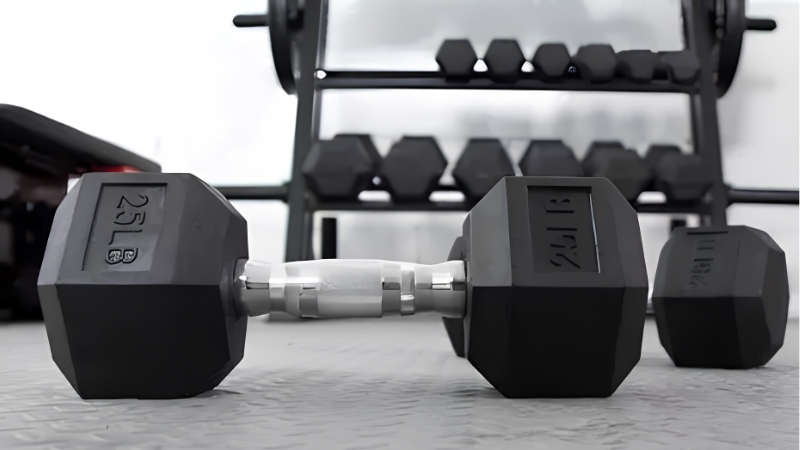
Solid rubber-coated hex heads on a knurled steel handle, with no mechanism to fail. They can be set down hard, used for carries and left in a damp garage, and the hex profile stops them rolling. For push-up handles and floor work they are simply better than any adjustable.
Space is the cost. A useful spread of pairs from 10 to 50 lb needs several feet of rack and a floor that can take it, and each pair is a separate purchase. Rubber can smell strongly when new. Budget to mid tier per pair, but expensive as a full set.
Yes4All Spinlock Dumbbells: Cheapest Entry
Threaded steel handles with cast iron plates and screw-on collars, letting you build any weight the plates allow. There is almost nothing to break, plates can be bought incrementally as budget permits, and the handles double as a plate-loaded system for other work.
Changing weight takes 30 to 60 seconds per side, which rules out drop sets and makes circuit work tedious. Collars work loose during high-rep sets and need checking. Loaded length grows quickly and becomes awkward on presses. Budget tier, and slow by design.
Frequently Asked Questions
These four questions cover what people ask before buying the best home gym dumbbells, mostly about increments, space and durability. Answers stay with what the hardware does rather than with any claim about training outcomes.
What weight range should I buy?
For most people starting out, 5 to 50 lb (2.3 to 22.7 kg) per hand covers pressing, rowing and accessory work for a long time. If you already train and press above that, look at 80 lb (36 kg) sets or an expandable system rather than replacing the set within a year.
Do 2.5 lb increments really matter?
On small movements, yes. Going from 15 to 20 lb on a lateral raise is a 33 percent jump, which is often too large to complete with the same form. Fine increments matter far less on presses and rows, where 5 lb steps are a small proportion of the load.
How much space do the cradles need?
Roughly 3 sq ft (0.28 sq m) of floor, or a shelf rated for the combined load, which for a 50 lb pair plus cradles is near 118 lb (54 kg). Check handle length as well: dial sets stay about 16.9 in (43 cm) at every weight, which affects shelf depth.
Are adjustable dumbbells durable enough?
Pin and twist mechanisms have a long track record, while dial systems carry more plastic and more moving parts. The June 2025 CPSC recall of over 3.7 million dial units is worth knowing before buying second hand. None of them tolerate being dropped, regardless of mechanism.
See More:
- Best beginner jump rope
- Best boxing jump rope
- Best boxer jump rope
- Best cheapest yoga mat
- Best workout exercise equipment
Final Thoughts
The best home gym dumbbells are the ones whose increment size matches your smallest lift and whose cradles fit the space you can permanently give up. Favour 2.5 lb steps and expandable ranges, never drop them, and measure the shelf and floor area before you order.


Write Your Review
No reviews yet. Be the first to share your experience!