
Key takeaways
What's inside
Best boxing jump rope selection is a weight decision before it is a brand decision. Rounds run three minutes, so a cord that is too light loses its arc and one that is too heavy burns your shoulders by round two. This guide covers cord mass, handle length, footprint and wear, then six ropes. Cord mass decides everything else.
As an Amazon Associate we earn from qualifying purchases at no extra cost to you. Product prices and availability are accurate as of the date shown and are subject to change.


As an Amazon Associate we earn from qualifying purchases at no extra cost to you. Product prices and availability are accurate as of the date shown and are subject to change.
By Chris Parker
🛒 Best Price Today on Amazon
Prime members get fast, free shipping on everything above, plus member-only deals. New members get a 30-day free trial — cancel anytime.
How to Choose the Best Boxing Jump Rope
Boxing rope work is not the same job as CrossFit rope work. You are holding a relaxed arc for three minutes at a time while your feet do something more interesting than a two-foot bounce. That pushes the best boxing jump rope priorities toward cord mass, handle comfort and durability, and away from raw rotation speed.
Cord Weight and the Three-Minute Round
Most shortlists for the best boxing jump rope start at a 5 mm PVC cord weighing roughly 5 oz (140 g) in total. It carries enough mass to hold a predictable arc through footwork changes, but not so much that the shoulders fatigue before the bell. Ropes marketed as boxing specific often add around 15 percent to standard PVC mass for exactly this reason.
Heavy cords in the 9 to 10 mm range, or handle-loaded ropes near 1 lb (0.45 kg), are conditioning tools rather than round tools. They build shoulder endurance genuinely well, but they slow the rotation enough that footwork drills stop resembling footwork. Keep them as a separate rope for separate work.
Pricing across this category clusters tightly. The mid tier is where the useful choices sit, because below that threshold manufacturers switch to thin cable and hollow handles rather than string-cored PVC. That single substitution is what most cheap boxing rope complaints come down to.
Handle Length, Grip and Wrist Snap
Handles near 5.5 in (14 cm) give you leverage for the crossover and boxer skip, since more handle means more room for the wrist to lead the turn. Very short handles favour pure speed work and make freestyle transitions noticeably awkward once your hands start moving.
Grip surface matters more in boxing than elsewhere because you sweat for the whole session rather than for a 60-second interval. Dimpled plastic and grip tape hold better than bare aluminium, which becomes slippery quickly. Ropes that ship with separate tape let you build up thickness where your dominant hand actually sits.
Floor Footprint and Ceiling Clearance in a Home Corner
Footprint is the constraint that decides whether the best boxing jump rope gets used at all. Budget a clear rectangle of about 5 by 7 ft (1.5 by 2.1 m) once footwork enters the picture, because the boxer skip and running step travel more than a static bounce ever will.
Overhead, allow your standing height plus roughly 12 in (30 cm). At 6 ft (183 cm) that means an 8 ft (2.44 m) ceiling is workable but tight, and a pendant light in the arc will not survive the month. Shortening the cord raises the arc rather than lowering it, so trimming does not solve a low ceiling.
Flooring completes the picture. Rope on bare tile is loud through the structure and hard on the knees; a 6 to 8 mm rubber mat fixes both and protects the cord from grit. Measure the actual corner you plan to use, including light fittings, before ordering anything.
Surface, Wear and Cord Replacement
PVC cord is the consumable in this category. On a mat indoors it can run for years, but on concrete or asphalt the sleeve abrades and frays within months. Beaded cords tolerate rough ground far better, at the cost of a slower arc and considerably more noise on hard floors.
Cold is the other failure mode worth knowing. PVC stiffens below freezing and can snap outright during outdoor winter sessions. Check whether the brand sells replacement cord on its own, because handles and bearings almost always outlast the cord by several cycles.
Rope also fits the wider reason home training keeps growing. The WHO 2020 guidelines put the adult target at 150 minutes of moderate activity per week plus two strength sessions, and the CDC reports fewer than one in four US adults meet both. Consult a doctor before beginning any new training programme.
Top Picks: Best Boxing Jump Rope Options for Home Rounds
Six ropes below, each assessed on cord mass, handle length, the surface it survives and its honest weak point. None of these are drop-and-forget items: every one has a cord that will eventually need replacing, and none of them should be dragged across bare concrete session after session.
| Rope | Cord | Handles | Best for |
|---|---|---|---|
| Elite Jumps Boxer Rope | 5 mm PVC, string core, 10 ft (3.05 m) | 5.5 in (14 cm) plastic | Standard round work |
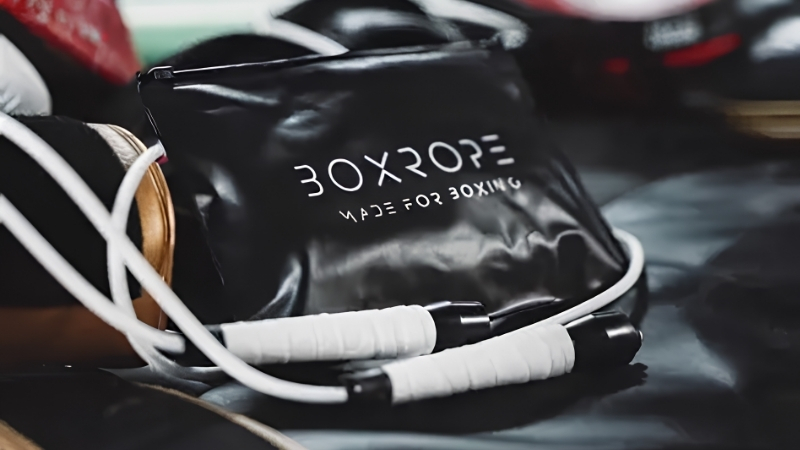
| BOXROPE Vol. I | PVC, about 15 percent heavier than standard | Screw adjust, grip tape | Footwork with feedback |
| EliteSRS Overcomer Beaded | 1 in (25 mm) beads, 10 ft (3.05 m) | Long, freestyle friendly | Outdoor and rough ground |
| Redify Weighted Rope | 9 mm cotton plus 9 mm PVC | Aluminium, ball bearings | Shoulder conditioning |
| Crossrope Get Lean Set | 1/4 lb and 1/2 lb coated cords | Clip-in system | Interval conditioning |
| WOD Nation Speed Rope | Coated steel cable | Short, speed oriented | Double unders |
Elite Jumps Boxer Rope: Best All-Round Choice
A 5 mm PVC cord with an internal string core, 10 ft (3.05 m) long and roughly 5 oz (140 g) in total, on 5.5 in (14 cm) plastic handles with dimpled grips. The string core stops the cord stretching under spin load, which is what keeps the arc predictable across a full three-minute round.
Sizing means trimming the cord, so a mistake is permanent. The PVC wears on concrete and stiffens badly in freezing conditions. Handles are plain plastic with no bearing system. Budget to mid tier.
BOXROPE Vol. I: Best for Footwork Feedback
Built around a PVC cable roughly 15 percent heavier than a standard speed cord, at a light overall weight near 5.3 oz (150 g). That small mass increase holds the arc through footwork changes without dulling the wrist snap you need for combination work between rounds.
Adjustment runs through screws in both handles, so no cutting is required and the change is reversible. Grip tape ships separately, so unwrapped handles feel thin out of the box. Mid tier pricing.
EliteSRS Overcomer Beaded Rope: Best for Rough Ground
Thick-walled 1 in (25 mm) beads on polycord, 10 ft (3.05 m) as supplied, shortened by unthreading and removing beads. Beads survive concrete and asphalt in a way PVC simply does not, and the long handles suit crossovers and freestyle transitions between rounds.
It is loud. On tile or hardwood in a flat that noise becomes a real neighbour problem without a mat. Rotation is slower than a boxing purist may want. Mid tier.
Redify Weighted Jump Rope: Best for Shoulder Conditioning
Supplied with both a 9 mm braided cotton cord and a 9 mm solid PVC cord on aluminium handles with double ball bearings, around 1 lb (0.45 kg) overall. Swapping cords gives you a slow conditioning setup and a faster round setup from a single purchase.
Aluminium grips get slick once sweat arrives, which is a recurring complaint mid-session. The cotton cord frays fast outdoors. At this weight the shoulders load quickly, so it works better as a supplementary rope than as your main round rope. Budget to mid tier.
Crossrope Get Lean Set: Best for Interval Conditioning
A clip-in handle system with interchangeable coated cords at 1/4 lb (0.11 kg) and 1/2 lb (0.23 kg). Swapping between them mid-session is quick, which suits interval formats where you alternate a light speed round with a heavy conditioning round.
It is the priciest option here, and the app leans on a subscription that adds nothing to the hardware. Cord lengths are fixed by height with no fine adjustment. Premium tier.
WOD Nation Speed Jump Rope: Best for Double Unders
A coated steel cable on free-spinning bearings with a wide adjustment range, built for rotation speed rather than arc feel. If your conditioning work includes double unders or timed speed sets, this is the cord that keeps up without drag.
It gives almost no tactile feedback, which makes footwork drills harder to feel. The coating chips on abrasive ground, and a miss stings more than PVC does. Budget to mid tier.
Frequently Asked Questions
These four questions cover what people ask before committing to the best boxing jump rope at home, from cord weight to noise. Answers stay with what the equipment does rather than what any training plan claims it will deliver over a given number of weeks.
How heavy should a boxing jump rope be?
Around 5 oz (140 g) total for a standard 10 ft (3.05 m) PVC rope is the traditional reference point, with boxing-specific cords adding roughly 15 percent. Weighted ropes near 1 lb (0.45 kg) are conditioning tools. Keep the heavy cord separate from the rope you use for footwork rounds.
Is a beaded rope suitable for boxing?
Yes, particularly outdoors or on concrete where PVC frays quickly. Beads rotate more slowly and land loudly on hard indoor floors, which can rule them out in a flat. Many fighters keep a beaded rope for outdoor sessions and a PVC rope for indoor round work.
How much space do I need to skip at home?
Plan on about 5 by 7 ft (1.5 by 2.1 m) of clear floor once footwork enters the routine, plus your standing height and around 12 in (30 cm) of ceiling clearance. Shortening the cord raises the arc, so a short rope does not compensate for a low ceiling.
How often will I replace the cord?
Indoors on a mat, PVC cord commonly lasts years. On concrete it may fray within a few months, and freezing outdoor temperatures can snap it outright. Beads last considerably longer on rough ground. Buy from a brand that sells spare cord so handles are not wasted.
See More:
Final Thoughts
Choosing the best boxing jump rope comes down to matching cord mass to the work: string-cored 5 mm PVC for rounds and footwork, beads for concrete, a heavy cord kept separate for conditioning. Confirm your clear floor area and ceiling height first, then buy the rope your surface can actually support.





Write Your Review
No reviews yet. Be the first to share your experience!