
Key takeaways
What's inside
Best shoe for jump rope selection is a forefoot problem, not a heel problem. Every landing arrives on the ball of the foot, thousands of times per session, and the rope repeatedly strikes the same spot on the upper. This guide covers stack height, drop, upper durability and the ceiling clearance you need.
As an Amazon Associate we earn from qualifying purchases at no extra cost to you. Product prices and availability are accurate as of the date shown and are subject to change.



As an Amazon Associate we earn from qualifying purchases at no extra cost to you. Product prices and availability are accurate as of the date shown and are subject to change.
By Chris Parker
🛒 Best Price Today on Amazon
Prime members get fast, free shipping on everything above, plus member-only deals. New members get a 30-day free trial — cancel anytime.
How to Choose the Best Shoe for Jump Rope Training
Running shoes fail at this because their cushioning sits under the heel, which never touches down. What matters is what is under the forefoot, how flat the platform is, whether the upper survives repeated rope contact, and and how much room the rope arc needs above and all around your body. It is a small detail that quietly adds up.
Forefoot Cushioning and Stack Height
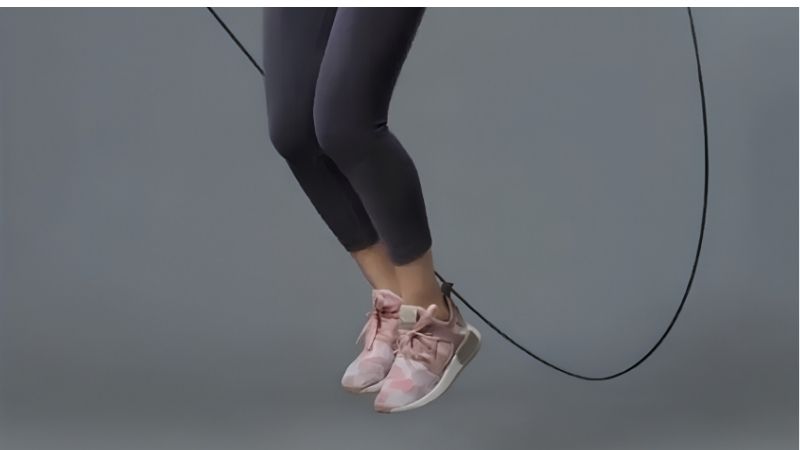
Jumping rope loads the forefoot on every contact, so that is where protection is needed. Too little foam and the metatarsals take a beating on concrete within a few hundred skips. Too much and the platform becomes unstable, since a tall, soft stack lets the foot roll very slightly on each and every landing.
The workable range for most people is a moderate forefoot stack that compresses under load but returns quickly. Cross-training shoes are built this way deliberately, because the same requirement applies to box jumps and lateral work. Dedicated running foam is too soft and too tall for repeated single-point landings.
Price tier changes this more than brand does. Below the mid tier, forefoot foam thins out, midsoles use a single generic compound, and the shoe flattens permanently within a few months of rope work. The mid tier is where dual-density midsoles and reinforced forefoot panels start appearing consistently.
Heel-to-Toe Drop and Platform Stability
Drop is the height difference between heel and forefoot, measured in millimetres. Cross-training shoes typically sit at 4-7 mm, which keeps the foot close to level and improves balance during rebounds. Running shoes at 10-12 mm tip the body forward slightly, which becomes noticeable across long rope sets.
Zero-drop and minimalist shoes put the foot flat with a thin sole, giving maximum ground feel and calf engagement. They also transmit far more impact, so they suit experienced rope users on timber floors and punish beginners on concrete. Transition gradually if you are moving down from a cushioned trainer.
Upper Durability Where the Rope Hits
The rope catches the same area on the medial forefoot and the lace region hundreds of times per session, and thin single-layer mesh abrades through faster than most buyers expect. Look for a reinforced overlay, a rubber toe wrap, or a woven upper with a noticeably denser weave across the forefoot panel.
Low-profile uppers also matter for a different reason: a bulky heel collar or a thick tongue increases the chance of the rope snagging mid-set. Cross-training shoes tend to run cleaner in profile than running shoes, which tend to pile foam and extra padding up around the ankle collar itself. Most buyers only notice this some weeks later.
Footprint: Ceiling Height and Floor Space
Rope work needs vertical clearance most people never measure. Add roughly 12-18 in (30-45 cm) above your standing reach for the rope arc, which means ceilings under about 8 ft (2.4 m) are marginal for taller users and rule out basements with exposed pipework or low ductwork almost entirely. That gap tends to show up within a month.
Floor area is smaller: around 4 x 6 ft (1.2 x 1.8 m) of clear space handles a standard rope, with more needed for crossovers. Surface matters as much as size – concrete transmits impact directly, while timber and rubber matting absorb some of it. Measure the actual area and ceiling before committing to rope training indoors.
Top Picks: Best Shoe for Jump Rope Volume at Home
These five span cushioned cross-trainers through to genuinely minimal shoes, which covers the range of surfaces and experience levels. Each entry notes the forefoot behaviour and the specific weakness, since any shoe that protects the metatarsals inevitably gives up some ground feel somewhere else in return.
| Shoe | Approx. drop | Forefoot feel | Best for |
|---|---|---|---|
| Nike Metcon 9 | 4 mm | Firm, stable | Rope plus lifting sessions |
| Reebok Nano X4 | 7 mm | Moderate cushion | All-round training |
| Inov-8 F-Lite 235 V3 | 6 mm | Light, flexible | High rope volume |
| NoBull Trainer | 4 mm | Firm, low profile | Durability, rope contact |
| Xero Shoes Prio | Zero drop | Minimal, ground feel | Timber floors, experienced |
Nike Metcon 9
Built around a wide, flat platform with a drop listed at 4 mm and a firm heel section designed for lifting. For anyone combining rope intervals with weights in the same session, it is the shoe that handles both without the compromise of switching footwear halfway through a single training session. It rarely appears anywhere on the spec sheet.
The forefoot is firmer than a dedicated rope shoe would ideally be, so long sets on concrete are less comfortable than in a softer trainer. It is also relatively heavy for high-rep skipping. As a one-shoe answer to the best shoe for jump rope question in mixed training, it is hard to fault at all. The difference is obvious the moment it is used.
Reebok Nano X4
A general cross-trainer with a drop around 7 mm and a midsole tuned for a mix of jumping, lifting and short runs. The forefoot has more give than a lifting-focused shoe, which makes extended rope work noticeably more comfortable on hard surfaces such as a bare concrete garage slab. The best shoe for jump rope question really comes down to this.
That extra cushioning costs some stability under heavy loads, and the upper is less abrasion-resistant in the rope strike zone than more reinforced designs. It is the versatile middle option rather than the specialist, and it wears fastest at exactly the point where the rope lands over and over again.
Inov-8 F-Lite 235 V3
Light at roughly 235 g per shoe with a drop near 6 mm and a flexible forefoot, which is the combination that suits high rope volume specifically. Less mass on the foot means less fatigue across long interval sessions, and the flexibility lets the forefoot articulate naturally on every single rebound.
Light construction means less protection on concrete and a shorter overall lifespan than heavier trainers. It is also narrower than several alternatives, which matters if you have wide feet. Choose it if rope work is the main event of the session rather than a brief warm-up before lifting weights. Checking it takes two minutes and saves a return.
NoBull Trainer
A firm, low-profile shoe with a drop around 4 mm and a one-piece abrasion-resistant upper, which directly addresses the rope-strike wear problem that shreds mesh trainers. The flat platform is stable for rebounds and equally usable for lifting weights straight afterwards. None of that is visible in the product photographs.
Cushioning is minimal by cross-trainer standards, so long sessions on concrete are demanding and the break-in period is genuinely stiff. Sizing runs narrow for some feet. It is the durability pick here, and the shoe most likely to still look intact after many months of repeated rope contact. That is worth checking before anything else is ordered.
Xero Shoes Prio
Zero drop with a thin, flexible sole and a wide toe box, giving maximum ground feel and letting the foot and calf do the shock absorption. Experienced rope users on timber or matted floors often prefer this, and the low profile eliminates rope snag points around the collar and tongue almost entirely.
The lack of cushioning is unforgiving on concrete and on anyone new to forefoot landing, and calf soreness during transition is normal rather than exceptional. Build volume gradually over several weeks. This is a shoe for people who already skip well, rather than a sensible starting point for a beginner.
Frequently Asked Questions
Most questions here are about whether existing shoes will do, and how much cushioning is genuinely needed. These four cover the common questions about the best shoe for jump rope work, including the surface question that changes the answer completely for some buyers. It is the sort of thing a spec sheet never captures.
Can I use running shoes as the best shoe for jump rope work?
They work poorly. Running shoes put cushioning under the heel, which never lands during skipping, and their 10-12 mm drop tips you forward. The tall soft forefoot also compresses unevenly under repeated single-point landings, which reduces stability quite noticeably across longer skipping sets. Everything else on the list is secondary to that.
Does barefoot skipping work?
On a padded or matted surface, experienced users manage it fine and it builds foot strength. On concrete or tile it concentrates impact directly through the metatarsals, which is a common route to bruising and stress-related pain. If anything hurts, see a doctor or a qualified physiotherapist rather than pushing through.
How quickly do rope shoes wear out?
The upper usually fails before the sole, specifically where the rope contacts the medial forefoot and laces. Thin mesh can show wear within a few months of frequent sessions, while reinforced uppers last considerably longer. Rotating two pairs extends the working life of both quite noticeably over a year.
What ceiling height do I need?
Roughly 12-18 in (30-45 cm) above your standing reach with arms relaxed, which puts most adults at a minimum of about 8 ft (2.4 m). Low ceilings force a shortened rope arc and a cramped technique, so measure carefully before setting up any kind of indoor rope area at home. Plan around it rather than hoping it will not matter.
See More:
Final Thoughts
The best shoe for jump rope work has a moderate forefoot stack, a low drop in the 0-7 mm range, and an upper that survives repeated rope contact. Match the cushioning level to your surface – more on concrete, less on timber or matting – check your ceiling clearance before training indoors, and expect the upper to wear out before the sole does.





Write Your Review
No reviews yet. Be the first to share your experience!