
What's inside
Best grippy yoga mat means two different things at once: a top surface that holds your palms, and an underside that stops the whole mat travelling across the floor. Most buyers only check the first. This roundup covers both halves, with six mats compared on texture, thickness, weight and storage space.
As an Amazon Associate we earn from qualifying purchases at no extra cost to you. Product prices and availability are accurate as of the date shown and are subject to change.


As an Amazon Associate we earn from qualifying purchases at no extra cost to you. Product prices and availability are accurate as of the date shown and are subject to change.
By Chris Parker
🛒 Best Price Today on Amazon
Prime members get fast, free shipping on everything above, plus member-only deals. New members get a 30-day free trial — cancel anytime.
What Makes the Best Grippy Yoga Mat Actually Grip
Traction has two halves that use different mechanisms. The top surface grips skin through texture or tack; the underside grips the floor through weight and friction. A mat can be excellent at one and useless at the other, which is why people who buy on star ratings alone still end up sliding around.
Top-Surface Grip: Texture Versus Tack
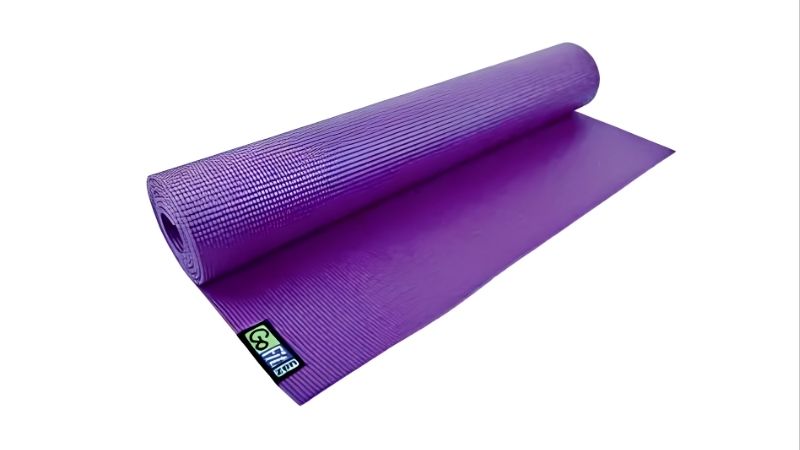
Textured grip comes from an embossed or moulded pattern that gives skin something mechanical to catch on. It works well dry, is easy to clean, and fades as the raised pattern wears smooth – usually noticeable within about 12 months of frequent practice on TPE and PVC mats in particular rather than on rubber.
Tacky grip comes from the material itself: polyurethane and natural rubber hold skin through surface adhesion rather than pattern. Tack survives longer and performs far better once palms are damp, which is why almost every serious hot-yoga mat uses one of those two surfaces rather than relying on texture alone.
Underside Grip: The Half Nobody Checks
On hardwood and tile, a light mat slides forward during downward dog no matter how good the top is. Weight is the simplest fix: mats above roughly 5 lb (2.3 kg) generally stay put through natural rubber or PVC friction, while sub-2.5 lb (1.1 kg) travel mats need a rug underneath or a wall to brace against.
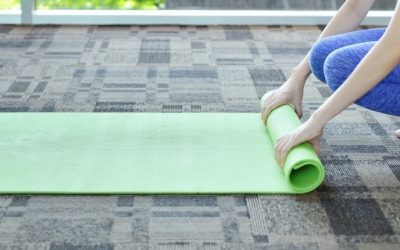
On carpet the problem inverts. Carpet pile lets a thin mat wrinkle and bunch under load, so a firmer, thicker mat with a wide base performs better than a grippy but floppy one. Check what you are putting the mat on before you choose thickness, because the right answer flips completely between hard floors and carpet.
Footprint, Thickness and Storage
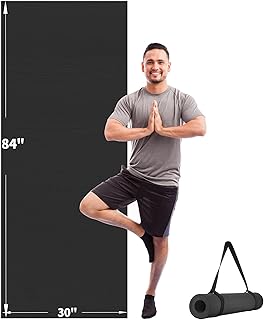
Standard mats run 68 x 24 in (173 x 61 cm), with longer options at 71-72 in (180-183 cm). Practice needs roughly 7 x 4 ft (2.1 x 1.2 m) of clear floor for arms-wide poses, and low ceilings interfere with standing overhead reaches in flats with exposed beams, low ductwork or sloped rooflines overhead.
Rolled, a 5-6 mm mat is about 5-6 in (13-15 cm) across and stores upright in a corner or horizontally under a bed. Thicker 1/2 in (12 mm) fitness-style mats roll to roughly 8 in (20 cm) and are noticeably harder to store. Measure the actual space where the mat will be used and stored before ordering anything.
Top Picks: The Best Grippy Yoga Mat for Each Practice
These six span dry-hand texture, damp-hand tack, and thick cushioned options that double for floor work. Formulations and stock change, so each entry sticks to material, dimensions and the specific weakness worth knowing about before buying, rather than a price that will simply be wrong again next month.
| Mat | Surface | Thickness | Approx. weight | Best for |
|---|---|---|---|---|
| Gaiam Dry-Grip | Textured, moisture-wicking | 5 mm | 3 lb / 1.4 kg | Sweaty hands, mid budget |
| IUGA Pro Non-Slip | Polyurethane over rubber | 5 mm | 6 lb / 2.7 kg | Hot yoga, damp grip |
| Manduka PROlite | Closed-cell PVC | 4.7 mm | 4 lb / 1.8 kg | Durability, travel |
| Yoga Design Lab Infinity | Polyurethane top | 5 mm | 5.5 lb / 2.5 kg | Alignment, tacky feel |
| Gorilla Mats Premium | Textured, dual-sided | 6-8 mm | 7 lb / 3.2 kg | Hardwood, floor work |
| Retrospec Solana | Textured TPE | 6-12 mm | 2.5 lb / 1.1 kg | Carpet, budget, knees |
Gaiam Dry-Grip Yoga Mat
Built specifically around the sweaty-hands problem at a mid-tier price, with a textured surface designed to wick moisture rather than let it pool. At 5 mm and around 3 lb (1.4 kg), it is light enough to carry and thick enough that knees are not punished during long kneeling sequences on a hard floor.
It is still a textured mat, not a tacky one, so it will not match polyurethane in a hot room. The pattern also holds dust and needs wiping more often. As an upgrade from a basic foam mat without spending premium money, this is the sensible next step up the range. It is a small detail that quietly adds up.
IUGA Pro Non-Slip Yoga Mat
A polyurethane top bonded to a natural rubber base at 5 mm, which is the same construction premium mats use, offered several tiers below them. Damp grip is the standout: palms hold during long holds in a warm room, where textured mats typically begin sliding within the first few minutes of a hot class.
Natural rubber brings the usual caveats – a strong smell for the first few weeks, unsuitable for latex allergies, and around 6 lb (2.7 kg) of carrying weight. The PU surface also marks if you practice in shoes or drag the mat. It rewards careful handling with genuinely dependable traction in a hot room.
Manduka PROlite
The lighter sibling of the PRO at 4.7 mm and roughly 4 lb (1.8 kg) in a 71 x 24 in (180 x 61 cm) format. Closed-cell PVC means sweat sits on top rather than soaking in, so cleaning takes seconds and the mat does not develop odour the way open-cell rubber can. The best grippy yoga mat question really comes down to this.
Grip needs a break-in period. Out of the box the surface is slick and requires several sessions, or a salt scrub, before traction arrives – a genuine drawback if you want performance on day one. It also sits well above budget pricing. You are buying lifespan and cushioning, with grip arriving later.
Yoga Design Lab Infinity Mat
A polyurethane top over a rubber base at 5 mm, with printed designs and a tacky feel that holds hands without needing moisture to activate. Around 5.5 lb (2.5 kg), it sits firmly on hardwood and does not creep forward during flowing sequences the way lighter mats do. It is one reason this ranks among the best grippy yoga mat options.
Polyurethane is a soft surface: fingernails, jewellery and shoes all mark it, and those marks are permanent. Prints also fade with heavy cleaning. It is a home-practice mat that tolerates occasional studio trips rather than a mat for daily commuting in a bag with keys and bottles. That gap tends to show up within a month.
Gorilla Mats Premium Yoga Mat
Aimed at people who want one mat for yoga and general floor training, with a textured surface on both sides and enough mass – around 7 lb (3.2 kg) – to stay planted on hardwood. Thickness in the 6-8 mm range makes kneeling, planks and core work considerably more comfortable than a 4 mm mat ever does.
That thickness costs stability in standing balance poses, where a firmer, thinner surface gives better feedback. It is also bulky rolled and heavy to carry. If your practice is mostly vinyasa and balance work, this is more mat than you need; if it includes floor conditioning, it is the versatile pick.
Retrospec Solana Yoga Mat
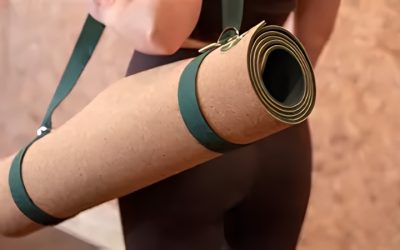
Textured TPE in 6 mm and 1/2 in (12 mm) options at roughly 2.5 lb (1.1 kg), with a strap included. The thicker version is the practical answer for carpet, where a firmer, deeper mat resists bunching under hands and knees far better than a thin, tacky mat does. It rarely appears anywhere on the spec sheet.
TPE grip fades as the texture flattens, and at 12 mm the sink under standing poses makes single-leg balances harder. It also dents where knees press repeatedly. For a beginner on carpet, or as a second mat kept purely for floor work at home, the value on offer is strong. The difference is obvious the moment it is used.
Frequently Asked Questions
Grip complaints usually turn out to be a mismatch between mat and floor, or a surface that needs cleaning rather than replacing. These four cover what people ask about the best grippy yoga mat, including carpet, home volume, and how long surface traction lasts. None of that is visible in the product photographs.
Which is the best grippy yoga mat for carpet?
A firmer mat in the 6-12 mm range with a wide, flat underside. Thin tacky mats wrinkle on pile because there is nothing rigid resisting the fold. On carpet the goal is a stable platform first and surface tack second, which reverses the usual order on bare hardwood. It is the sort of thing a spec sheet never captures.
How much practice does a home mat need to justify itself?
The World Health Organization’s 2020 guidelines put the adult target at 150 minutes of moderate activity per week plus two muscle-strengthening sessions. A mat at home removes travel time from that equation, which is the barrier most people actually hit. Check with a doctor before starting a new exercise programme.
Why did my grippy mat stop gripping?
Usually residue rather than wear. Skin oils, sweat salts and cleaning-product film build up into a thin layer between palm and surface. A proper wash restores most mats. If traction stays poor after a proper wash, the texture has genuinely flattened, and no cleaning product will bring it back again.
Do I need a mat towel as well?
Only for hot practice on a mat without a tacky surface. On polyurethane or open-cell rubber, a towel adds a layer that can slide unless it has silicone backing. On closed-cell PVC in a hot room, a mat towel is often the difference between a usable mat and an unusable one. That is worth checking before anything else is ordered.
See More:
Final Thoughts
Choosing the best grippy yoga mat comes down to matching surface type to how much you sweat and underside weight to what your floor is made of. Tack for damp hands, texture for dry rooms, mass for hardwood and firmness for carpet. Measure your practice space, keep the surface clean, and traction stays reliable for years.
Write Your Review
No reviews yet. Be the first to share your experience!