
Key takeaways
What's inside
Best cheap yoga mat shopping is really an exercise in choosing which compromise you can live with, because every mat at this price gives something away. Density, surface texture and edge finish are the three, and knowing which one matters for your practice is what separates a good buy from a drawer ornament.
As an Amazon Associate we earn from qualifying purchases at no extra cost to you. Product prices and availability are accurate as of the date shown and are subject to change.


As an Amazon Associate we earn from qualifying purchases at no extra cost to you. Product prices and availability are accurate as of the date shown and are subject to change.
By Chris Parker
🛒 Best Price Today on Amazon
Prime members get fast, free shipping on everything above, plus member-only deals. New members get a 30-day free trial — cancel anytime.
How to Choose the Best Cheap Yoga Mat
The best cheap yoga mat is not worse in every dimension, only in specific and predictable ones. Understanding which corners get cut lets you pick a mat whose weaknesses fall outside your practice, and it stops you paying extra for a feature that will make no difference to how you actually train.
The Three Things Cheap Mats Trade Away
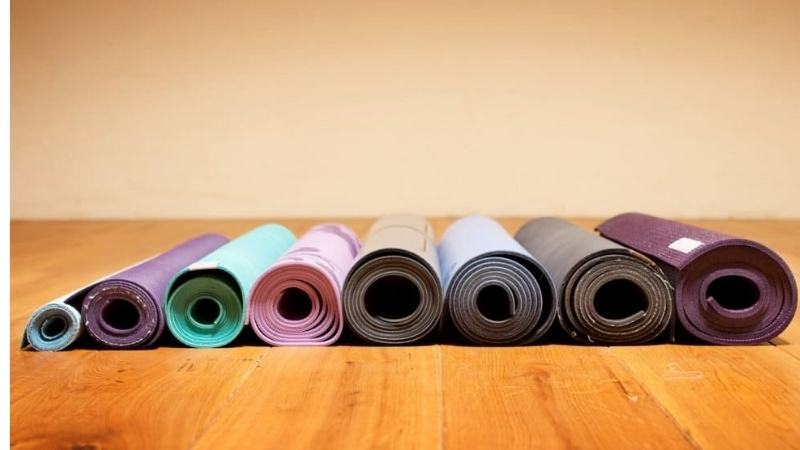
Density comes first. The best cheap yoga mat options are almost all NBR or PER foam, which is light, warm underfoot and easy to mould at thickness, but which takes a permanent set under concentrated pressure. Knees and elbows create the craters, and once compressed the foam never recovers its height.
Surface texture and edge finish are the other two. Budget mats emboss the pattern shallowly rather than moulding it deep, so grip declines as the raised areas wear flat, and edges are cut rather than sealed, which is why corners start lifting inside a year. Neither problem is visible in a product photograph.
Thickness, Size and Rolled Footprint
Footprint is worth checking on the best cheap yoga mat candidates precisely because thickness is where budget makers compete. A 1/2 in (12.7 mm) foam mat rolls to roughly 6-7 in (15-18 cm) in diameter, while a 6 mm mat rolls to about 4-5 in (10-13 cm). In a small flat that difference decides where it lives.
Unrolled, most sit at 68-74 in long by 24 in wide (173-188 x 61 cm), which is around 12 sq ft (1.1 sq m) of clear floor. Extended arms in a wide stance need more than the mat itself. Measure the actual clear area of the room you plan to use before ordering anything long.
Where the Price Floor Sits Right Now
The floor in this category is set by material cost, and foam is the cheapest thing that can be produced at 10 mm or more. That is why the entire bottom tier looks the same regardless of branding: the same NBR sheet, a different printed pattern and a different carry strap.
Move up a small amount in absolute money and TPE appears, which is where the market becomes genuinely competitive. The gap between the very cheapest mat and a solid TPE one is small enough that shopping at the absolute bottom rarely makes sense unless the mat is for guests or occasional stretching.
What has not changed is the extra-long and extra-wide segment, which stays expensive because sheet size drives cost directly. If you need 26 in (66 cm) of width or 78 in (198 cm) of length, expect the budget options to thin out sharply and to be a step up in price rather than a small one.
Top Picks: 6 Cheap Yoga Mats and Their Real Weaknesses
Every mat below is honestly inexpensive, and every one has a named failure mode listed with it. The best cheap yoga mat for you is the one whose weakness sits outside your own practice, so it is worth reading the second paragraph of each entry before the first one.
| Mat | Material | Thickness | Size | Weakest Point |
|---|---|---|---|---|
| BalanceFrom GoYoga | High-density foam | 1/4 or 1/2 in (6.4 or 12.7 mm) | 71 x 24 in (180 x 61 cm) | Permanent knee dents |
| Amazon Basics Extra Thick | NBR foam | 1/2 in (12.7 mm) | 74 x 24 in (188 x 61 cm) | Unstable in balance poses |
| ProsourceFit Extra Thick | NBR foam | 1/2 in (12.7 mm) | 71 x 24 in (180 x 61 cm) | Corner peel |
| Gaiam Print Premium | PVC | 6 mm | 68 x 24 in (173 x 61 cm) | Short for taller users |
| Toplus Yoga Mat | TPE | 1/4 in (6 mm) | 72 x 24 in (183 x 61 cm) | Slippery once damp |
| Heathyoga Eco Friendly | TPE, double layer | 6 mm | 72 x 26 in (183 x 66 cm) | Heavier to carry |
BalanceFrom GoYoga All-Purpose Mat
The default answer to the cheapest usable mat question. Two thickness options, a carry strap in the box, and a price low enough that discovering yoga is not for you costs almost nothing. For stretching, physiotherapy exercises and occasional floor sessions it is entirely adequate.
Its weakness is density. Kneeling positions compress the foam permanently, usually within a year at three sessions a week, and once the dent forms it changes how the mat sits. Never set a dumbbell or kettlebell down on it, because a point load leaves a crater immediately and permanently.
Amazon Basics 1/2-Inch Extra Thick Exercise Mat
Notable mostly for length. At 74 x 24 in (188 x 61 cm) it is longer than most budget mats, which solves the heels-off-the-end problem for anyone around 6 ft (183 cm). The 1/2 in (12.7 mm) of NBR foam is generous for sit-ups, planks, bridges and anything else performed on the knees.
That thickness is the weakness for yoga specifically. Standing balance work feels vague because the foot sinks unevenly into the foam, so tree pose and warrior three become considerably harder than they should be for no useful reason. Treat it as a floor exercise mat that tolerates gentle yoga rather than the other way around.
ProsourceFit Extra Thick Yoga and Pilates Mat
Another 1/2 in (12.7 mm) NBR option at 71 x 24 in (180 x 61 cm), aimed squarely at Pilates and mat-based conditioning where cushioning beats ground feel. The surface texture is more aggressive than on most budget mats, which helps a little on dry hands and on bare feet.
Cut edges are the giveaway at this price, and corners lift once the mat has been rolled and unrolled a few hundred times. Foam also holds odour, so it needs wiping and full drying after any sweaty session. Roll it loosely rather than tightly, which slows the edge damage down noticeably.
Gaiam Print Premium Yoga Mat
PVC rather than foam at 6 mm and 68 x 24 in (173 x 61 cm), which changes the character completely. PVC holds its thickness far longer than NBR, takes a proper moulded texture, and it is the material most studio mats were made from before natural rubber became fashionable.
The catch is length. At 68 in (173 cm) it is short for anyone above roughly 5 ft 8 in (173 cm), and in a lying position your heels will overhang. PVC is also slippery until the surface is broken in over several sessions, and it is not a biodegradable material at end of life.
Toplus Yoga Mat
The best value TPE mat in this group, at 1/4 in (6 mm) over 72 x 24 in (183 x 61 cm). It is the thickness most people should be using, it is light enough to carry to a class without irritation, and the moulded texture proves far more durable over time than an embossed foam pattern.
TPE is closed-cell, so sweat sits on top of it rather than being absorbed, and the surface becomes noticeably slippery in a warm room. That makes it a poor match for hot yoga unless you add a mat towel. Keep it out of direct sunlight, as heat degrades the surface faster than use does.
Heathyoga Eco Friendly Non Slip Yoga Mat
The wide option, at 72 x 26 in (183 x 66 cm) and 6 mm of double-layer TPE with printed body alignment lines. The extra 2 in (5 cm) of width is more useful than it sounds for wide-legged standing poses, and the alignment markings genuinely help when practising without an instructor watching.
Extra width and a double layer mean extra weight, so it is less pleasant to carry than a plain 24 in mat. The alignment lines are printed and will fade with wear and cleaning over a year or two. As with all TPE, expect grip to fall away as sweat builds rather than to improve.
Frequently Asked Questions
Questions about the best cheap yoga mat cluster around grip, hygiene and how long the thing will realistically survive. These four answers deal with the practical realities of the bottom tier, including the one problem that no amount of money at this level is going to solve.
Why does my mat get slippery when I sweat?
Because foam, TPE and PVC are all closed-cell surfaces, so moisture sits on top rather than soaking in. Natural rubber and polyurethane behave differently and grip better when damp, but neither exists at budget prices. The practical fix is a mat towel, which costs a fraction of upgrading the mat.
How thick should a cheap yoga mat be?
For yoga specifically, 5-6 mm is the sweet spot: enough padding for kneeling, thin enough that standing poses feel stable. Go to 10-13 mm only if the priority is floor conditioning or joint comfort rather than balance work. If knee pain is driving the decision, speak to a doctor or a physiotherapist.
Can I clean a cheap mat properly?
You can wipe it, but you cannot deep clean foam. Use a damp cloth with a little mild soap, avoid alcohol-based sprays which dry the surface out, and let the mat dry flat and completely before rolling. Moisture trapped in a rolled mat is the single biggest cause of persistent odour.
Is it worth spending more?
It depends entirely on frequency. Below about two sessions a week, a budget mat replaced occasionally is the cheaper path. Above three, the difference in cost per year narrows to almost nothing and you spend far less time on a flattened surface, so the step up to TPE pays for itself.
See More:
- Best home pull-up bar
- Best at home pull up bar
- Best in house pull up bar
- Best rated ab roller
- Best yoga travel mat
Final Thoughts
The best cheap yoga mat is the one whose known weakness does not overlap with your practice. Kneeling work means buying thickness and accepting the balance penalty; standing sequences mean 6 mm TPE and less cushioning. If you sweat, add a mat towel. Measure your floor space first.
Write Your Review
No reviews yet. Be the first to share your experience!