
Key takeaways
What's inside
Best yoga mat for carpets has no single answer, because a low-pile office carpet and a deep shag rug are completely different surfaces. One behaves almost like a hard floor; the other moves independently under the mat. This guide sorts the choice by pile type.
As an Amazon Associate we earn from qualifying purchases at no extra cost to you. Product prices and availability are accurate as of the date shown and are subject to change.
As an Amazon Associate we earn from qualifying purchases at no extra cost to you. Product prices and availability are accurate as of the date shown and are subject to change.


By Chris Parker
🛒 Best Price Today on Amazon
Prime members get fast, free shipping on everything above, plus member-only deals. New members get a 30-day free trial — cancel anytime.
Start 30-Day Prime Free Trial →See Today’s Amazon DealsHow Pile Type Decides the Best Yoga Mat for Carpets
The variable nobody measures is pile depth, and it decides the best yoga mat for carpets more than any specification on the label. Below roughly 1/4 in (6 mm) of pile, a mat behaves as it would on wood. Above about 1/2 in (13 mm), the floor itself becomes unstable and the mat has to compensate.
Low-Pile and Loop Carpet
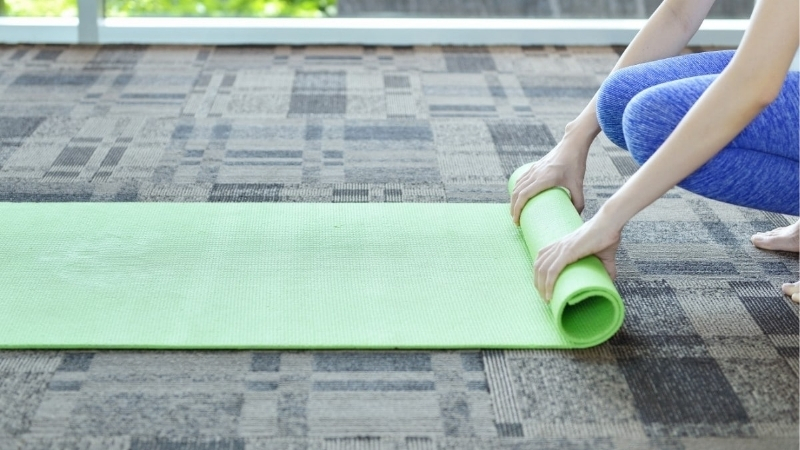
Commercial-style loop carpet and short domestic pile under about 1/4 in (6 mm) compress very little under bodyweight. On these surfaces almost any standard mat between 4 mm and 6 mm sits flat, and the usual buying advice for hard floors applies unchanged.
The only thing worth adding here is grip between mat and floor. Loop carpet is smooth enough that a light mat can still travel during transitions, so weight or a textured underside matters more than thickness on this surface type.
Plush and Medium Pile
Plush carpet between roughly 1/4 in and 1/2 in (6-13 mm) is where most homes sit, and it is where thick foam mats fail. A soft 10 mm mat on top of 10 mm of pile gives 20 mm of compressible material, and balance poses become genuinely unreliable.
The fix is density rather than thickness. A dense 5-6 mm PVC or natural rubber mat resists deformation and spreads load across the pile instead of sinking into it, which is why studio-weight mats consistently outperform cheap thick ones on this surface.
Shag, Deep Pile and Rugs Over Carpet
Anything above about 1/2 in (13 mm) of pile is the hard case. The surface moves independently of the mat, so even a dense mat rocks during transitions and a plank position feels like it is on sand. This is where weight becomes the deciding specification.
A studio mat at around 7.5 lb (3.4 kg) holds position through mass alone. The alternative is a rigid base: a sheet of plywood or a firm mat board under a thin rubber mat gives a genuinely stable platform at the cost of storage space.
Mat Dimensions, Weight and Storage
Standard mats run about 68 in (173 cm) long, with longer options at 71 in (180 cm), 74 in (188 cm) and 85 in (216 cm). Anyone above roughly 5 ft 9 in (175 cm) should size up, because hands or heels landing on carpet defeats the purpose entirely.
Rolled diameter runs 5-6 in (13-15 cm) and weight from about 2.5 lb (1.1 kg) for a travel mat to 7.5 lb (3.4 kg) for a dense studio mat. Measure the clear floor rectangle in the room before committing to a longer mat.
Market and Seasonal Context
The mid tier holds the widest choice and the clearest trade-offs. Below it the pattern is consistent: thinner surface layers that peel at the edges, foam that takes permanent dents at knee and elbow positions, and a stronger initial smell that takes several weeks to fade.
Practice moves indoors as evenings draw in through autumn, and carpeted spare rooms become the default space. That is the point in the year when the pile problem stops being theoretical, which is also when the better mats sell out of the longer lengths first.
What the market still does not address is floor type. Specification sheets talk about thickness, material and grip, but almost never about what the mat is being laid on, so the carpet question is one buyers have to answer for themselves.
Top Picks: Best Yoga Mat for Carpets by Pile Type
These seven candidates for the best yoga mat for carpets are grouped by the surface they suit rather than by price, because on carpet the wrong mat at any price performs badly. Each entry notes the pile type it handles and its honest weakness.
| Mat | Thickness | Material | Best Pile Type | Weakness |
|---|---|---|---|---|
| Manduka PRO | 6 mm | Closed-cell PVC | Plush to deep | Slippery until broken in |
| Manduka eKO | 5 mm | Natural rubber | Plush | Strong initial smell |
| Jade Harmony | 5 mm | Natural rubber | Low to plush | Wears at contact points |
| Liforme Yoga Mat | 4.2 mm | Rubber and polyurethane | Low to plush | Premium price |
| Lululemon Reversible 3mm | 3 mm | Rubber with PU top | Low pile only | Too light for deep pile |
| IUGA Non-Slip Mat | 6 mm | Dense TPE or PVC | Low to plush | Less durable surface |
| Gorilla Grip Rug Pad | 2-3 mm | PVC mesh | Any, as underlay | Does not stop sinking |
Manduka PRO
For deep pile this is the answer, and the reason is mass rather than material. At around 7.5 lb (3.4 kg) in the 71 in (180 cm) length, it holds position on shag through weight alone, and the closed-cell PVC resists compressing into the pile beneath.
The surface is genuinely slippery when new and needs weeks of use before grip develops. It is also the heaviest mat here, which makes it a poor travel choice and a commitment to keep it in one room.
Manduka eKO
Natural rubber at 5 mm gives more immediate grip than the PRO while keeping enough density for plush carpet. For anyone who wants a studio-weight mat without the break-in period, this is the more forgiving of the two.
Natural rubber smells strongly for the first weeks and degrades under direct sunlight, so it must not be stored on a sunny windowsill. It is also lighter than the PRO, which shows on the deepest pile.
Jade Harmony
The best hand grip of any mat on this list, which matters because a mat that stays put is useless if your palms slide. At 5 mm it has enough density for medium pile, and length options run up to 80 in (203 cm) for taller practitioners.
Open-cell rubber absorbs moisture and needs regular cleaning, and it wears faster at knee and elbow contact points than PVC does. Like all natural rubber it has a noticeable smell for the first few weeks.
Liforme Yoga Mat
At 4.2 mm this is thin by studio standards, and that is an advantage on low and medium pile because there is less material to deform. The printed alignment system is genuinely useful for anyone practising alone at home.
It sits at the top of the price range and the polyurethane surface scuffs at high-contact points sooner than PVC. It is also not heavy enough to be the right answer on deep shag.
Lululemon Reversible 3mm
The thinnest option here suits low-pile and loop carpet, where the floor is firm enough that the mat only needs to provide grip. The polyurethane face grips well as it dampens, which suits warmer practice.
On anything deeper than low pile it is the wrong choice: too thin to spread load and too light to stay put. The PU surface also marks easily and absorbs skin oils, so it needs wiping after every session.
IUGA Non-Slip Yoga Mat
The budget entry that actually works on carpet, because it is dense at 6 mm rather than soft. For anyone testing whether the best yoga mat for carpets really needs to be a studio-weight purchase, this answers the question cheaply.
The surface layer is less durable than premium mats and shows wear at hand and knee positions within a year of frequent use. The initial smell is also stronger than on higher-tier PVC mats.
Gorilla Grip Rug Pad
Cut to mat size, a PVC mesh underlay grips the pile from below and stops a light mat travelling, adding only 2-3 mm of thickness. It is the cheapest fix for a mat you already own and do not want to replace.
It solves sliding but not sinking, so it does nothing for a soft foam mat compressing into plush pile. Cheaper mesh also breaks down within a year or two and can shed particles into the carpet.
Frequently Asked Questions
These questions about the best yoga mat for carpets come up whenever someone practises at home and finds their mat behaving nothing like it did at the studio.
How do I tell which pile category I have?
Press a thumb into the carpet and see how far it sinks. Under about 1/4 in (6 mm) is low pile, up to roughly 1/2 in (13 mm) is plush, and anything deeper is the difficult case. Underlay thickness counts toward the total.
Is a thicker mat ever right on carpet?
Only for kneeling and lying work where balance is not involved, such as floor stretching or rehabilitation exercises. For any standing sequence the best yoga mat for carpets is dense and relatively thin rather than padded.
Can I put a board under the mat?
Yes, and on deep shag it is the most effective fix. A sheet of plywood roughly 24 x 68 in (61 x 173 cm) creates a rigid platform, at the cost of somewhere to store it between sessions.
Will a mat damage the carpet underneath?
A heavy mat left in one position will flatten pile over time, and rubber can transfer colour onto pale carpet in warm rooms. Rolling the mat away after each session avoids both, and it also lets the pile recover.
See More:
- Ankle weights best
- Best rated ankle weights
- Best home workout equipment budget
- Best resistance bands for men
Final Thoughts
The best yoga mat for carpets is decided by pile depth more than by brand: low pile takes almost any standard mat, plush needs density rather than thickness, and deep shag needs mass or a rigid base underneath. Press a thumb into your floor to work out which category you are in before you buy anything.

Write Your Review
No reviews yet. Be the first to share your experience!