
Key takeaways
What's inside
Best rated ankle weights tend to earn their star counts on comfort and value rather than on load, which is why so many buyers replace their first pair inside a year. Below are six sets judged on load per ankle, increment size, bulk around the joint, strap fit range and the component that actually fails first.
As an Amazon Associate we earn from qualifying purchases at no extra cost to you. Product prices and availability are accurate as of the date shown and are subject to change.


As an Amazon Associate we earn from qualifying purchases at no extra cost to you. Product prices and availability are accurate as of the date shown and are subject to change.
By Chris Parker
🛒 Best Price Today on Amazon
Prime members get fast, free shipping on everything above, plus member-only deals. New members get a 30-day free trial — cancel anytime.
How to Choose the Best Rated Ankle Weights
The best rated ankle weights carry star counts that mostly tell you people were happy in the first month. It says very little about whether the strap still grips after two hundred sessions or whether the load is enough once you get stronger. These three filters get you past the review count and onto the numbers that matter.
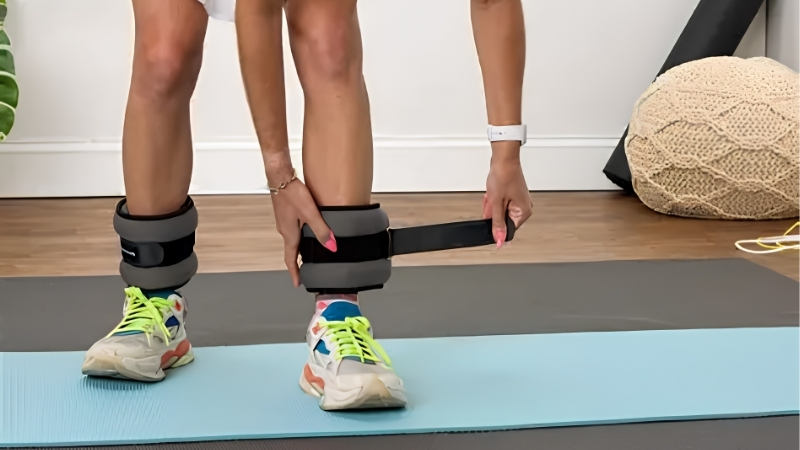
Load Per Ankle and Increment Size
The best rated ankle weights are frequently light ones, because light cuffs are comfortable and comfortable products collect good reviews. That is fine if the job is walking or Pilates. It is a problem if you intend to load hip abduction or step-ups, where 2.5 lb (1.1 kg) stops being a stimulus quickly.
Check whether the headline figure is per ankle or per pair, then check the increment. Fixed cuffs give you exactly one load. Bar-loaded designs move in 0.5-1 lb (0.23-0.45 kg) steps up to 10 or 20 lb (4.5 or 9 kg) per ankle, which is the only way to run genuine progressive overload on the lower leg.
Bulk, Fit Range and Storage Footprint
Footprint on the best rated ankle weights means how far the cuff stands off the leg. Slim silicone designs sit within about 0.5 in (13 mm) of the bone; a heavier sand-filled cuff can stand 1.5-2 in (4-5 cm) proud, which is enough to clip the opposite ankle during lunges and to make trousers impossible.
Strap range is the other sizing number. Most cuffs are designed for ankle circumferences of roughly 8-16 in (20-40 cm) and the hook-and-loop overlap runs short at both ends of that band. Storage needs nothing more than a drawer, but measure your ankle over the sock you train in before you order.
How Often You Actually Need Them
The World Health Organization recommends adults accumulate 150 to 300 minutes of moderate-intensity aerobic activity a week alongside muscle-strengthening work on two or more days, guidance published by WHO in 2020 and mirrored by the US Physical Activity Guidelines for Americans, second edition, 2018.
Ankle weights are useful mainly because they attach to activity you are already doing. A weighted walk, or a set of standing hip abductions while the kettle boils, removes the travel time that stops most people reaching that second resistance session, which is a scheduling barrier far more often than a motivation one.
That is a logistics argument rather than a health claim. Adding mass at the end of a long lever changes how force passes through the knee and the hip, so if you have existing joint pain, a previous injury or any medical condition, speak to a doctor or a certified trainer before starting.
Top Picks: 6 Ankle Weight Sets Worth the Rating
These six cover the practical range from 1 lb (0.45 kg) silicone bangles to bar-loaded cuffs reaching 20 lb (9 kg) per ankle. The best rated ankle weights in each tier are listed with their real drawback attached, because every one of these designs trades something away to be good at its job.
| Model | Construction | Load Style | Profile Off the Leg | First Thing to Fail |
|---|---|---|---|---|
| All Pro Adjustable | Steel bars in a cuff | 0.5 lb steps to 20 lb (9 kg) | Bulky | Bar rattle if not re-seated |
| Bala Bangles | Silicone over steel | Fixed 1-2 lb (0.45-0.9 kg) | Very slim | Strap length on wide ankles |
| Sportneer Adjustable | Removable sand packets | Coarse steps | Tall on the leg | Empty pockets bunching |
| Henkelion Ankle Weights | Neoprene, iron sand | Fixed 1-3 lb (0.45-1.36 kg) | Moderate | Hook-and-loop grip |
| ProsourceFit Ankle Weights | Neoprene, sand filled | Fixed, quoted per pair | Moderate | Seam stitching |
| Nordic Lifting | Denser neoprene | Mid to heavy fixed | Bulky when heavy | Strap edge wear |
All Pro Adjustable Ankle Weights
The only design here that grows with you. Individual steel bars slide in and out of the cuff, so load moves in 0.5-1 lb (0.23-0.45 kg) steps up to the ceiling of whichever model you buy, whether that is 5 lb (2.3 kg), 10 lb (4.5 kg) or 20 lb (9 kg) on each ankle rather than per pair.
It is the bulkiest option and several times the price of a neoprene pair. The bars need occasional re-seating so nothing rattles at speed, and the width rules out wearing them under clothing. Buy it if progression is the point, and ignore it entirely if you only want a little load for walking.
Bala Bangles
Silicone-wrapped steel in 1 lb (0.45 kg) and 2 lb (0.9 kg) versions, sitting closer to the bone than anything else on this list. They clear shoe collars, do not clack together during lunges, and wipe clean rather than soaking up sweat, which is the main reason neoprene cuffs eventually start to smell.
Two fixed weights and no route to progression is the trade, at a price several times a basic cuff. The band is short, so very slim or very broad ankles can struggle for a secure wrap. Excellent for walking and floor work, and clearly the wrong tool for loaded hip or hamstring training.
Sportneer Adjustable Ankle Weights
A middle path between fixed and fully adjustable. Iron-sand packets pull out of pockets in the cuff, so a lighter session does not require a second pair, and the padding is thicker than most budget neoprene. The strap runs long, which helps considerably if standard cuffs finish short on your ankle.
The steps are coarse next to a bar-loaded system, and every removed packet leaves an empty pocket that bunches under the strap. The cuff sits tall on the leg, which some people find intrusive on longer walks. A fair compromise if you want flexibility without the bulk and cost of steel bars.
Henkelion Ankle Weights
The value benchmark and a sensible first pair. Neoprene cuffs with iron-sand filling, options running from about 1 lb (0.45 kg) to 3 lb (1.36 kg) each, a long hook-and-loop strap that fits most ankles, and on some versions a thumb hole so that the same cuff can double as a wrist weight.
Sand shifts inside the cuff, so the load is never distributed perfectly evenly, and a seam failure after a year of heavy use puts grit on the floor. The fastening loses grip once it picks up lint from the wash. At this price they are best treated as a consumable rather than a lifetime buy.
ProsourceFit Ankle Weights
Straightforward sand-filled neoprene in a range of fixed pair weights, with a wide strap and enough padding to stay comfortable through a long floor session. It is the sort of set people buy when they want a known light load for rehabilitation-style movement and have no interest in adjustability.
Because the sizes are quoted per pair, a set that sounds substantial can be modest on each leg, so read the specification carefully. Stitching at the strap ends is the usual failure point, and sand-filled cuffs of any brand slowly lose their shape once the filling settles into one end.
Nordic Lifting Ankle Weights
The mid-tier choice for someone who already knows the load they want. Denser neoprene, tighter stitching and a wider strap than the budget tier, aimed squarely at people who are never going to adjust anything and simply want the cuff to survive several years of consistent weekly use.
Fixed load is still the drawback, and the heavier options are bulky enough around the joint to interfere with lunges and lateral movement. As with every ankle weight, do not run in them: added mass on a long lever alters gait and changes loading at the knee and hip on every foot strike.
Frequently Asked Questions
Most of the confusion around the best rated ankle weights comes from three things: whether the quoted figure is per leg, whether the cuff will actually fit, and how much load is sensible to add. These four answers deal with each, plus the durability question that reviews rarely cover honestly.
Do higher star ratings mean better ankle weights?
Not reliably. Ratings skew towards light, comfortable cuffs bought for walking, because those satisfy expectations immediately. Heavier and adjustable sets attract more criticism for bulk and price even when the construction is better. Read the one and two star reviews for failure modes, not the overall average for quality.
How much weight should I start with?
For standing hip and glute work, 1-2 lb (0.45-0.9 kg) per ankle is a normal starting point and 5 lb (2.3 kg) is already substantial at the end of a long lever. Add load only when the movement stays controlled through the full range. If any joint complains, stop and speak to a qualified professional.
Will ankle weights fit over shoes or under trousers?
Slim silicone designs fit under most trousers and sit above the shoe collar without interference. Sand-filled cuffs standing 1.5-2 in (4-5 cm) proud will not go under fitted clothing and can catch the opposite leg during lunges. Check the ankle circumference range on the listing before ordering rather than after.
How long should a set last?
Budget sand-filled cuffs used a few times a week typically give one to three years before the fastening or the seams give up. Silicone and bar-loaded designs last longer because there is no filling to migrate and no fabric seam under load. Sweat, not weight, is what shortens the life of neoprene.
See More:
- Best home pull-up bar
- Best at home pull up bar
- Best in house pull up bar
- Best rated ab roller
- Best home workout equipment budget
Final Thoughts
The best rated ankle weights for you depend on whether you need load or comfort. For walking, yoga and floor work, a light silicone or soft neoprene pair is sufficient. For progressive hip and glute work, only a bar-loaded set keeps working as you get stronger. Check per ankle versus per pair.


Write Your Review
No reviews yet. Be the first to share your experience!