
Key takeaways
- Confusing bar weight with plate weight: A “100-pound set” may include the bar, so calculate the actual plate total.
- Buying a full-size bar for a narrow room: Measure the bar and add clearance at both ends before purchasing.
- Choosing plates by diameter alone: Thickness determines how many plates fit on the sleeves. Compare both dimensions.
- Using a 1-inch plate on an Olympic bar: The holes are different sizes and are not interchangeable without an adapter.
- Skipping small plates: Pairs of 2.5- and 5-pound plates allow manageable progress, especially for presses and curls.
- Ignoring storage: Plates left on the floor create a trip hazard and make a small room feel significantly smaller.
- Assuming more weight is always better: A 100-pound set that fits your room and supports consistent training is more useful than a 260-pound set you cannot safely store.
What's inside
The Short Answer
For most home lifters, a 100-pound barbell set is the best starting point. It usually includes a 45-pound Olympic bar and 55 pounds of plates, or a lighter bar with enough plates for beginner strength training. Choose a 200- to 260-pound set if two people will use it, you already lift regularly, or you want room to progress without buying plates again soon.
If you are new to resistance training, start with the empty bar or approximately 20 to 65 pounds for movements such as squats, presses, and deadlifts. A standard Olympic bar weighs 45 pounds, while a shorter training bar may weigh 15 to 35 pounds. The correct starting load is one you can lift with controlled form for your planned repetitions, leaving approximately two or three good repetitions in reserve.
As an Amazon Associate we earn from qualifying purchases at no extra cost to you. Product prices and availability are accurate as of the date shown and are subject to change.


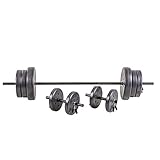
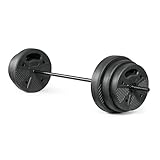
For a compact home gym, plan on 100 to 150 pounds of total weight. For a more versatile setup, 200 to 260 pounds is a practical range. Prices for basic home sets commonly run from about $80 to $260, depending on whether the package includes a bar, collars, iron plates, or bumper plates.
Standard Sizes
Barbell sets are sold in two main formats: standard bars with approximately 1-inch-diameter plate sleeves and Olympic bars with approximately 2-inch-diameter sleeves. Olympic equipment is generally the better long-term choice because plates are easier to find, the bars are stronger, and the load capacity is usually higher.
| Equipment | Typical dimensions | Metric dimensions | Typical weight | Best use |
|---|---|---|---|---|
| Olympic men’s bar | 86.6 in long; 28 to 29 mm diameter | 220 cm long; 2.8 to 2.9 cm diameter | 45 lb | Squats, presses, deadlifts, general lifting |
| Olympic women’s bar | 79.9 in long; 25 mm diameter | 203 cm long; 2.5 cm diameter | 33 lb | Smaller lifters and lighter training |
| Short Olympic bar | 47 to 72 in long; about 28 mm diameter | 119 to 183 cm long; about 2.8 cm diameter | 15 to 35 lb | Small rooms and moderate loads |
| Standard 1-inch bar | 5 to 6 ft long; about 1 in diameter | 152 to 183 cm long; about 2.5 cm diameter | 10 to 20 lb | Light home workouts |
| Olympic bumper plate | 17.7 in maximum diameter; 2 in center hole | 45 cm maximum diameter; 5 cm center hole | 10 to 55 lb | Deadlifts, Olympic lifts, quieter floors |
| Olympic iron plate | Approximately 10 to 17.7 in diameter; 2 in center hole | Approximately 25 to 45 cm diameter; 5 cm center hole | 2.5 to 45 lb | General strength training and compact storage |
| Barbell collar | Approximately 3 to 5 in long per collar | Approximately 8 to 13 cm long per collar | 1 to 5 lb per pair | Securing plates during lifts |
Plate dimensions vary by material and brand. Bumper plates are often the same 17.7-inch diameter at several weights, so a 10-pound bumper can be nearly as large as a 45-pound bumper. Iron plates are usually thinner, which lets you fit more weight on a bar. Check the manufacturer’s listed diameter and thickness if your storage rack or bar sleeve has limited space.
A 100-pound package does not always mean 100 pounds of plates. Some listings count the bar and collars in the total, while others advertise plate weight only. For example, an economy Olympic set near $100 may include a 45-pound bar and roughly 55 pounds of bumper plates. A 260-pound bumper set near $260 may provide enough plates for gradual progression, but the included bar and collars should still be confirmed before purchase.
How to Measure Your Space
- Measure the usable floor area. Record the clear length and width, excluding door swings, furniture, radiators, and low shelves. A basic barbell station needs at least 8 feet by 6 feet, or approximately 244 by 183 cm.
- Allow room for the bar. An 86.6-inch Olympic bar is longer than 7 feet. Leave at least 12 inches of clearance on each end, creating a recommended total width of about 9 feet, or 274 cm.
- Add lifting clearance. For squats, presses, and deadlifts, reserve roughly 3 feet of open space in front of and behind the bar. A 9-by-7-foot area is a more comfortable minimum for general lifting.
- Measure ceiling height. Overhead presses and squat-rack adjustments require extra clearance. A ceiling around 8 feet may work for a low rack, but 9 feet or more is easier for standing movements.
- Check the floor. A loaded bar can damage hard flooring and make noise. Use a lifting platform or rubber mats at least 3/8 inch thick, or approximately 10 mm. For repeated deadlifts, thicker tiles or a dedicated platform provide better protection.
- Plan storage space. A 260-pound set can occupy a vertical plate tree or several feet of wall-mounted storage. Leave space for plates to be lifted on and off the rack without hitting walls or furniture.
- Check the bar path. Make sure the bar can move vertically without striking a ceiling fan, light fixture, shelf, or garage-door hardware. Also measure the route from the delivery door to the training area.
By Room or Use Case
Bedroom or Small Apartment
Choose a short Olympic bar or a standard bar with 50 to 100 pounds of plates. A 47-inch threaded barbell set can fit more easily than a full-size bar, but it is generally intended for lighter loads and may not suit heavy squats or deadlifts. Keep the total setup close to 6 by 6 feet, or 183 by 183 cm, and use controlled lifts rather than dropping plates. Iron plates are usually thinner and easier to store, while bumper plates reduce impact noise but take up more room.
Garage Gym
A garage is usually the most practical location for a full-size 45-pound Olympic bar and a 200- to 260-pound plate set. Allow at least 9 by 7 feet for the barbell area and verify the ceiling height before buying a rack. A 100-pound set, such as an Olympic bumper package near $100, is adequate for beginners. If you plan to train for several years, a 260-pound set near $260 often offers better progression value than repeatedly adding small plates.
Shared Household Gym
For two users, buy at least 150 to 200 pounds of total plates, with pairs of 2.5-, 5-, 10-, and 25-pound plates. Matching pairs make it possible to load the bar evenly and adjust resistance in small steps. If users have different strength levels, consider a 33-pound women’s bar or a 15- to 20-pound training bar in addition to the standard 45-pound bar.
Beginner Strength Training
A 100-pound set is usually sufficient for the first stage of training. Look for a 45-pound bar plus plates that can be loaded in 2.5- or 5-pound increments. A set with a bar and plates priced around $95 to $110 may be a useful entry point, but inspect the stated bar weight, sleeve diameter, plate material, and maximum load before ordering.
Heavy Strength Training
Choose a full-size Olympic bar rated for the loads you expect to use, plus at least 260 pounds of plates. Competitive or advanced lifters may need 300 pounds or more. The bar’s load rating, sleeve length, knurling, and whip matter more than the package’s advertised total weight. Use a power rack, safety arms, collars, and appropriate flooring for heavy work.
Common Sizing Mistakes
- Confusing bar weight with plate weight: A “100-pound set” may include the bar, so calculate the actual plate total.
- Buying a full-size bar for a narrow room: Measure the bar and add clearance at both ends before purchasing.
- Choosing plates by diameter alone: Thickness determines how many plates fit on the sleeves. Compare both dimensions.
- Using a 1-inch plate on an Olympic bar: The holes are different sizes and are not interchangeable without an adapter.
- Skipping small plates: Pairs of 2.5- and 5-pound plates allow manageable progress, especially for presses and curls.
- Ignoring storage: Plates left on the floor create a trip hazard and make a small room feel significantly smaller.
- Assuming more weight is always better: A 100-pound set that fits your room and supports consistent training is more useful than a 260-pound set you cannot safely store.
FAQ
How much barbell weight do I need as a beginner?
Start with an empty 15- to 45-pound bar, depending on the bar type and exercise. A 100-pound total set gives most beginners enough room to progress through basic squats, presses, rows, and deadlifts. Add weight only when your form remains controlled.
Is a 100-pound barbell set enough?
It is enough for many beginners and for lighter home workouts. If the set includes a 45-pound bar, it may contain only 55 pounds of plates, which can become limiting for deadlifts and squats. A 200- to 260-pound set is more suitable for long-term, two-person, or advanced use.
Should I buy Olympic or standard-size weights?
Olympic equipment is usually the better investment for general strength training. The 2-inch sleeve standard is widely supported, and full-size bars are more stable under heavier loads. Standard 1-inch equipment can make sense when space, budget, or training loads are limited.
How much room do I need for a barbell?
For a full-size Olympic bar, plan on approximately 9 feet of width and 7 feet of depth, or 274 by 213 cm. A compact bar may work in a smaller area, but always include space to load plates, move safely, and keep the bar away from walls and fixtures. Check these measurements before ordering in 2026.


Write Your Review
No reviews yet. Be the first to share your experience!