
Key takeaways
- Table of Contents 7 sections 9 min read 1 Quick Verdict 2 Side by Side 3 Where Resistance Bands Wins 4 Where Free Weights Wins 5 Cost Over 5 Years 6 Which One for Your Home 6.1 Small apartment 6.2…
What's inside
The real choice in a home gym is not simply whether bands or weights build more muscle. It is whether your available space, budget, noise tolerance, and training habits match the equipment. Resistance bands can fit in a drawer and cost less than a single adjustable dumbbell. Free weights offer more predictable loading and a familiar path for progressive strength training, but they take up more room and demand more care around floors, children, and pets.
Both can support full-body workouts in 2026. The better purchase depends on how heavily you plan to train, how often you will use the equipment, and whether you need a setup that disappears when the workout ends.
As an Amazon Associate we earn from qualifying purchases at no extra cost to you. Product prices and availability are accurate as of the date shown and are subject to change.


Quick Verdict
Choose resistance bands if you want the lowest-cost, quietest, most portable option for general strength, mobility, physical therapy, travel, or a small apartment. A basic set can cost about $15 to $40, weigh less than 5 pounds, and provide enough resistance for rows, presses, squats, curls, lateral walks, and assisted pull-ups.
Choose free weights if your priority is measurable strength progression, heavier lower-body training, or a traditional weightlifting experience. Dumbbells and adjustable sets typically cost more and require a dedicated storage spot, but they provide consistent resistance and are easier to load in precise increments.
For many homes, the best answer is a combination: bands for warmups, mobility, travel, and accessory exercises, plus adjustable dumbbells for major lifts.
Side by Side
| Factor | Resistance bands | Free weights |
|---|---|---|
| Comfort | Gentle on joints, though handles can pinch and thick bands may rub skin | Comfortable with a good grip; heavier loads can stress wrists, shoulders, and joints |
| Durability | Usually lasts 1 to 5 years depending on material, sunlight, stretching, and storage | Metal and cast iron can last decades; rubber coatings and grips may wear sooner |
| Price range | About $15 to $80 for common home sets | About $50 to $500 or more, depending on weight and storage |
| Maintenance | Wipe clean, inspect for cracks, and store away from heat and sunlight | Keep dry, tighten adjustable collars, and protect floors from impact |
| Space needed | Roughly the size of a drawer; anchor points may require additional clearance | About 6 to 15 square feet for a set and rack, plus workout clearance |
| Look | Compact and colorful, but can look like therapy equipment | More substantial gym appearance; racks can become visible furniture |
| Resale | Low resale value, especially for stretched or worn latex | Good resale value when plates, handles, and coatings are in good condition |
| Best for | Beginners, small spaces, mobility, travel, rehabilitation, and general fitness | Progressive strength, muscle building, heavy squats, presses, and deadlifts |
| Noise and floor risk | Very quiet and unlikely to damage flooring when used correctly | Can clang or thud; dropped weights can damage floors and furniture |
Where Resistance Bands Wins
Space efficiency is the biggest advantage. A set of loop and tube bands can fit in a closet, under a sofa, or inside a small storage bin. A 5-Level Resistance Bands for Working Out, Pull Up Assistance Bands set costs $16.99 and illustrates how little equipment is needed to create several resistance levels. A set with a door anchor and handles can still occupy less space than one pair of fixed dumbbells.
Bands are also easier to use in shared spaces. They do not require a rack, bench, or thick rubber flooring, and most movements are quiet enough for an upstairs apartment. That matters if you exercise early in the morning or live below another household.
They are particularly useful for movements where increasing stability and control matter more than moving maximal weight. Rows, face pulls, pull-aparts, external rotations, glute bridges, lateral walks, and arm exercises all work well with bands. The variable resistance can also make the end of a pressing or pulling motion more challenging as the band stretches.
Portability is another clear win. A Pull Up Bands, Resistance Bands Set, Exercise Workout Bands for Men & Women, listed at $22.49, can support warmups, stretching, muscle training, and assisted pull-ups without adding meaningful luggage weight. Bands are useful for hotel rooms, office breaks, and vacations where bringing metal weights is impractical.
They are not maintenance-free, however. Latex can weaken from ultraviolet light, heat, moisture, and repeated sharp bending. Inspect bands before every demanding exercise. Do not use one with a split, bubble, deep nick, or damaged anchor point, and avoid anchoring a band to a door or railing that has not been checked for stability.
Where Free Weights Wins
Free weights provide a clearer route to progressive overload. You can move from a 10-pound dumbbell to a 12.5- or 15-pound dumbbell and track the change precisely. With bands, the stated resistance is often an approximate maximum or depends on how far the band is stretched, where you hold it, and your body position.
That predictability is valuable for compound movements. Dumbbells make it easier to progressively load goblet squats, Romanian deadlifts, bench presses, overhead presses, rows, lunges, and farmer carries. They also provide a consistent feel from repetition to repetition, which many lifters prefer for building strength and muscle.
Free weights generally have a longer service life. A cast-iron plate or solid metal handle can remain useful for decades, while rubber coverings may develop odor, scuffs, or surface damage. The tradeoff is size. A basic adjustable set may fit in a corner, but a collection of fixed dumbbells quickly needs a rack.
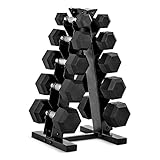
An FDS1 Adjustable dumbbell set, listed at $67.99 and designed as a 45-pound set with multiple configurations, shows why adjustable equipment appeals to space-conscious buyers who still want weight-based training. At the other end, a CAP 150lb Rubber Hex Dumbbell Set with a chrome grip and black A-frame storage rack costs $189.99 and requires a more permanent footprint. Neither price includes a bench or protective floor covering.
Cost Over 5 Years
For a realistic five-year comparison, assume three workouts per week and normal home use. A basic resistance-band setup costs approximately $20 to $50 initially. Replacing one worn band during five years might bring the total to $35 to $90. Higher-quality fabric loops, multiple tube handles, door anchors, and specialty pull-up bands can raise the five-year total to about $80 to $180.
Free weights have a wider range. A small adjustable dumbbell set may cost $60 to $150 upfront and require little replacement, producing a five-year total of roughly $70 to $180. A larger set with 100 to 150 pounds of dumbbells and a rack commonly costs $180 to $600, with a five-year total of about $200 to $650. Floor mats may add $30 to $150, depending on the room and the amount of protection needed.
Free weights can retain more resale value, particularly recognizable sets in good condition. Bands are cheaper to replace but generally have little resale value once opened or visibly stretched. If your budget is under $50, bands offer the more complete solution. If you can spend $100 to $250 and have room to store equipment, adjustable weights offer more long-term loading potential.
Which One for Your Home
Small apartment
Start with bands unless you already know you need heavy resistance. They store in a bin measuring roughly 12 by 8 by 6 inches, create little noise, and will not crowd a living room. If strength training is a major goal, pair them with adjustable dumbbells rather than a full fixed-weight collection. Leave at least 6 feet by 6 feet of clear floor space for safe movement, even with compact equipment.
Family with kids or pets
Bands are easier to conceal and less likely to cause damage if accidentally knocked over, but they can snap back if misused and should never be left stretched or attached unattended. Free weights should be stored on a stable rack or in a locked room. Avoid leaving plates on the floor where small children can reach them or pets can move them. In this setting, storage and supervision matter more than the equipment category.
Rental
Resistance bands are usually the safest rental-friendly choice because they do not require drilling, heavy floor protection, or loud dropping. Use a removable door anchor only according to its instructions and close the door in the direction that keeps the anchor secure. For free weights, choose rubber-coated or adjustable dumbbells, add a dense exercise mat, and never drop a lift.
Long-term home
If you have a dedicated room and expect to train for years, free weights offer the stronger foundation. A 100- to 150-pound dumbbell setup can support progressive training for many users, while bands fill gaps for warmups, mobility, and smaller muscle groups. Build storage into the room from the start and leave enough clearance to set down weights safely.
FAQ
Are resistance bands as effective as free weights?
They can be effective for improving strength, coordination, and muscular endurance, especially for beginners and accessory exercises. Free weights usually make it easier to measure and increase load, particularly for heavy lower-body and compound lifts. Consistent training matters more than choosing the more expensive option.
Can resistance bands build muscle?
Yes. Bands can build muscle when an exercise is challenging, performed through a useful range of motion, and progressed over time. Progress may mean using a thicker band, increasing stretch, adding repetitions, slowing the tempo, or reducing rest. For advanced lifters, bands alone may not provide enough resistance for every major movement.
Which is safer for beginners?
Either can be safe with controlled form. Bands reduce the risk of dropping a heavy object, but they need regular inspection and secure anchoring. Free weights provide straightforward loading but require attention to balance, lifting technique, and storage. Beginners should start with light resistance and avoid training to failure without a clear, safe setup.
Should I buy bands or dumbbells first?
Buy bands first if space, noise, portability, or budget is your main concern. Buy adjustable dumbbells first if your priority is measurable strength progression and you have a stable storage area. If your budget allows, a modest band set plus adjustable dumbbells covers more exercises than either option alone.


Write Your Review
No reviews yet. Be the first to share your experience!