
Our Top Picks
 Amazon Basics Heavy-Duty Slam Medicine Balls for Exercise20lb9.3 x 9.3 x 0.8 inches20 PoundsCheck on Amazon
The best slam balls for most home gyms are low-bounce rubber balls in the 10–20 lb range, while commercial facilities usually benefit from a broader 6–50 lb set with thick shells, reinforced seams, and consistent diameters.
A slam ball is built to absorb repeated impacts rather than rebound like a basketball or medicine ball. The right choice depends less on the logo than on five practical details: weight progression, shell construction, diameter, bounce resistance, and how well the seams tolerate repeated drops onto your particular floor.

ProsourceFit Slam Medicine Ball, Tread Textured Grip Dead Weight Balls for Strength and Conditioning Exercises, Cardio and Core Workouts, 15lb, Black
Chosen because it specifies Cardio and Core Workouts and 15lb.
View on Amazon
MARCY 35 lb Slam Ball Dead Weight, Sand-Filled Medicine Ball with Durable PVC Shell & Textured Grip – Non-Bounce Workout Ball for Slams, Tosses, Core & Full Body Training MCSB-035
Chosen because it specifies Non-Bounce Workout Ball for Slams and Tosses.
View on AmazonAmazon Basics Heavy-Duty Slam Medicine Balls for Exercise, Weighted Design, 20lb, Black, 2-Pack
Chosen because it specifies Weighted Design and 20lb.
View on Amazon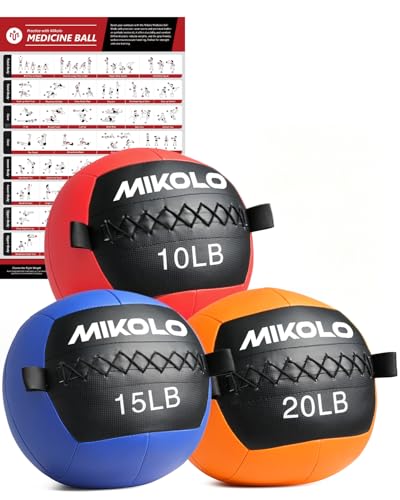
Mikolo Medicine Ball, Wall Ball,Soft Medicine Ball Set,Slam Ball for Core Training, Strength Workouts -Multi-Weight 10lbs 20lbs Exercise Balls for Home Gym, Functional Fitness (10/15/20LB)
Chosen because it specifies Wall Ball and Soft Medicine Ball Set.
View on AmazonBest slam balls by training situation
| Training situation | Recommended weight range | Best construction | Why it fits |
|---|---|---|---|
| First slam ball for a home gym | 10–15 lb | Textured rubber, low bounce | Manageable for overhead slams, rotational throws, and conditioning |
| Experienced athlete or power-focused training | 15–30 lb | Heavy-duty rubber with reinforced seams | Provides resistance without becoming too large to control |
| Small room, apartment, or hard floor | 6–12 lb | Dead-bounce shell, compact diameter | Reduces unpredictable rebounds and limits impact load |
| High-volume commercial gym | 10–50 lb set | Thick rubber or rugged PVC, welded or heavily stitched seams | Handles many users, frequent drops, and varied exercise selection |
| Partner chest passes and wall work | 6–15 lb | Slightly resilient medicine-ball style shell | More comfortable to catch than a completely dead slam ball |
Our category picks for the best slam balls
Best overall: a 10–15 lb textured rubber slam ball
For most people, this is the most useful starting point. A rubber shell with a pebbled or textured finish is easier to grip with sweaty hands, and a dead-bounce design stays near the impact point instead of ricocheting across the room. Choose 10 lb if you are new to loaded explosive movement, or 15 lb if you already perform kettlebell swings, dumbbell lifts, or medicine-ball work comfortably.
Rogue Ballistic Rubber Slam Balls are a prominent example of this category. They are intended for repeated slams and are available across a range of weights, making it easier to add a second ball later rather than replacing the first one.
Best for heavy power work: a 20–30 lb heavy slam ball
Heavy balls are useful for slow, forceful slams, loaded carries, and controlled rotational work. They are not automatically better for explosive training: if the ball slows your movement, changes your posture, or forces you to catch it awkwardly, it is too heavy for that exercise.
Look for a relatively compact diameter, a thick rubber exterior, and a shell that does not feel soft or hollow when squeezed. Heavy slam balls from established strength-equipment ranges, including Rogue and Titan Fitness, are common choices in this category. Check the manufacturer’s intended use before buying; a heavy ball designed only for slamming may not be suitable for repeated catching or wall throws.
Best budget choice: a basic low-bounce rubber ball
A budget slam ball can perform well when its shell is thick enough and its seams are cleanly finished. The main compromise is usually less consistent sizing, a narrower weight range, or a surface that becomes slicker with sweat. For occasional home workouts, a 10 or 12 lb ball in the general market range of roughly $25–$50 is often sufficient.
Inspect the ball before use. Avoid examples with a visible seam ridge, loose thread, deep molding line, or soft spot near the valve. A lower price is not a saving if the ball fails after a few weeks of frequent impacts.
Best for a commercial gym: a complete weight set
A facility needs progression more than a single heavy ball. A practical set might include 6, 8, 10, 12, 15, 20, 25, and 30 lb balls, with optional 40 and 50 lb sizes for advanced users. This supports beginner technique, group classes, conditioning circuits, and heavier strength-endurance work without forcing everyone to use the same load.
Commercial buyers should prioritize replaceable inventory and consistent dimensions. A set whose 10 lb balls differ noticeably in diameter can make storage and programming less predictable. Heavy-duty rubber or rugged PVC shells are preferable to soft vinyl when the equipment will be dropped hundreds of times per week.
What the specifications mean in practice
Weight
Weight controls how quickly the ball can be accelerated and how safely it can be stopped. For overhead slams, begin with a load you can raise without leaning backward. For rotational slams, use a lighter ball because the leverage increases as the ball moves away from your center.
A useful progression is to increase weight only after you can complete every repetition with the same speed and body position. Moving from 10 to 20 lb is a 100% load increase, not a small upgrade. A 12 to 15 lb step is usually easier to manage.
Shell material
- Thick rubber: Usually the best all-purpose option. It grips well, resists abrasion, and handles repeated drops on appropriate flooring.
- Rugged PVC: Can offer a durable, slightly more uniform shell and is common in commercial-style equipment. Texture and seam quality vary by model.
- Soft vinyl: Comfortable and sometimes inexpensive, but more vulnerable to cuts, scuffs, and deformation when slammed onto rough surfaces.
Material alone does not determine durability. A thick shell with a poorly finished seam can fail sooner than a thinner-looking ball with better molding and reinforcement.
Diameter
Many slam balls fall roughly between 9 and 14 inches in diameter, with heavier balls generally becoming larger. A compact ball is easier to hold overhead and may be preferable in a small room. A larger ball can distribute impact across more surface area and may feel more comfortable for chest passes, but it also requires more control.
For home use, measure the ceiling and clear space before choosing a heavy ball. You need room to raise the ball without touching a light fixture, and enough lateral clearance that a missed catch does not strike shelving or a wall-mounted screen.
Bounce resistance
“Dead bounce” is a safety and workflow feature, not merely a marketing phrase. A low-rebound ball stays close after impact, reducing the chance that it will roll under equipment or rebound toward another person. Completely dead balls are ideal for floor slams; slightly resilient balls are often better for partner drills and wall throws.
Do not substitute a basketball, standard medicine ball, or inflated fitness ball. Those products are designed to rebound, absorb catches, or support body weight, not to tolerate repeated forceful impacts against the floor.
Seam durability
The seam is often the first area to inspect and one of the first areas to wear. Look for a smooth, continuous join without gaps, raised sharp edges, exposed fabric, or glue residue. On stitched models, tight and even stitching matters. On molded rubber models, a clean seam with no deep flashing is preferable.
Match the ball to your floor
| Floor type | Recommended ball | Additional protection | Avoid |
|---|---|---|---|
| Rubber gym flooring, 8–12 mm | Most low-bounce rubber slam balls | Keep grit swept away | Using a ball with exposed seams |
| Concrete | Heavy-duty rubber, lighter weights initially | Thick impact mat rated for dropping equipment | Direct repeated slams without a mat |
| Wood or laminate | Low-bounce ball, usually 6–15 lb | Large dense rubber lifting mat | Hard, heavy slams onto unprotected flooring |
| Outdoor asphalt | Rugged rubber only | Use a clean, smooth section | Soft vinyl shells and sharp gravel |
A mat protects both the floor and the shell, but it does not make every ball suitable for every surface. Rough concrete and asphalt can abrade rubber quickly, especially around seams.
How much ball do you need?
For a single-user home gym, one 10–15 lb ball covers most general conditioning. Add a 6–8 lb ball if you want faster rotational work, or a 20–25 lb ball for controlled strength-focused slams. Buying three carefully spaced weights is usually more useful than buying one very heavy ball.
For example, a 10 lb, 15 lb, and 25 lb setup gives 50 lb of equipment across three movement demands: speed, moderate power, and heavy resistance. If each ball costs approximately $35–$80, the initial range is about $105–$240. That is often better value than purchasing a single 30 or 40 lb ball that only suits a narrow selection of exercises.
Maintenance and common mistakes
- Wipe the shell after sweaty sessions. Use a damp cloth and mild soap, then dry it fully. Sweat and grit can make the surface slippery and accelerate seam wear.
- Check the seam weekly. Look for splitting, bulging, cuts, or a new soft spot. Retire the ball if the shell is opening or the filler is shifting.
- Store it off abrasive surfaces. A rack, shelf, or clean rubber mat is better than a concrete corner or outdoor gravel.
- Do not overinflate it. Most slam balls are not user-inflated. If a ball has a valve, follow its specific instructions rather than treating it like a basketball.
- Do not slam beyond your space. A ball that repeatedly contacts walls, racks, or sharp edges will wear faster and may rebound unpredictably.
Final buying recommendation
Choose a 10–15 lb low-bounce rubber slam ball with a textured exterior and clean, reinforced seams for the best balance of speed, durability, and versatility. Move to a 20–30 lb model only when your technique remains controlled with lighter weights. Commercial gyms should buy a graduated set and prioritize consistent diameters, heavy-duty shells, and replacement availability over decorative features or the lowest sticker price.
Write Your Review
No reviews yet. Be the first to share your experience!