
Our Top Picks
 CAP Barbell Olympic Hex / Trap /Shrug /DeadliftCombo Grips55.71 x 24.61 x 4.72 Inches52 PoundsCheck on Amazon
The best trap bars are the ones that fit your body, plates, and storage space—not necessarily the heaviest-duty model or the one with the most attachments. For most home gyms, start by comparing handle height, inside frame clearance, sleeve length, and overall dimensions; then check capacity, steel construction, and whether the bar can be stored safely between sessions.
Best trap bars by situation
- Best for a compact home gym: A rackable open-frame bar with short sleeves and a footprint that fits your lifting area. Check its full length and width, not just whether the maker calls it “compact.”
- Best for beginners or general strength training: A standard hex bar with both raised and low handles. Raised handles shorten the range of motion; low handles offer a longer pull when your mobility and technique allow.
- Best for frequent, heavy lifting: A sturdy, closed-frame bar with a clearly stated load capacity, durable sleeves, and a finish suited to your storage conditions.
- Best for varied exercises: An open-frame model with a removable or included handle system. The extra access can help with carries and stepping into the bar, but the design may cost more and require more storage space.
- Best on a tight budget: A basic closed hex bar with fixed handles, standard Olympic sleeves, and a capacity appropriate for your planned loads. Skip attachments you are unlikely to use.
Compare the details that affect fit and use
Specifications are not perfectly standardized: makers may measure the frame, handles, or capacity differently. Treat the figures below as common product ranges, not promises about every bar. Verify the exact model’s manual and dimensions before buying.
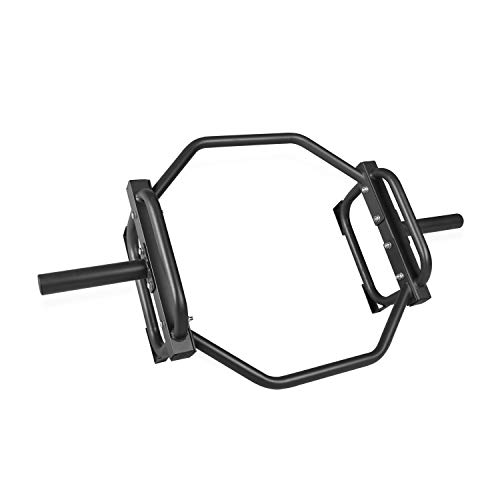
CAP Olympic Trap and Shrug Bar, Elevated Grip, Black, 500lb Capacity
Chosen because it specifies Elevated Grip and Black.
View on AmazonCAP Barbell Olympic Hex / Trap /Shrug /Deadlift Bar with Combo Grips, Black - New Version (OBIS-89HB)
Chosen because it specifies Black and New Version (OBIS-89HB).
View on Amazon
VEVOR Trap Bar Hex Bar, Open-Ended Frame Hex Barbell, 2-Inch 800 LBS Capacity Shrug Bars with Knurled Grips, Weightlifting and Strength Training Equipment, Home Gym for Squats Deadlifts Shoulder Press
Chosen because it specifies Open-Ended Frame Hex Barbell and 2-Inch 800 LBS Capacity Shrug Bars with Knurled Grips.
View on Amazon
CAP Olympic Trap Bar, Combo Grip, Chrome, 750lb Capacity
Chosen because it specifies Combo Grip and Chrome.
View on Amazon| Feature | Common range or format | Why it matters |
|---|---|---|
| Overall length | About 50–90 in (127–229 cm) | Determines whether the bar fits your lifting area or a power rack. Open-frame designs can be longer than compact hex bars. |
| Frame width | About 24–32 in (61–81 cm) | A wider frame may give more room for the body, but can be awkward in tight spaces or narrow rack uprights. |
| Handle height | Low handles often sit near the frame; raised handles commonly add about 2–4 in (5–10 cm) | Raised handles reduce the distance to the floor. Check whether the handles are reversible, removable, or fixed. |
| Steel and frame construction | Tube or solid steel; thickness commonly around 0.08–0.25 in (2–6 mm) for tubing | Tube dimensions and wall thickness affect stiffness, weight, and clearance. Thickness alone does not establish safe capacity. |
| Rated load capacity | Commonly 500–1,500 lb (227–680 kg), depending on design | Capacity is a manufacturer rating, not a substitute for sound construction or correct loading. Leave a margin above your intended working weight. |
| Usable sleeve length | Often about 9–16 in (23–41 cm) per side | Short sleeves may not fit enough plates for heavy lifts. Account for collars and the plate hub, not just the advertised sleeve length. |
| Inside frame clearance | Varies widely; check the maker’s stated inside width and length | Measure your stance and the room needed to step in and out. A bar can have adequate outside dimensions but cramped interior clearance. |
| Grip surface | Knurled, textured, or smooth handles; common handle diameters are about 25–32 mm | Coarse knurling improves grip but may be uncomfortable for high-repetition work. Smooth or rubber-coated grips can feel better but may be slippery when sweaty. |
How to choose the right dimensions
Match handle height to your training, not just your current lift
Raised handles are useful when you want a higher starting position or are learning the movement. Low handles allow a longer range of motion and can make the lift more demanding. A dual-handle bar offers both options, but confirm that the raised handles do not obstruct your stance and that the low handles are comfortable to reach.
Check clearance with plates loaded
Measure your available floor space, then compare it with the bar’s full length and width. Also check the distance between the handles and the inside of the frame. If you plan to use large-diameter plates, confirm they will not hit the frame or floor before the bar reaches the intended position. Plate size, handle height, and frame clearance work together; a single “fits Olympic plates” claim does not answer all three questions.
Calculate whether the sleeves fit your plates
Estimate the space needed using the plate thickness printed by its manufacturer. For example, if each side of your planned load uses three plates that are 2 inches thick, that is 6 inches of plate width per sleeve. Add room for the collar and a small loading margin, then compare the total with the usable sleeve length. Bumper plates can be thicker than iron plates at the same weight, so a bar that works for a heavy iron setup may run out of sleeve space with bumpers.
Steel, capacity, knurling, and ownership trade-offs
A high load rating is helpful only when it is clear what the rating means. Look for a stated maximum capacity, construction details, and a warranty; be cautious about comparing ratings when one maker provides a tested limit and another gives no explanation. For regular heavy use, avoid choosing a bar whose rating is only slightly above your planned maximum.
Frame material and geometry matter more than a wall-thickness number in isolation. A thicker tube can add weight without guaranteeing better welds or less flex. Consider the complete construction, including welds, handle attachment, sleeves, and manufacturer support. A heavy bar may feel reassuring, but it is harder to move and store.
Knurling is a preference as well as a grip feature. Fine or moderate knurling can be more comfortable for repeated sets, while aggressive knurling may feel secure but irritate hands during carries. If you train in a shared space, textured handles can be a practical middle ground. Rubber-coated handles can wear or become slick; inspect them periodically.
In ordinary use, inspect welds, sleeves, and removable-handle bolts for looseness or damage. Wipe sweat and chalk residue from the bar, and keep bare steel dry to limit corrosion. Store the bar where it cannot roll, tip, or obstruct a walkway. Open-frame bars are easier to step into, but their shape can take up more floor space; closed bars are often simpler to lean or rack, provided the manufacturer permits that storage method.
Quick decision matrix
| Your situation | Look for | Trade-off to expect |
|---|---|---|
| New lifter, occasional sessions | Dual-height handles, moderate knurling, clear capacity rating | A basic model may not offer rackability or long sleeves. |
| Small room or shared gym | Compact length, manageable bar weight, storage-compatible frame | Shorter sleeves can limit plate loading. |
| Frequent heavy training | Capacity well above planned loads, robust construction, sufficient sleeve length | Expect more weight, higher cost, and greater storage demands. |
| Carries and varied movements | Open frame, comfortable handles, ample inside clearance | May be longer or less convenient to store. |
Price and final buying checklist
As a broad 2026 market guide, basic trap bars often fall around $100–$250, midrange models around $250–$500, and specialized or heavy-duty designs around $500–$1,000 or more. These are general ranges, not quotes; shipping and included attachments can change the total cost substantially.
Before ordering, verify the exact model’s overall dimensions, inside clearance, handle height, usable sleeve length, plate compatibility, capacity, and storage requirements. If you have access to a rack, confirm the bar’s rackable dimensions rather than assuming it will fit. The best trap bars are the ones that accommodate your intended lifts and plates while leaving enough room to load, use, and store the bar safely.
Write Your Review
No reviews yet. Be the first to share your experience!