
Key takeaways
- Measuring only the cushion: The feet, rear stabilizer, adjustment rails, and leg rollers may add several inches.
- Ignoring the raised backrest: An incline position can bring your head closer to a wall or shelf and change the bench’s effective length.
- Forgetting storage height: A bench may fold in half but remain too tall for a closet or under-bed space.
- Using capacity as a quality score: A high advertised load rating does not tell you the pad width, frame stability, or folded dimensions.
- Leaving no exercise clearance: A bench that technically fits against a wall may be unusable when you need room to lift, stand, or retrieve weights.
- Overlooking floor protection: Bare flooring can slide under a lightweight bench. A suitable mat can improve grip, but it also adds a small amount of height.
What's inside
The Short Answer
For most apartments, the best weight bench dimensions for small spaces are about 43 to 51 inches long, 11 to 16 inches wide, and 17 to 20 inches high when set up. A foldable bench can shrink to roughly 30 to 36 inches long and 11 to 16 inches wide for storage, although the folded height varies considerably.
Allow more room than the bench itself. For safe dumbbell workouts, plan on a clear exercise area measuring at least 6 feet long by 5 feet wide (72 by 60 inches, or 183 by 152 cm). If you perform incline presses, overhead movements, step-ups, or exercises with resistance bands, a 7-by-6-foot area (84 by 72 inches, or 213 by 183 cm) is more comfortable.
As an Amazon Associate we earn from qualifying purchases at no extra cost to you. Product prices and availability are accurate as of the date shown and are subject to change.


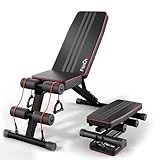
A compact bench does not have to be flimsy. Current home models commonly advertise weight capacities from 600 to 827 pounds (272 to 375 kg), including the user and lifted weight. Treat capacity as a ceiling, not a target, and check the manufacturer’s instructions before buying. Compact adjustable benches typically cost about $45 to $80, while heavier-duty or more fully featured models may cost more.
Standard Sizes
Bench measurements differ by brand, especially when a back pad is raised. The following ranges are practical planning numbers for home and apartment use. “Length in use” includes the back pad and seat in a flat position; “storage length” applies to a folded bench only.
| Bench measurement | Typical compact size | Roomier home-gym size | Small-space planning note |
|---|---|---|---|
| Length in use | 43–48 in (109–122 cm) | 49–56 in (124–142 cm) | Measure from the front foot to the rear support, not just the pad. |
| Width | 11–14 in (28–36 cm) | 14–18 in (36–46 cm) | Include the widest stabilizer bar or frame section. |
| Height, flat | 17–19 in (43–48 cm) | 18–21 in (46–53 cm) | A lower pad is generally easier to mount and store beneath shelves. |
| Length, folded | 30–36 in (76–91 cm) | 36–44 in (91–112 cm) | Confirm whether the seat folds or only the back support collapses. |
| Folded thickness or depth | 8–12 in (20–30 cm) | 10–18 in (25–46 cm) | Useful for closet, under-bed, or behind-door storage. |
| Bench weight | 20–35 lb (9–16 kg) | 35–55 lb (16–25 kg) | Lighter is easier to move; heavier frames usually feel more planted. |
For a small apartment, prioritize the assembled footprint and folded footprint together. A bench measuring 48 by 14 inches (122 by 36 cm) may fit beautifully in use but still be awkward if it folds into a tall, 45-inch (114-cm) package. Look for a transport handle, wheels, or a frame that can be carried without catching on furniture.
Adjustability also affects size. A flat bench has the simplest footprint. Incline and decline benches need room for the back support to rise and for your head and shoulders to clear nearby walls. Some compact benches include leg rollers or resistance-band anchors that extend beyond the main frame. Include those attachments in your measurement even if they are removable.
How to Measure Your Space
- Choose the storage location first. Measure the closet, under-bed opening, wall gap, or furniture space where the folded bench will live. Record width, height, and depth in inches and centimeters.
- Mark the footprint on the floor. Use painter’s tape to outline the bench’s maximum in-use length and width. Use the manufacturer’s largest dimensions if the back pad can incline or decline.
- Add a movement zone. Leave at least 12 inches (30 cm) beyond the bench on each side for repositioning. For dumbbell work, 18 to 24 inches (46 to 61 cm) is more comfortable.
- Check overhead clearance. Keep at least 12 inches (30 cm) between your hands and the ceiling, light fixtures, shelves, or a low fan during overhead presses. A ceiling height of 7 feet 6 inches (90 inches, or 229 cm) is usually workable for seated dumbbell movements, but your height and exercise determine the actual requirement.
- Measure the path into the room. Compare the folded bench’s largest dimension with doorways, stair turns, elevators, and hallways. A 30-inch (76-cm) doorway may not help if the bench must turn through a 26-inch (66-cm) corridor.
- Check the floor. Place the bench on a level, solid surface. A rubber mat can protect flooring, but include its thickness when checking whether the bench will slide under a bed or shelf.
- Plan for the weights. Dumbbells, plates, and a storage stand need their own area. Keep plates and adjustable dumbbells where they will not block the bench or create a tripping hazard.
By Room or Use Case
Bedroom
A bedroom often works best with a foldable bench measuring no more than 36 inches (91 cm) long when stored and 14 to 16 inches (36 to 41 cm) wide in use. Leave a clear route around the bed and avoid placing the bench where it blocks a closet, dresser drawer, or emergency exit. Behind a door can work if the folded bench is less than 8 to 10 inches (20 to 25 cm) deep and does not interfere with the door swing.
Living room
For shared spaces, choose a bench that looks manageable when folded and can be moved quickly. A 43-to-48-inch (109-to-122-cm) setup footprint is common for compact adjustable benches. Measure from the sofa, coffee table, and television console rather than measuring an empty section of floor. A bench weighing 20 to 30 pounds (9 to 14 kg) is easier to relocate between workouts, while a 40-pound-plus (18-kg-plus) bench may stay in one place more reliably.
Closet or utility room
Closet storage is practical when the folded depth is around 10 to 12 inches (25 to 30 cm). Check the folded height, too: some benches stand more than 36 inches (91 cm) tall and will not fit beneath a standard shelf. Keep the frame away from damp floors, cleaning chemicals, and hanging items that could fall onto the equipment.
Home office
An office can accommodate a compact bench if it is stored outside the chair’s rolling path. Plan for at least 60 by 72 inches (152 by 183 cm) of temporary exercise space if you will use dumbbells. Cable cords, desk legs, and floor mats can become obstacles, so clear them before each session.
Studio apartment
In a studio, prioritize a bench with a fast folding design, a carry handle, and a flat or nearly flat storage profile. Models marketed with capacities around 600 to 827 pounds (272 to 375 kg) commonly sell in the approximately $45-to-$80 range, but compare the actual folded dimensions and adjustment mechanism rather than choosing by capacity alone. A smaller pad may save space but feel less supportive during presses.
Common Sizing Mistakes
- Measuring only the cushion: The feet, rear stabilizer, adjustment rails, and leg rollers may add several inches.
- Ignoring the raised backrest: An incline position can bring your head closer to a wall or shelf and change the bench’s effective length.
- Forgetting storage height: A bench may fold in half but remain too tall for a closet or under-bed space.
- Using capacity as a quality score: A high advertised load rating does not tell you the pad width, frame stability, or folded dimensions.
- Leaving no exercise clearance: A bench that technically fits against a wall may be unusable when you need room to lift, stand, or retrieve weights.
- Overlooking floor protection: Bare flooring can slide under a lightweight bench. A suitable mat can improve grip, but it also adds a small amount of height.
FAQ
What is the smallest practical weight bench for an apartment?
A practical compact bench is about 43 inches long by 11 to 14 inches wide (109 cm long by 28 to 36 cm wide) when open. You still need approximately 6 by 5 feet (183 by 152 cm) of clear floor space for safe dumbbell movements. A shorter bench may limit support for taller users.
How much clearance should I leave around a weight bench?
Leave at least 12 inches (30 cm) on each side for access, and preferably 18 to 24 inches (46 to 61 cm) where you will pick up dumbbells or stand. Add overhead clearance for shoulder presses and other movements performed with your arms raised.
Are foldable weight benches stable?
Many foldable benches are suitable for home workouts when placed on a level surface and assembled correctly. Stability depends on the frame, feet, adjustment points, floor grip, and total load—not simply whether the bench folds. Check the stated user-plus-weight capacity and inspect the locking pins before every workout.
What bench dimensions suit a tall user?
A taller user may prefer a length of 50 to 56 inches (127 to 142 cm), a pad width of 12 to 16 inches (30 to 41 cm), and a flat height near 18 to 20 inches (46 to 51 cm). Compare the back-pad length with your torso and head position, especially when shopping for a compact bench in 2026. A very short bench can leave your head unsupported during presses.


Write Your Review
No reviews yet. Be the first to share your experience!