
Key takeaways
What's inside
Hot yoga mat best picks come down to a single question: does the surface still hold once sweat starts pooling on it? This guide compares six mats by thickness in mm, length in inches and centimetres, surface material and long-term wear, so you can match a mat to your floor, your height and how heavily you sweat.
As an Amazon Associate we earn from qualifying purchases at no extra cost to you. Product prices and availability are accurate as of the date shown and are subject to change.

#1 Pick

#2 Pick


#4 Pick

#5 Pick

#6 Pick


As an Amazon Associate we earn from qualifying purchases at no extra cost to you. Product prices and availability are accurate as of the date shown and are subject to change.
By Chris Parker
🛒 Best Price Today on Amazon
Prime members get fast, free shipping on everything above, plus member-only deals. New members get a 30-day free trial — cancel anytime.
How to Choose the Hot Yoga Mat Best Suited to Your Practice
A heated room changes the rules completely. A mat that feels secure at 70°F (21°C) can turn slick at 105°F (40°C) once palms and forearms are wet, so the three criteria below are ordered by what fails first in a real class: surface grip, then size, then how the mat wears over a year of use.
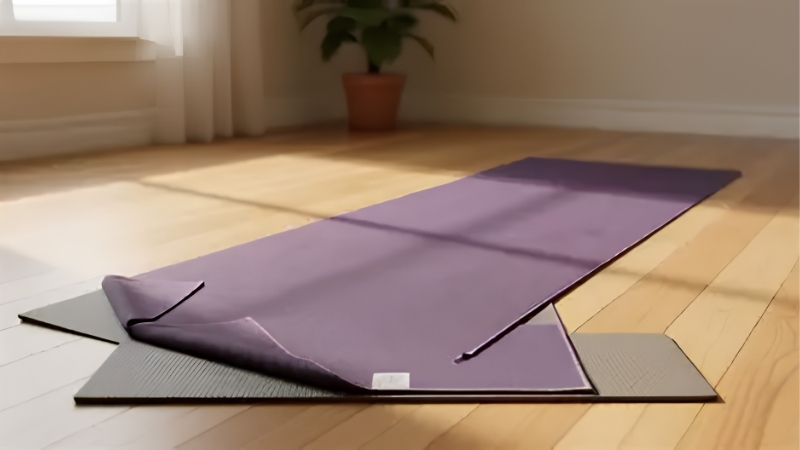
Surface Chemistry: Open-Cell vs Closed-Cell Grip
Closed-cell surfaces, used on PVC mats such as the Manduka PRO, seal moisture out entirely. Nothing soaks in, so the mat wipes clean in seconds and stays hygienic for years, but sweat sits on top of it and traction drops fast. These mats are engineered to be used with a towel, not for bare palms in a heated studio.
Open-cell surfaces, meaning natural rubber or polyurethane laminated over a rubber core, absorb a thin film of moisture and grip harder as you sweat. The trade-off is absorption: they need to dry fully after every class, they stain over time, and the hot yoga mat best matched to a heated room gets tackier rather than slicker at minute twenty.
Footprint: Mat Size, Roll Diameter and Floor Space
Most heated-room mats run 4 mm to 6 mm thick. The 68 in (173 cm) standard length leaves anyone over roughly 5 ft 10 in (178 cm) hanging off the end in savasana, so a 71 to 73 in (180 to 185 cm) mat is the safer buy, and 26 to 27 in (66 to 68 cm) of width keeps wide stances on the surface.
The mat also needs more room than its own dimensions suggest. Plan on about 7 ft by 3 ft (213 x 91 cm) of clear floor plus an arm’s length either side for side plank. Rolled, a 5 mm mat is around 6 in (15 cm) across, so measure the actual space you intend to use before you order anything.
Durability, Odour and What the Market Now Offers
Natural rubber arrives with a strong smell that usually fades across one to three weeks of airing out of direct sun. Polyurethane tops barely smell but scuff, and PVC has neither problem, which is why several PVC mats carry lifetime warranties. Mid-tier is where hot yoga mat best value now sits.
Below that tier the compromises show quickly: thinner surface layers, shorter mats and grip that fades within months. For context on why a home mat earns its space, the World Health Organization’s 2020 guidelines recommend 150 to 300 minutes of moderate activity weekly plus two strengthening sessions. Check with a doctor before starting a new programme.
Top Picks: Hot Yoga Mat Best Buys for Heated Classes
The hot yoga mat best list below was selected for heated practice specifically, which means wet grip first and cushioning second. Dimensions and materials are manufacturer specifications, and cost is described as a tier rather than a number, because pricing in this category moves constantly across the year.
| Mat | Thickness | Size | Surface |
|---|---|---|---|
| Manduka PRO | 6 mm | 71 x 26 in (180 x 66 cm) | Closed-cell PVC |
| Lululemon The Reversible Mat 5mm | 5 mm | 71 x 26 in (180 x 66 cm) | PU over natural rubber |
| Jade Yoga Harmony | 3/16 in (~5 mm) | 68 or 74 in (173 / 188 cm) | Open-cell natural rubber |
| Liforme Original | 4.2 mm | 72.8 x 26.8 in (185 x 68 cm) | Eco-PU over rubber |
| Yoga Design Lab Combo | 5.5 mm | 70 x 24 in (178 x 61 cm) | Microfibre over rubber |
| Gaiam Dry-Grip | 5 mm | 68 x 24 in (173 x 61 cm) | Textured PVC |
Manduka PRO: Best for Hard Floors and Long-Term Use
Six millimetres of dense closed-cell PVC across a 71 x 26 in (180 x 66 cm) surface at roughly 7.5 lb (3.4 kg). Knees and elbows are genuinely protected on concrete or hardwood, the corners never curl after months of rolling, and the lifetime warranty on the mat itself is unusual in this category.
The honest limitation is bare-hand grip. Until the surface breaks in over several weeks it is slippery when wet, and most owners end up pairing it with a towel permanently. It is also the heaviest mat here, which is fine in a home corner but tiring on a daily walk to the studio.
Lululemon The Reversible Mat 5mm: Best Wet Grip Overall
A polyurethane face bonded to a natural rubber base, 5 mm thick, 71 x 26 in (180 x 66 cm), at around 5.2 lb (2.4 kg). The PU absorbs a thin film of sweat, so traction actually improves as the room heats up instead of disappearing halfway through a long standing sequence.
The drawbacks are real and worth knowing. The PU surface abrades where hands and heels pivot, darker marks show with use, and it must dry fully or it develops an odour. The rubber core contains natural latex, which rules it out entirely for latex-sensitive practitioners.
Jade Yoga Harmony: Best Bare-Hand Grip in Natural Rubber
Open-cell natural rubber at roughly 5 mm (3/16 in), offered in 68 in (173 cm) and 74 in (188 cm) lengths at about 5 lb (2.3 kg). Wet traction is the headline here: the tacky surface gives more purchase as it picks up moisture, and most users skip the towel entirely after the first class.
In exchange the surface sheds fine rubber particles across the first few months, the new-mat smell is strong enough to need airing, and it wears faster than PVC under daily use. Latex allergy is once again a hard stop rather than a minor inconvenience.
Liforme Original: Best for Alignment Reference
4.2 mm of eco-polyurethane over natural rubber, measuring 72.8 x 26.8 in (185 x 68 cm) at 5.5 lb (2.5 kg). The extra length and width suit taller practitioners, and the printed alignment system gives repeatable reference points for hand and foot placement during fast transitions in a heated flow.
It sits firmly in the premium tier and weighs enough to notice on the walk to class. The surface also dislikes abrasive cleaners and oil-based sprays, both of which dull grip permanently, so cleaning discipline matters far more here than it ever does on a PVC mat.
Yoga Design Lab Combo Mat: Best Towel-Free Option
A microfibre towel layer bonded to a natural rubber base, 5.5 mm thick, at roughly 70 x 24 in (178 x 61 cm). It is built to be used damp: a light spray of water before class activates the grip, and there is no separate towel sliding around and bunching up mid-sequence.
Dry, it is the slipperiest surface in this group, which is the design rather than a defect and not a fault to complain about. It also needs machine washing far more often than a wipe-clean mat, and the microfibre pills over time at the high-contact points under hands and feet.
Gaiam Dry-Grip: Best Budget Entry
5 mm of textured PVC at 68 x 24 in (173 x 61 cm), light enough to carry without thinking about it. For someone testing whether heated classes will become a habit, it offers usable dry traction and enough padding for kneeling work without committing to a large outlay.
Size is the compromise: it is both narrower and shorter than everything else here, so taller users run off the end during floor work. The surface texture also flattens with regular heated use, and there is no lifetime warranty standing behind the material if that happens.
Frequently Asked Questions
Four questions come up repeatedly from people moving off studio rental mats and buying their own for the first time, usually after one class where the grip gave out halfway through. Answer them before choosing a hot yoga mat best matched to the way you actually practise.
Do I still need a towel on a hot yoga mat?
It depends entirely on the surface. Closed-cell PVC needs one; PU, natural rubber and microfibre tops are designed to grip when damp and usually manage without. If your palms are wet within ten minutes of the class starting, a towel remains the safer choice for balance poses.
How thick should a hot yoga mat be?
4 mm to 5 mm suits most practices, giving enough padding for knees while staying stable in standing balances. Move up to 6 mm if you practise on concrete or have sensitive joints, and accept slightly less stability. Below 3 mm is travel territory rather than a daily heated-room mat.
How do I clean and dry a sweaty mat?
Wipe it after every session with water and a small amount of mild soap, then hang it fully open until it is completely dry. Keep natural rubber out of direct sun and skip oil or alcohol-heavy sprays on PU. Rolling a damp mat is the fastest route to permanent odour.
Are natural rubber mats a problem for latex allergies?
Yes. Natural rubber mats contain latex proteins, and that includes rubber-cored mats topped with polyurethane or microfibre. If you have a latex sensitivity, stay with PVC or TPE construction, and speak to a doctor about your specific level of reaction before you choose a mat.
See More:
- Best dumbbells exercises
- Best workout dumbbells
- Best back exercises using dumbbells
- Best exercise upright bike
- Best exercise stationary bike
Final Thoughts
The hot yoga mat best for you is decided by surface chemistry before anything else: PU or rubber if you want bare-hand traction, PVC with a towel if maximum lifespan matters more. Confirm the length against your height, measure the floor space you actually have, and check the material against any latex sensitivity before ordering.

Write Your Review
No reviews yet. Be the first to share your experience!