
Key takeaways
What's inside
Best home adjustable dumbbells are usually compared on weight range, but the selector mechanism decides more: how fast you change load, how long the set lasts, and whether a broken part ends the product. This roundup ranks six sets by mechanism rather than by top weight, with change times and cradle lengths listed alongside.
As an Amazon Associate we earn from qualifying purchases at no extra cost to you. Product prices and availability are accurate as of the date shown and are subject to change.

#1 Pick

#2 Pick

#3 Pick

#5 Pick

#6 Pick

#7 Pick

As an Amazon Associate we earn from qualifying purchases at no extra cost to you. Product prices and availability are accurate as of the date shown and are subject to change.
By Chris Parker
🛒 Best Price Today on Amazon
Prime members get fast, free shipping on everything above, plus member-only deals. New members get a 30-day free trial — cancel anytime.
How to Compare the Best Home Adjustable Dumbbells by Mechanism
Four mechanisms dominate the best home adjustable dumbbells on sale, and each one trades speed against durability differently. Once you know which trade suits your training, the shortlist narrows to two or three sets before weight range even enters the conversation.
Selector Type: Dial, Twist, Pin or Spinlock
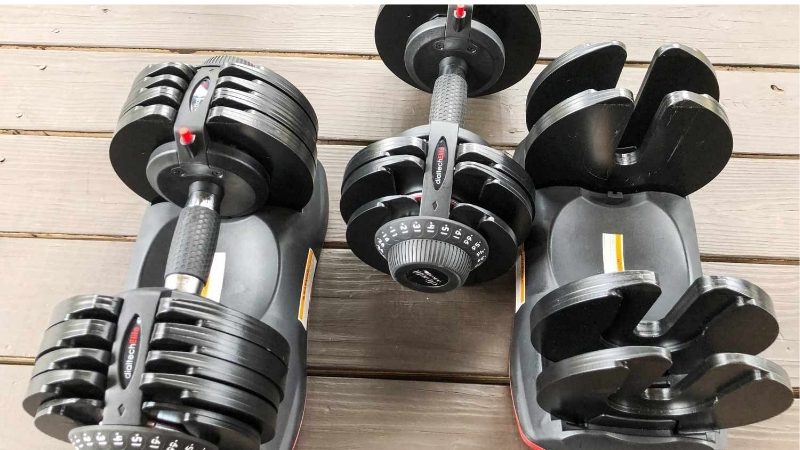
Most of the best home adjustable dumbbells use a rotating dial at each end that engages a set number of plates. They are the fastest to learn, give the finest increments at the low end, and are also the format most dependent on a plastic housing staying intact.
Twist-handle sets rotate the grip itself to pick up plates, so one movement sets both ends at once. Pin-and-adder systems, used on block-shaped sets, drop a pin through a stack and add small magnetic weights on top for fine steps.
Spinlock sets are the outlier: a threaded handle with screw collars and loose plates, no housing and nothing proprietary. They are the slowest to change and the only format where a damaged part costs a few pounds rather than the whole set.
Change Speed and How It Shapes a Session
Dial and twist systems change weight in roughly two to four seconds. Pin-and-adder takes a little longer once the magnetic adder is involved. Spinlock takes one to two minutes per dumbbell, which rules out drop sets and circuits entirely.
That difference decides which programmes are practical. Straight sets with two minutes of rest work on any mechanism, but supersets, drop sets and circuits need a selectorised set, because the rest interval is the whole point of the protocol.
Every selectorised design shares one rule: the dumbbell must be returned to its cradle to change weight. That means the cradles have to sit somewhere reachable rather than in a cupboard, which is a storage constraint people rarely plan for.
Cradle Footprint and Where the Set Lives
Dial and twist sets sit in trays roughly 17 to 18 in (43 to 46 cm) long, so a pair claims about 3 ft (91 cm) of floor or shelf width. Block-format sets in cages are nearer 12 in (30 cm), which is the difference between fitting under a desk and not.
Spinlock sets have no cradle at all, but the loose plates need a rack or a box, and that storage is usually larger than the cradles it replaces. Nothing in this category genuinely disappears from the room; it simply moves the problem somewhere else.
Measure the actual dimensions of the space you plan to use before ordering, including the vertical clearance to lift each handle straight up out of its tray. Cradle length is always published; the lift-out clearance above it almost never is.
What Fails First and Whether Parts Exist
On dial-based best home adjustable dumbbells the failure points are the dial itself and the plastic shroud, usually after a knock or a rest on the ends. On twist sets it is the internal locking collar. On block-format sets it is the selector pin and the small adder magnets.
Ask whether dials, cradles and shrouds are sold separately, because a sealed assembly turns a small breakage into a replacement purchase. Warranties normally split frame, moving parts and plastics into three different terms, and the plastics get the shortest.
One real gap in this category is worth naming: almost every set drops to 5 lb (2.3 kg) increments above 25 lb (11.3 kg), exactly where intermediate lifters need finer steps. Only a handful of sets hold 2.5 lb jumps across the full range, and they command a premium for it.
Top Picks: 6 of the Best Home Adjustable Dumbbells
One of the best home adjustable dumbbells per mechanism, plus the two variations worth knowing about. The table pairs each set with its change time and cradle length, which together predict how well it will fit into the way you actually train each week.
| Set | Mechanism | Range per hand | Change time | Cradle length |
|---|---|---|---|---|
| Bowflex SelectTech 552 | Dial | 5-52.5 lb (2.3-23.8 kg) | 2-4 seconds | ~16.9 in (43 cm) |
| NUOBELL 80 lb Classic | Twist handle | 5-80 lb (2.3-36.3 kg) | 2-3 seconds | ~17.5 in (44 cm) |
| PowerBlock Elite EXP | Pin and adder | 5-50 lb (2.3-22.7 kg) | 4-8 seconds | ~12 in (30 cm) |
| Core Home Fitness set | Twist handle | 5-50 lb (2.3-22.7 kg) | 2-4 seconds | ~16 in (41 cm) |
| Ironmaster Quick-Lock 75 | Screw lock | 5-75 lb (2.3-34 kg) | 15-30 seconds | Plates stored separately |
| Yes4All spinlock set | Threaded collar | Plate dependent | 1-2 minutes | No cradle |
1. Bowflex SelectTech 552
The default recommendation, and the reason is the increment rather than the range. Steps of 2.5 lb (1.1 kg) from 5 lb to 25 lb cover the loads where small muscle groups actually progress, and fifteen settings per hand change in a couple of seconds.
Above 25 lb the steps widen to 5 lb, the shroud is plastic and cannot take a knock, and at roughly 16.9 in (43 cm) loaded the ends collide during close-grip pressing. Accept those limits and it remains the most broadly useful set available.
2. NUOBELL 80 lb Classic
The twist mechanism is the fastest here in practice, because one rotation of the handle sets both ends without reaching down twice. An 80 lb (36.3 kg) ceiling per hand also covers heavy rows and split squats that a 50 lb set cannot.
Increments are a flat 5 lb (2.3 kg) throughout, which is coarse for lateral raises and other small-muscle work, and it sits at the premium end of the price range. Like all selectorised sets, it has to be back in its cradle before the weight can be adjusted.
3. PowerBlock Elite EXP
The block cage keeps loaded length near 12 in (30 cm), which is the shortest here and the reason it fits shelves and desk cavities that bar-shaped sets do not. Expansion kits raise the ceiling later rather than forcing the decision at purchase.
The handle sits inside a frame, which restricts wrist position on a few movements and never suits some users. Weight changes involve a pin plus a magnetic adder for the fine steps, which makes it slower in practice than either a dial or a twist handle.
4. Core Home Fitness Adjustable Dumbbell Set
A twist-handle set covering 5 to 50 lb (2.3 to 22.7 kg) in 5 lb steps, positioned below the premium twist options on price while still keeping the single-motion weight change that makes the twist-handle format worth having at all.
The 5 lb increment throughout is the main compromise, and the plastic components feel lighter than the pricier twist sets. Parts availability is narrower too, which matters more than usual on a mechanism built around an internal locking collar.
5. Ironmaster Quick-Lock 75
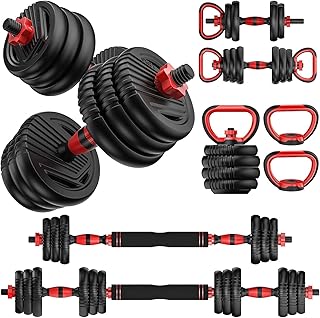
All steel, no shroud, plates held by a screw lock, and a 2.5 lb (1.1 kg) increment that holds across the entire range rather than collapsing above 25 lb. Add-on plate kits extend the ceiling later without replacing the handles you already own.
Changing weight takes fifteen to thirty seconds, which rules out drop sets and makes circuits tedious. Loose plates need their own storage, and it is the heaviest option here to carry between rooms, but nothing else is as serviceable.
6. Yes4All Spinlock Adjustable Dumbbells
The plate-loaded option: a threaded handle, screw collars and standard 1 in plates. Nothing is proprietary, replacement parts cost very little, and total load is limited only by how many plates you own rather than by any mechanism.
Changing weight takes one to two minutes per dumbbell, so it suits straight-set training only. Collars can work loose during high-rep sets and need checking, and the loaded length grows as plates are added, which affects pressing clearance.
Frequently Asked Questions
Questions about the best home adjustable dumbbells cluster around reliability, protocol compatibility and storage. Each of the answers below is given against the selector mechanism itself rather than against brand or price reputation.
Which Mechanism Is Most Reliable?
Screw-lock and spinlock designs, because there is no housing to crack and no internal selector to misalign. Dial and twist systems are far more convenient and perfectly durable in normal use, but their failure modes are more expensive when they do occur.
Can I Use Adjustable Dumbbells for Drop Sets?
Only with a selectorised set. A dial or twist change takes two to four seconds, which fits inside a drop set. Screw-lock and spinlock changes take fifteen seconds to two minutes, which breaks the protocol entirely regardless of how you organise the plates.
Do I Need a Dumbbell Stand?
Not strictly, but the cradles have to stay accessible because every selectorised set adjusts only when seated. A stand raises them to hand height, which saves repeated bending during a session and keeps the trays off a floor you have to walk across.
Are Plate-Loaded Sets Worth Considering?
Yes, if budget is tight or if you already own standard plates. You lose change speed entirely and gain repairability, unlimited loading and a much lower entry price. It is a straight trade of convenience against cost and longevity.
See More:
- Best changeable dumbbells
- Best rated yoga mat
- Best mat yoga
- Best home gym equipmen
- Best fitness equipment for home gym
Final Thoughts
Choosing the best home adjustable dumbbells starts with the mechanism, because it sets change speed, failure mode and repair cost long before top weight matters. Check the increment above 25 lb, measure the cradle space, and confirm which parts can be bought separately.


Write Your Review
No reviews yet. Be the first to share your experience!