
Key takeaways
- The listing shows a total set weight but does not state the weight per dumbbell.
- There is no clear explanation of how plates lock onto the handle.
- Collars loosen during normal movement or the plates visibly wobble.
- The advertised maximum weight requires stacking so many plates that the handle becomes unusually long.
- Reviews repeatedly mention missing plates, damaged threads, cracked coating, or inaccurate weights.
- The product has no stated warranty, return policy, or replacement-parts information.
- A light neoprene set is marketed as a complete solution for heavy strength training.
What's inside
- Decide These 3 Things First
- Size: Choose a Range, Not Just One Weight
- Material: Match the Finish to Your Floor and Training Style
- Construction: Inspect the Handle, Plates, and Adjustment System
- Comfort and Performance: Handle Feel Matters More Than It Seems
- Price Tiers: Spend According to Your Range
- Warranty: Look for Coverage That Matches the Mechanism
- Delivery and Assembly: Measure Before Ordering
- Spec Checklist
- Red Flags
- FAQ
Choosing a dumbbell set is less about finding the heaviest option and more about buying weights you can use consistently. A common mistake is starting with a weight that is too heavy for every exercise, then compensating with poor form. Another is buying a light pair for curls and discovering it is useless for rows, presses, lunges, and lower-body work. Some shoppers also focus on the total advertised weight rather than the weight of each dumbbell, or overlook storage space, handle comfort, and the time required to change plates.
- Decide These 3 Things First
- Size: Choose a Range, Not Just One Weight
- Material: Match the Finish to Your Floor and Training Style
- Construction: Inspect the Handle, Plates, and Adjustment System
- Comfort and Performance: Handle Feel Matters More Than It Seems
- Price Tiers: Spend According to Your Range
- Warranty: Look for Coverage That Matches the Mechanism
- Delivery and Assembly: Measure Before Ordering
- Spec Checklist
- Red Flags
- FAQ
If you are asking, “what dumbbell weight range do I need,” begin with your exercises, current strength, and available space. The best home-gym purchase gives you room to progress without becoming awkward to handle or difficult to store. This guide explains what matters when shopping in 2026, from beginner-friendly pairs to adjustable sets for full-body training.
As an Amazon Associate we earn from qualifying purchases at no extra cost to you. Product prices and availability are accurate as of the date shown and are subject to change.


Decide These 3 Things First
- What exercises will you perform? A 3-pound pair may work for shoulder raises but not goblet squats. A 15-pound pair may be useful for rows and presses, while heavier lower-body movements may require 30 to 50 pounds per hand.
- Are you a beginner or an experienced lifter? Beginners generally need smaller jumps and lighter starting weights. Experienced users often need a wider range, especially for back, leg, and chest exercises.
- Do you want fixed or adjustable dumbbells? Fixed weights are faster and quieter to use. Adjustable sets save space and money when you need several weight levels but require more setup and careful tightening.
Size: Choose a Range, Not Just One Weight
For general home workouts, a useful starting range is approximately 3 to 20 pounds per hand for beginners, 10 to 35 pounds for intermediate users, and 20 to 50 pounds or more for experienced lifters. These are broad guidelines, not requirements. Your ideal range depends on the movement and your training history.
For isolation exercises such as lateral raises, front raises, reverse flyes, and triceps kickbacks, many people use 2.5 to 15 pounds per hand. Curls, overhead presses, and chest presses commonly fall in the 5-to-30-pound range. Rows, Romanian deadlifts, split squats, and goblet squats often need 15 to 50 pounds per hand.
A practical beginner setup is a pair each of 5, 10, and 15 pounds, with 20 pounds added when those weights become easy. If space is limited, an adjustable set covering 5 to 45 pounds per hand is more versatile. Stronger users may prefer an adjustable range that reaches 70 or 90 pounds, but check the handle length before buying: heavy adjustable dumbbells can become much longer than fixed ones and may interfere with presses or squats.
Material: Match the Finish to Your Floor and Training Style
Rubber-coated dumbbells are a reliable choice for home gyms. They reduce clanging, protect some flooring from direct metal contact, and are less likely to rust than unfinished iron. Rubber can have a noticeable odor when new, particularly in an enclosed room, and the coating may eventually crack if repeatedly dropped.
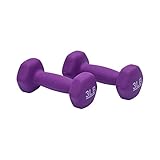
Neoprene dumbbells are soft, easy to identify by color, and comfortable for light workouts, walking routines, physical therapy, and high-repetition movements. They are usually available from 1 to 10 pounds per hand, although some models go higher. They are not usually the best choice for heavy strength training because the coating can become damaged and the compact range limits progression. A 3-pound neoprene pair, such as the type sold under the Amazon Basics name, is best viewed as a light accessory rather than a complete strength set.
Chrome-plated or bare cast-iron dumbbells are durable and compact, but they can be noisy and hard on delicate floors. If you choose metal weights, place them on a rubber mat at least 6 millimeters thick. Hex-shaped ends are useful because they are less likely to roll away and can support certain floor exercises.
Construction: Inspect the Handle, Plates, and Adjustment System
Fixed dumbbells should have a handle that is permanently secured to the heads. Look for clean welds or a solid one-piece design, with no visible movement when you rotate the weight. A typical handle diameter is about 25 to 35 millimeters. Thinner handles may suit smaller hands, while thicker handles can challenge grip strength but may feel tiring during high-repetition sets.
Adjustable dumbbells use threaded collars, spin-lock nuts, selector mechanisms, or locking pins. Threaded systems are usually the least expensive and can be dependable if tightened properly, but they take longer to change. Selector-style sets are quicker, though more mechanically complex and often more expensive. Locking pins and dials should engage fully without wobbling.
Check the smallest available increment. Increments of 2.5 pounds per dumbbell are useful for beginners and upper-body movements. Five-pound jumps may be acceptable for rows and squats but can be too large for shoulder presses or curls. Sets that advertise a total weight should clearly state whether that number includes both dumbbells, plates, handles, and accessories. A “45-pound set” may provide 22.5 pounds per dumbbell, not 45 pounds in each hand.
Comfort and Performance: Handle Feel Matters More Than It Seems
A knurled metal handle offers secure grip during sweaty sessions but may feel rough during high-repetition exercises. Smooth chrome or lightly textured handles are more comfortable for casual workouts, though they can become slippery if your hands are damp. Rubber and neoprene grips are softer, but thick coatings can make the handle feel bulky.
Pay attention to balance. A fixed dumbbell with compact heads usually feels more stable than a long adjustable handle carrying several plates. For presses and flyes, a balanced design can make the movement easier to control. For curls and rows, the difference may be less noticeable.
Consider noise as well as performance. Fixed rubber weights are quieter than loose adjustable plates. Adjustable sets may rattle slightly, especially if collars are not tightened after each change. If you live above another unit or train early in the morning, choose rubber-coated weights and use a mat.
Price Tiers: Spend According to Your Range
Budget: $10 to $80. This tier includes light neoprene pairs, individual rubber dumbbells, and basic adjustable sets. A 3-pound neoprene pair may cost around $9 to $15, while a single 15-pound rubber hex dumbbell may cost approximately $15 to $25. Basic adjustable kits can fall between $50 and $80. The FDS1-style 45-pound set listed at $67.99 is an example of a low-cost kit that may combine dumbbell plates with barbell, kettlebell, or push-up accessories.
Midrange: $80 to $250. Expect better finishing, a wider range, stronger collars, and more consistent handles. Many adjustable sets in this tier cover 20 to 45 pounds per hand, with some reaching 70 pounds. The UNNMIIY-style sets listed from $99.99, with versions advertised at 20, 30, 45, 70, or 90 pounds, illustrate how range affects price and size. Confirm exactly what each package includes before comparing prices.
Premium: $250 to $800 or more. Premium selectorized dumbbells usually offer fast weight changes, compact storage, and a polished stand or cradle. They make sense for frequent training and limited space, but they are not automatically more durable than a simple fixed dumbbell. If you need only 5 to 25 pounds, buying premium adjustables may be unnecessary.
Warranty: Look for Coverage That Matches the Mechanism
For fixed dumbbells, a one-year limited warranty is a reasonable minimum, although many manufacturers offer longer coverage against manufacturing defects. Adjustable designs deserve closer attention because collars, selector dials, pins, and internal mechanisms have more failure points. Look for at least one year of coverage and clear instructions for replacement parts.
Warranties generally do not cover normal coating wear, misuse, dropping weights, rust caused by moisture, or damage from exceeding the stated load. Keep your receipt and photograph the product if it arrives damaged. Also check whether the warranty covers the whole set or only the handle or selector mechanism.
Delivery and Assembly: Measure Before Ordering
Fixed dumbbells require little assembly, but a large order can arrive in multiple boxes and weigh more than expected. A pair of 50-pound dumbbells weighs 100 pounds before packaging. Make sure the delivery path includes stairs, narrow hallways, and door openings.
Adjustable sets usually require initial assembly, even when the process takes only 10 to 20 minutes. You may need to install handles, collars, plates, or a storage tray. Measure the dumbbell at its shortest and longest configuration. Many adjustable models are approximately 14 to 18 inches long, while compact fixed dumbbells may be 8 to 12 inches long in moderate weights.
Reserve at least 2 feet of floor width for changing plates safely, plus 3 feet of clearance around your workout position. Do not leave loose plates where children or pets can reach them. A low shelf, vertical rack, or included tray helps keep the set organized.
Spec Checklist
| Spec | Budget | Mid | Premium |
|---|---|---|---|
| Typical price | $10-$80 | $80-$250 | $250-$800+ |
| Useful range | 3-25 lb per hand | 5-45 or 70 lb per hand | 5-90 lb per hand |
| Weight increments | 2.5-5 lb | 2.5-5 lb | 2.5-5 lb |
| Materials | Neoprene, iron, basic rubber | Rubber, cast iron, steel | Rubber, steel, engineered polymer |
| Handle length | 4.5-6 inches fixed; 10-18 inches adjustable | 5-7 inches fixed; 12-18 inches adjustable | Compact selector design or 12-18 inches adjustable |
| Warranty target | 90 days-1 year | 1-2 years | 2 years or longer |
Red Flags
- The listing shows a total set weight but does not state the weight per dumbbell.
- There is no clear explanation of how plates lock onto the handle.
- Collars loosen during normal movement or the plates visibly wobble.
- The advertised maximum weight requires stacking so many plates that the handle becomes unusually long.
- Reviews repeatedly mention missing plates, damaged threads, cracked coating, or inaccurate weights.
- The product has no stated warranty, return policy, or replacement-parts information.
- A light neoprene set is marketed as a complete solution for heavy strength training.
FAQ
What dumbbell weight should a beginner buy?
A beginner can often start with pairs of 5, 10, and 15 pounds per hand for general workouts. If your primary goal is lower-body strength, add a 20- or 25-pound option. Choose a weight that allows 8 to 15 controlled repetitions while leaving about two repetitions in reserve.
Is it better to buy adjustable or fixed dumbbells?
Adjustable dumbbells are usually better when you need several weights but have limited space or budget. Fixed dumbbells are better for quick transitions, shared workouts, and movements where balance and speed matter. A mixed setup can work well: adjustable weights for heavy exercises and fixed neoprene or rubber pairs for light movements.
How heavy should dumbbells be for home workouts?
For a full-body home program, a range from 5 to 35 pounds per hand covers many beginners and intermediate users. Stronger trainees may need 50 pounds or more for rows, deadlifts, and squats. The correct weight is the heaviest one you can control without changing your form.
Do I need two dumbbells of every weight?
Two matching dumbbells are preferable for presses, rows, lunges, and most full-body exercises. One dumbbell can be enough for goblet squats, suitcase carries, single-arm rows, and other unilateral movements. If budget is tight, begin with one heavier dumbbell and one lighter pair, then expand as your training becomes more consistent.


Write Your Review
No reviews yet. Be the first to share your experience!