
Key takeaways
What's inside
Best bike exercise stand means a trainer that turns the bike you already own into an indoor one, and the four designs behave completely differently. This guide compares fluid, magnetic, direct-drive and roller trainers on noise, road feel, tyre wear, axle compatibility and the floor space each one claims.
As an Amazon Associate we earn from qualifying purchases at no extra cost to you. Product prices and availability are accurate as of the date shown and are subject to change.
As an Amazon Associate we earn from qualifying purchases at no extra cost to you. Product prices and availability are accurate as of the date shown and are subject to change.






By Chris Parker
🛒 Best Price Today on Amazon
Prime members get fast, free shipping on everything above, plus member-only deals. New members get a 30-day free trial — cancel anytime.
Start 30-Day Prime Free Trial →See Today’s Amazon DealsHow to Choose an Indoor Bike Trainer
The best bike exercise stand options divide by how they apply resistance and whether your rear wheel stays on the bike. Those two decisions drive everything else, including noise and tyre wear. The four criteria below explain what separates the best bike exercise stand designs from each other.
Resistance Type: Fluid, Magnetic, Direct Drive or Rollers
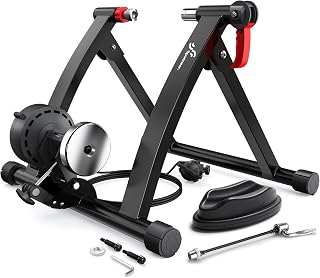
Fluid trainers use an impeller in silicone oil, giving resistance that rises progressively with speed. That progression feels closest to riding outdoors on a wheel-on trainer, and it needs no adjustment mid-ride because the load follows your effort automatically.
Magnetic wheel-on trainers set a fixed resistance level, usually via a handlebar lever. They cost less and are quieter at low speeds, but the load does not build the way fluid does, which makes hard efforts feel flat rather than progressively harder.
Direct-drive trainers remove the rear wheel entirely and drive a cassette on the unit, which eliminates tyre wear and slip and gives the most accurate power data. Rollers are the fourth option, requiring balance rather than clamping the bike at all.
Noise, Tyre Wear and Flooring
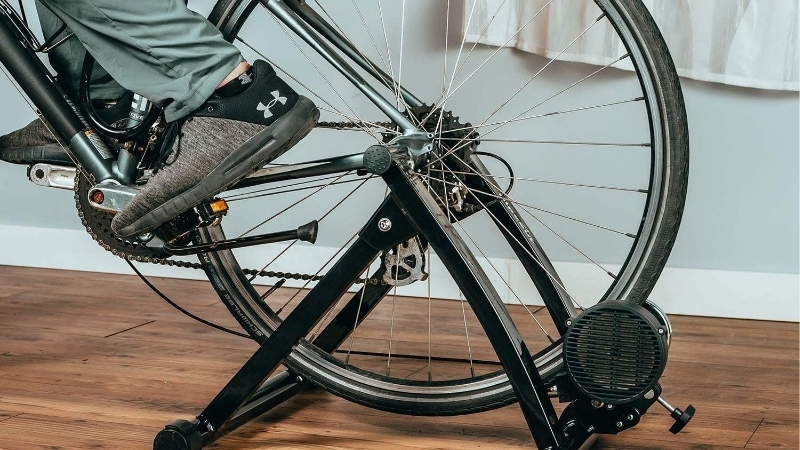
Wheel-on versions of the best bike exercise stand are noisier because the tyre contacts a roller, and a standard road tyre both wears fast and hums loudly against it. A dedicated trainer tyre reduces both, but it means swapping tyres whenever you ride outdoors.
Direct-drive units are markedly quieter since no tyre is involved at all, and the loudest sound in the room becomes your own drivetrain. Whichever you choose, a trainer mat under the bike absorbs vibration into the floor and catches sweat, which corrodes bike components surprisingly quickly.
Compatibility: Axle Standards and Cassette Fit
Wheel-on units clamp the rear axle and generally need the skewer supplied with the trainer, plus an adapter if your bike uses a thru-axle rather than a quick release. Check your axle standard before ordering, since this is the most common fitment problem.
Direct-drive trainers need a cassette matching your bike’s drivetrain, usually bought separately and fitted using a chain whip and a lockring tool. Factor that cost and job into the purchase, because a direct-drive unit is not usable out of the box.
Footprint, Setup Time and Storage
The best bike exercise stand with a bike on it occupies roughly 6 x 3 ft (1.8 x 0.9 m), plus room to get on and off and space for a fan, which you will want within a few minutes of your first indoor ride. Ceiling height is not a constraint.
Most wheel-on trainers fold to about 24 x 20 x 8 in (61 x 51 x 20 cm) and lean in a cupboard, whereas direct-drive units are heavier and simply stay where you put them. Measure both the riding area and the storage spot, and plan for the mat as part of the footprint.
Top Picks: Best Bike Exercise Stand Options
The six best bike exercise stand options below cover all four designs across a range of prices. The table lists the specs that decide the purchase, and each write-up names a genuine drawback so you can weigh noise, road feel and setup effort honestly.
| Trainer | Type | Noise | Rear wheel | Price tier |
|---|---|---|---|---|
| Saris Fluid2 | Fluid wheel-on | Moderate | Stays on | Mid |
| Wahoo Kickr Snap | Smart wheel-on | Moderate | Stays on | Premium |
| Wahoo Kickr Core | Direct drive smart | Quiet | Removed | Premium |
| Alpcour Bike Trainer Stand | Magnetic wheel-on | Moderate | Stays on | Budget |
| Sportneer Magnetic Trainer | Magnetic wheel-on | Moderate | Stays on | Budget |
| Elite Quick-Motion Rollers | Rollers | Moderate | Stays on, unclamped | Mid to premium |
Saris Fluid2
The long-standing benchmark for wheel-on fluid trainers. Resistance builds progressively with speed so the ride feels natural without any adjustment, the frame is stable under hard efforts, and it folds down small enough to store in a cupboard.
It is louder than any direct-drive unit and chews through road tyres, so a dedicated trainer tyre is effectively a required extra. It also produces no power data of its own, which matters if you follow structured training built around watts.
Wahoo Kickr Snap
A smart wheel-on trainer that controls resistance from an app and broadcasts power data, which brings structured indoor training to a bike you already own without removing the rear wheel. Setup is quicker than any direct-drive alternative.
Power accuracy is lower than direct-drive units because tyre pressure and slip affect the reading, requiring a calibration spin-down before rides. It is also expensive for a wheel-on trainer, and tyre wear remains part of the deal.
Wahoo Kickr Core
Direct drive, so the rear wheel comes off and the bike bolts onto a cassette on the unit. That removes tyre wear and slip entirely, delivers the most accurate power figures here, and drops the noise to little more than your chain.
You must buy and fit a cassette matching your drivetrain, which needs specific tools or a bike shop visit. It is also heavy and does not fold, so it becomes a permanent fixture rather than something you pack away.
Alpcour Bike Trainer Stand
The budget magnetic option, with a handlebar resistance lever and a folding frame that stores easily. For someone wanting to ride indoors occasionally through winter rather than train seriously, it does the job at a low cost.
Fixed resistance levels mean the load does not build with speed, so hard efforts feel flat compared with fluid. The frame is also lighter and flexes more under out-of-saddle efforts, which is noticeable if you sprint.
Sportneer Magnetic Bike Trainer
A close alternative at a similar price, with a stable enough frame for seated riding and a quick-release clamp that fits standard skewers. Assembly is simple and the whole unit folds flat for storage between seasons.
The same flat resistance profile applies, and the roller wears tyres quickly without a dedicated trainer tyre. Build tolerances also vary between units, so check the roller contacts the tyre evenly before your first ride.
Elite Quick-Motion Rollers
Rollers do not clamp the bike at all, so you have to balance exactly as you would outdoors. That makes them the best option for developing a smooth pedal stroke and bike handling, and they pack down smaller than any frame trainer.
The learning curve is real and falls do happen, so set up in a doorway or beside a wall for the first few sessions. Resistance is limited compared with frame trainers, which makes hard interval work harder to achieve at low speeds.
Frequently Asked Questions
These four questions cover what people most want settled about the best bike exercise stand before buying — whether a trainer tyre is necessary, direct drive versus wheel-on, power data and how much space is genuinely needed.
Do I need a special trainer tyre?
On any wheel-on trainer, effectively yes if you ride regularly. A road tyre wears visibly within weeks and is noticeably louder. The alternative is a spare wheel with a trainer tyre fitted, which avoids swapping tyres every time you ride outdoors.
Is direct drive worth the extra cost?
If you train indoors regularly and follow structured sessions, yes, because of the accuracy, quietness and lack of tyre wear. For occasional winter riding, a fluid or magnetic wheel-on trainer costs far less and stores more easily.
Does the best bike exercise stand measure power?
Only smart trainers do. Basic fluid and magnetic units provide resistance and nothing else, though you can add a separate power meter to your bike. Check whether the model broadcasts power before assuming it works with training apps.
How much space do I need?
About 6 x 3 ft for the bike and trainer, plus room to mount and dismount and space for a fan. Add a trainer mat, which catches sweat and absorbs vibration into the floor, and measure the storage spot for folding units.
See More:
- Ankle weights best
- Best rated ankle weights
- Best home workout equipment budget
- Best resistance bands for men
Final Thoughts
The best bike exercise stand depends on how often you will use it: fluid or magnetic wheel-on for occasional winter riding, direct drive if indoor training becomes a regular part of your week. Check your axle standard before ordering, budget for a trainer tyre or a cassette, and lay a mat down to protect both the floor and your bike.


Write Your Review
No reviews yet. Be the first to share your experience!