
Key takeaways
What's inside
Best exercise upright bike choices are decided by three numbers most listings bury: resistance type, flywheel weight and the floor space the frame actually needs. This guide compares six bikes on those figures in lb and kg, in and cm, plus noise levels and exactly what each machine still does without a paid subscription attached to it.
As an Amazon Associate we earn from qualifying purchases at no extra cost to you. Product prices and availability are accurate as of the date shown and are subject to change.


#2 Pick

#3 Pick

#4 Pick

#5 Pick

#6 Pick

#7 Pick

As an Amazon Associate we earn from qualifying purchases at no extra cost to you. Product prices and availability are accurate as of the date shown and are subject to change.
By Chris Parker
🛒 Best Price Today on Amazon
Prime members get fast, free shipping on everything above, plus member-only deals. New members get a 30-day free trial — cancel anytime.
How to Choose the Best Exercise Upright Bike for Home
Upright bikes split into two families that get sold as one: traditional uprights with a padded seat and a console, and indoor cycles with a heavy flywheel and a road-bike posture. The three filters below sort out which family the best exercise upright bike for you belongs to, and which model fits the room you already have.
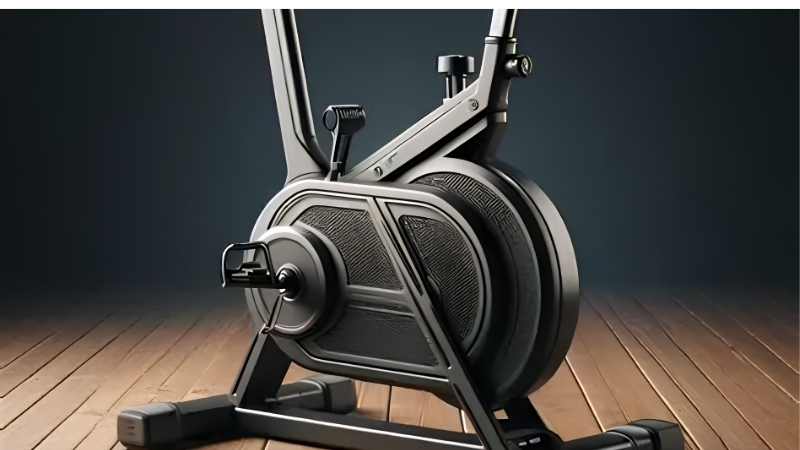
Resistance Type, Flywheel Weight and Noise
Magnetic resistance uses non-contact magnets, so nothing wears out and the bike stays close to silent apart from belt hum. Felt-pad friction resistance is cheaper and gives a heavier road feel, but the pad is a consumable that needs replacing, and it squeaks once it dries out or wears unevenly.
Flywheel weight ranges from about 35 lb (16 kg) on budget cycles to 49 lb (22 kg) on heavier frames. A heavier wheel smooths the pedal stroke at low cadence, while a lighter wheel with fine magnetic control feels just as steady in practice, so treat flywheel mass as one factor in choosing the best exercise upright bike rather than the deciding one.
Footprint, Ceiling Height and Where the Bike Lives
Most upright frames occupy roughly 40 to 49 in long by 21 to 24 in wide (102 to 124 cm by 53 to 61 cm). Add about 12 in (30 cm) of clearance on each side for mounting and dismounting, and a folding model drops to around half that footprint when stored against a wall.
Ceiling height matters if you ride out of the saddle, since standing adds roughly 10 to 12 in (25 to 30 cm) above seated height. Weight also concentrates: a bike plus rider can exceed 300 lb (136 kg) in a small area. Measure the actual space, including door width, before ordering the best exercise upright bike for your room.
Subscriptions, Apps and What the Market Now Offers
App-connected bikes have moved down into the mid tier, but the important question is what works when you pay nothing. Bikes that broadcast speed and cadence over Bluetooth work with free or low-cost third-party apps, while bikes built around a branded screen usually lose most functions without an active membership.
The health case for owning one is straightforward. According to the World Health Organization’s 2020 guidelines, adults should get 150 to 300 minutes of moderate activity weekly, which works out at roughly 22 to 43 minutes a day. A bike at home removes the travel time from that total. Speak to a doctor before starting a new programme.
Top Picks: Best Exercise Upright Bike Options by Room Size
Six bikes covering budget through mid tier, from folding frames for apartments to heavier cycles for a dedicated corner, so the best exercise upright bike for one household is not assumed to suit another. Specifications are manufacturer figures, and cost is given as a tier rather than a number, because bike pricing shifts constantly.
| Bike | Resistance | Flywheel or levels | User capacity |
|---|---|---|---|
| Schwinn IC4 | Magnetic | 40 lb (18 kg), 100 levels | 330 lb (150 kg) |
| Schwinn 170 Upright | Magnetic | 25 levels, 29 programs | 300 lb (136 kg) |
| Schwinn 130 Upright | Magnetic | 16 levels, 22 programs | 300 lb (136 kg) |
| XTERRA Fitness FB150 | Magnetic, folding | 8 tension levels | 225 lb (102 kg) |
| YOSUDA YB007 | Felt-pad friction | 35 lb (16 kg) flywheel | 270 lb (122 kg) |
| Sunny Health SF-B1002 | Felt-pad friction | 49 lb (22 kg) flywheel | 275 lb (125 kg) |
Schwinn IC4: Best Overall for Serious Training
A 40 lb (18 kg) flywheel with 100 micro-adjustable magnetic resistance levels and a 330 lb (150 kg) user capacity. It broadcasts speed and cadence over Bluetooth, so third-party training apps work directly, and the dual-sided pedals take both cycling cleats and ordinary trainers in a toe cage.
There is no built-in screen, so you supply a tablet or phone on the holder, and the stock saddle is firm enough that a good number of riders replace it within the first month. At roughly 106 lb (48 kg) assembled it is reassuringly stable but awkward to move alone between rooms.
Schwinn 170 Upright: Best Traditional Console Bike
25 magnetic resistance levels, 29 built-in programs and a 300 lb (136 kg) capacity, with a padded contoured seat and an upright riding position rather than a road-bike lean. For steady sessions while reading or watching something, the seated posture is far more comfortable than an indoor cycle.
The console design is dated next to app-driven bikes, and assembly realistically takes a good hour, with a second pair of hands needed for the heavier parts. It also cannot match an indoor cycle for out-of-the-saddle work, so treat it as a steady-state machine rather than a sprint platform.
Schwinn 130 Upright: Best Mid-Budget Console Option
16 resistance levels and 22 programs on the same 300 lb (136 kg) frame rating, aimed at riders who want a simple console and a comfortable seat without paying for the higher-spec model. For three or four moderate sessions a week it covers the requirement cleanly.
Fewer resistance levels means coarser jumps between efforts, which is immediately noticeable during interval sessions. The pedals and straps are basic plastic and are usually the first parts riders upgrade, and the frame feels less planted than heavier bikes when you push hard at high output.
XTERRA Fitness FB150: Best Folding Footprint
Eight levels of magnetic tension on a folding frame that stores in roughly half the floor area of a fixed bike. For a shared living room or a small apartment, being able to fold it flat against a wall after each session is worth more than extra resistance levels.
The 225 lb (102 kg) user capacity is the lowest here and rules it out for some riders entirely. Eight tension steps are coarse, the pedals are small, and the frame is not built for standing sprints, so keep the work seated and steady.
YOSUDA YB007: Best Budget Indoor Cycle
A 35 lb (16 kg) flywheel with belt drive and felt-pad friction resistance, rated to 270 lb (122 kg). Belt drive keeps it quiet enough for evening sessions in a flat, and the four-way adjustable seat and handlebars fit a wide range of rider heights without extra parts.
Friction resistance has no numbered levels, so repeating an exact effort week to week takes guesswork, and the felt pad is a wear item you will eventually replace. There is no Bluetooth broadcasting, so app-based training needs a separate cadence sensor.
Sunny Health SF-B1002: Best Heavy Flywheel on a Budget
A 49 lb (22 kg) flywheel, the heaviest in this comparison, sits on a belt-driven frame rated to 275 lb (125 kg). That extra mass smooths the pedal stroke at low cadence and gives the closest feel to riding outdoors of any budget bike listed here.
It is a stripped-back machine: friction resistance with no marked levels, minimal electronics, and a saddle most riders swap out. The felt pad also needs periodic adjustment and replacement, and the assembled weight makes repositioning it a two-person job.
Frequently Asked Questions
These four questions decide most purchases, and the answers usually narrow the best exercise upright bike shortlist from six options down to two before anyone looks at a price tag, a star rating or a review score at all.
Upright bike or indoor cycle: which should I buy?
A traditional upright suits longer seated sessions and riders who want a comfortable saddle and a console. An indoor cycle suits intervals, standing work and app-based training. If you plan to ride while watching something for 40 minutes, the upright is usually the better daily choice.
How much resistance do I actually need?
More levels matter more than more maximum resistance. Sixteen steps are workable, 25 steps allow finer interval control, and 100 micro-adjustable steps let you repeat an effort precisely. Most home riders never reach the top of the range on any magnetic bike in this group.
Do I need a subscription to use these bikes?
Not for any bike listed here. Bikes that broadcast cadence over Bluetooth work with third-party apps, and console bikes run their built-in programs offline. Subscription lock-in is mostly a feature of screen-based bikes, so check what remains usable if you stop paying.
How loud is an exercise bike in an apartment?
Magnetic bikes are quiet enough for evening use, with the belt and your own breathing the main sound in the room. Friction bikes add pad noise as the felt wears down. A rubber mat 3/8 in (10 mm) or thicker cuts vibration transfer through the floor, which matters far more than airborne noise in flats.
See More:
- Hot yoga mat best
- Best dumbbells exercises
- Best workout dumbbells
- Best back exercises using dumbbells
- Best exercise stationary bike
Final Thoughts
The best exercise upright bike for a home is chosen on resistance type first, footprint second and app policy third. Take magnetic resistance if quiet operation matters, a folding frame if the room is shared, and confirm the assembled dimensions and door width before you order anything.


Write Your Review
No reviews yet. Be the first to share your experience!