
Key takeaways
What's inside
Best home upright exercise bike gives you comfortable, upright cardio with a natural cycling posture, sitting between a gentle recumbent and an aggressive spin bike. This guide compares flywheel weight, resistance, console and capacity so you land on a quiet, sturdy bike that fits your room and your budget.
As an Amazon Associate we earn from qualifying purchases at no extra cost to you. Product prices and availability are accurate as of the date shown and are subject to change.
By Chris Parker
🛒 Best Price Today on Amazon
Prime members get fast, free shipping on everything above, plus member-only deals. New members get a 30-day free trial — cancel anytime.
Start 30-Day Prime Free Trial →See Today’s Amazon DealsHow to Choose the Right Best Home Upright Exercise Bike
An upright bike puts the pedals beneath your hips for a natural, comfortable ride, so choose one on ride quality first, meaning flywheel weight and resistance type. The best home upright exercise bike stays quiet and stable while giving you enough resistance range to progress.
What Makes an Upright Bike Different
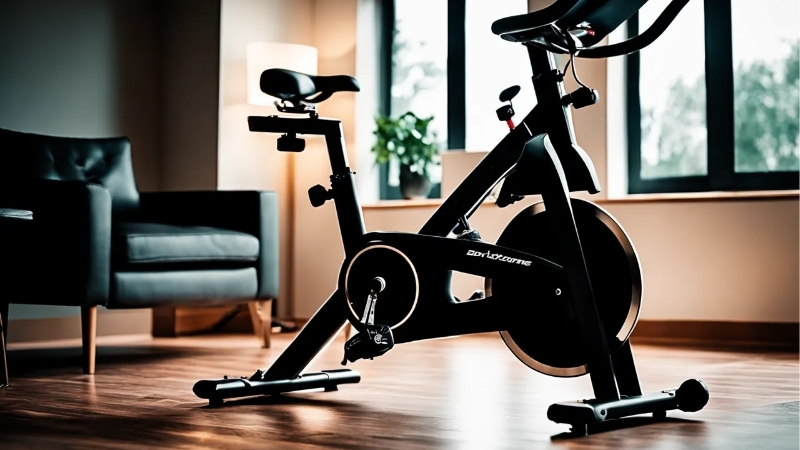
An upright bike seats you as you would sit on a normal bicycle, with a comfortable saddle and a moderate posture, more engaging for the core than a recumbent but far more relaxed than a forward-leaning spin bike. It suits steady cardio, beginners and anyone wanting comfort over intensity.
That posture is the reason to pick one. If a spin bike feels too aggressive on the back and wrists and a recumbent feels too passive, an upright sits in the middle, delivering real cardio in a position most people can hold comfortably for thirty minutes or more.
Uprights also tend to have a smaller footprint than recumbents, which stretch out along the floor. That makes an upright a sensible middle choice for a home that wants comfort and cardio without either the space of a recumbent or the intensity of a studio cycle.
Flywheel and Resistance
Flywheel weight drives smoothness. Budget bikes use light 10 to 15 lb (4.5 to 6.8 kg) wheels that feel a little choppy, while quality home bikes use 20 to 40 lb (9 to 18 kg) wheels for a smoother, more consistent stroke. A heavier flywheel is the single biggest upgrade to ride feel.
Magnetic resistance is the standard to want, running silent and maintenance-free with anywhere from 8 to 100 levels. More levels mean finer control, though even 16 well-spaced magnetic levels suit most riders. Avoid older friction systems if you value a quiet, low-upkeep ride at home.
Do not over-index on the level count alone. A bike with 100 magnetic levels but a light flywheel can still feel choppy, while 16 levels over a heavy flywheel feel smooth and progressive. Judge the flywheel weight and the resistance type together, since the two combine to set the real quality of the ride.
Console, Comfort and Connectivity
Consoles range from a simple LCD showing time, distance, speed, calories and pulse to Bluetooth screens that link to apps like Zwift or Explore the World. Decide whether you want guided classes and virtual routes or just clear numbers, since app features add cost and often a subscription.
Comfort keeps you consistent. Look for a padded, adjustable saddle with both height and fore-aft movement, padded handlebars and cage or strapped pedals. A gel seat or a wide saddle helps on longer rides, and a device holder turns any session into screen time to pass the miles.
Footprint, Capacity and Value
Uprights are compact but not tiny. Many need about 3.5 by 2 ft (1.1 by 0.6 m) of floor plus room to mount, and most do not fold, so measure your actual space before ordering and check for transport wheels if you plan to move it between sessions.
Capacity signals sturdiness: budget uprights list around 270 to 350 lb (122 to 159 kg), and a higher number usually means a more stable frame, so pick one well above your bodyweight. On value, a subscription-free upright is affordable long-term cardio; for context, the WHO physical activity guidelines suggest about 150 minutes of moderate activity a week, which regular rides meet with a low-impact, joint-friendly stroke.
Top Picks for the Best Home Upright Exercise Bike
These seven cover the best home upright exercise bike range, from Bluetooth-ready budget bikes to heavy-flywheel value machines. Match the flywheel and console to your ride and budget. All are widely available on Amazon.
| Bike | Flywheel | Resistance | Best for |
|---|---|---|---|
| Schwinn 130 | 13 lb (5.9 kg) | 16 magnetic | Budget Bluetooth |
| Schwinn 170 | Weighted | 25 magnetic | Programs and data |
| Sunny SF-B1805 | 40 lb (18 kg) | Micro magnetic | Smoothest ride |
| YOSUDA Magnetic Upright | 35 lb (16 kg) | Magnetic | Value all-rounder |
| pooboo Upright Bike | 35 lb (16 kg) | Magnetic | High capacity |
| Marcy Upright ME-709 | Standard | 8 magnetic | Simple and cheap |
| SOLE B94 | 20 lb (9 kg) | 40 magnetic | Premium warranty |
Schwinn 130 Upright Bike
A budget upright that punches above its price with quiet magnetic resistance across 16 levels, Bluetooth to apps like Zwift and Explore the World, and a 5.5 in (140 mm) LCD showing distance, time, calories, speed, RPM and heart rate, plus a contoured seat with a 13 in (330 mm) height range.
The 13 lb (5.9 kg) flywheel means the stroke is less smooth than heavier bikes and there can be slight lag changing resistance. As the best affordable upright with app support, it leads. Best budget Bluetooth pick.
Schwinn 170 Upright Bike
A step up from the 130 with more resistance levels, more built-in programs and a dual-track console with USB and app connectivity, giving data-minded riders preset workouts and clearer tracking in a comfortable upright frame.
It costs more than the 130 and still needs your own device for streaming classes. As the pick for riders who want programs and data, it stands out. Best for guided workouts.
Sunny Health SF-B1805 Magnetic Upright Bike
Built around a heavy 40 lb (18 kg) flywheel, this bike delivers the smoothest, most road-like stroke here through micro-adjustable magnetic resistance, closing on a studio feel while keeping the comfortable upright posture.
The heavy flywheel makes it heavier to move and it leans toward a firmer, spin-style ride. As the smoothest-riding upright here, it excels. Best for the smoothest ride.
YOSUDA Magnetic Upright Bike
A value all-rounder with a 35 lb (16 kg) flywheel, quiet magnetic resistance and a compact roughly 40 by 22 in (102 by 56 cm) footprint, offering a smooth belt-driven ride, a comfortable saddle and a high weight capacity for the money, all subscription-free.
The console is basic and taller riders should check the seatpost range. As the best balance of smoothness and price, it delivers. Best value all-rounder.
pooboo Upright Exercise Bike
A sturdy upright with a 35 lb (16 kg) flywheel, magnetic resistance and a high weight capacity in the 300 to 400 lb (136 to 181 kg) range, giving a stable, quiet ride that suits heavier riders and shared households.
The display is straightforward and assembly takes a little time. As the pick for a high capacity and a planted feel, it works. Best for high capacity.
Marcy Upright ME-709 Exercise Bike
A simple, inexpensive upright with eight magnetic resistance levels, a counterbalanced pedal and a basic LCD, built on a steel frame that has stayed a reliable budget seller for years of casual home cardio.
The light flywheel and eight levels limit intensity for stronger riders, and the console is minimal. As a no-frills, dependable budget bike, it is solid. Best for simple and cheap.
SOLE B94 Upright Bike
A premium upright with a 20 lb (9 kg) flywheel, 40 resistance levels, an adjustable gel seat and, notably, a lifetime frame warranty and the free SOLE+ app with no subscription, aimed at riders who want commercial-grade durability at home.
It costs well above the budget bikes and is heavier to move. As the most durable, best-supported upright here, it stands out. Best for a premium warranty.
Frequently Asked Questions
Common questions about choosing the best home upright exercise bike.
What is the difference between an upright and a spin bike?
An upright seats you in a comfortable, natural cycling posture with a padded saddle, suited to steady cardio. A spin bike leans you forward over a heavier flywheel for intense, studio-style riding. Uprights favour comfort; spin bikes favour intensity.
Is an upright bike good for weight management and fitness?
It is a solid low-impact cardio tool. Regular riding contributes to the roughly 150 minutes of weekly moderate activity health bodies suggest, and it is gentle on the joints. Results vary between people, so pair consistent riding with your wider routine rather than expecting a set outcome.
How heavy should the flywheel be?
Heavier is smoother. Budget bikes use 10 to 15 lb (4.5 to 6.8 kg) wheels that feel a little choppy, while 20 to 40 lb (9 to 18 kg) wheels give a smoother, more consistent stroke. If ride feel matters most, prioritise a heavier flywheel.
Do upright exercise bikes need a subscription?
No. Bikes like the Schwinn 130, YOSUDA, Sunny and SOLE work fully without any monthly fee, showing your metrics on their own console. Some connect to third-party apps like Zwift with your own device, but that is optional, not required.
See More:
- Best flooring for home gym over concrete
- Best collapsible exercise bike
- Best fold away exercise bike
- Best exercise bike folding
Final Thoughts
The best home upright exercise bike delivers comfortable, quiet, low-impact cardio in a natural posture and a compact footprint, which is why it suits so many homes. Prioritise a heavier flywheel and magnetic resistance for a smooth ride, a console that matches how you like to train, and a capacity above your bodyweight. Measure your space, and the best home upright exercise bike becomes a cardio habit you keep.
As an Amazon Associate we earn from qualifying purchases at no extra cost to you. Product prices and availability are accurate as of the date shown and are subject to change.


Write Your Review
No reviews yet. Be the first to share your experience!