
Key takeaways
What's inside
Best wall mount for resistance bands is a question about what is behind the plasterboard, not about the bracket itself. A band under tension pulls outward with real force, and an anchor screwed into drywall alone will eventually come out. Here is how to get it right.
As an Amazon Associate we earn from qualifying purchases at no extra cost to you. Product prices and availability are accurate as of the date shown and are subject to change.
As an Amazon Associate we earn from qualifying purchases at no extra cost to you. Product prices and availability are accurate as of the date shown and are subject to change.


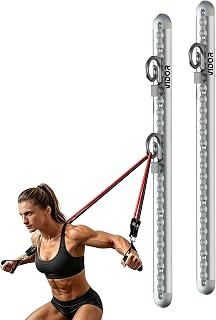


By Chris Parker
🛒 Best Price Today on Amazon
Prime members get fast, free shipping on everything above, plus member-only deals. New members get a 30-day free trial — cancel anytime.
Start 30-Day Prime Free Trial →See Today’s Amazon DealsHow to Choose the Best Wall Mount for Resistance Bands
Three things decide this: what you can drill into, how many anchor heights you need, and whether you are allowed to drill at all. The best wall mount for resistance bands in a rented flat is often not a wall mount, and that is worth establishing before you buy hardware.
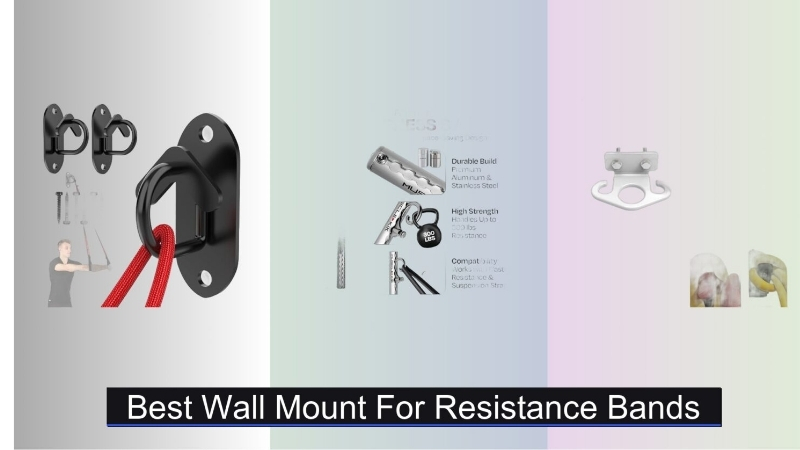
Footprint, Anchor Height and Clear Floor
A wall anchor takes almost no room itself, but the working area does. Allow roughly 6-8 ft (1.8-2.4 m) of clear floor straight out from the wall, because bands stretch to two or three times their resting length and you need room to step back into tension.
Anchor height determines what you can train. A low anchor around 12 in (30 cm) covers rows and curls, chest height at roughly 48-54 in (122-137 cm) covers presses and flyes, and a high point near 78-84 in (198-213 cm) covers pulldowns. Measure the wall before choosing between single and multi-point mounts.
Studs, Fixings and What Actually Fails
Timber studs sit at 16 in (406 mm) or 24 in (610 mm) centres in most homes, and the mount must land on one. Lag bolts into solid timber are the standard fixing; drywall plugs are not, regardless of the rating printed on the packet.
With the best wall mount for resistance bands, failure is almost never the bracket. It is the fixing pulling through, and it happens under the outward, angled load a stretched band applies rather than under straight downward weight. A stud finder costs a fraction of the mount and removes the guesswork entirely.
No-Drill Alternatives for Rented Homes
Door anchors are the honest answer where drilling is not allowed. A heavy strap with a moulded stopper passes through the hinge side of a closed door and gives a usable anchor at almost any height by moving it up or down the frame.
The limits are real: the door must open away from you, must be closed and ideally locked, and hollow-core doors are not appropriate for heavy tension. A wall-mounted pull-up bar is the middle option, giving one high anchor with two fixing points.
What the Anchor Market Offers Right Now
Most equipment in this category is still designed on the assumption of a garage with exposed studs or a concrete wall. Genuinely renter-friendly options remain the thinnest part of the shelf, which is why the humble door anchor is still the most-used product in the category.
Below the mid tier the compromises are consistent: thinner steel that flexes visibly under load, powder coating that chips at the bolt holes and starts rusting, and welded eyelets rather than forged ones. The eyelet weld is the part worth inspecting when a cheap mount arrives.
The useful development is multi-point mounting boards, which put three or four anchor heights on one plate spanning two studs. That solves the height problem in one purchase rather than three separate drilling jobs, and it is where the value now sits in the mid tier.
Top Picks: Best Wall Mount for Resistance Bands
These seven answers to the best wall mount for resistance bands cover the single anchor, the multi-height board, the dual-purpose bar and the no-drill route, plus the stud finder that makes all of the drilled options safe. Each entry notes its honest limitation.
| Product | Type | Fixing | Anchor Points | Best For |
|---|---|---|---|---|
| Anchor Gym H1 Wall Mount | Single ball anchor | Lag bolts to stud | One | Simple single height |
| Anchor Gym CORE Station | Multi-point board | Spans two studs | Several | Low, mid and high |
| Titan Wall Mounted Folding Rack | Rack with uprights | Bolted to studs | Multiple heights | Bands plus barbell work |
| Yes4All Wall Mounted Pull-Up Bar | Bar | Multiple lag bolts | One high point | Dual purpose |
| Bodylastics Heavy Door Anchor | Door strap | None | Adjustable height | Rented homes |
| Ceiling Mount Anchor Plate | Overhead anchor | Joist fixing | One overhead | Pulldowns and triceps |
| Franklin ProSensor 710 Stud Finder | Tool | None | Not applicable | Finding the stud |
Anchor Gym H1 Wall Mount
A single ball anchor bolted into one stud is the simplest working version of the anchor problem. It accepts loop bands, tube bands with carabiners and suspension straps, and it disappears visually in a living room in a way a rack never will.
One anchor means one height, so you are choosing between rows and presses unless you buy two or three. Installation also depends entirely on hitting the stud centre, and an off-centre lag bolt is the most common reason these come loose.
Anchor Gym CORE Station
A mounting board spanning two studs with several anchor positions solves the height problem in a single drilling job. Low, chest and high anchors on one plate means a full band programme runs from one installation rather than three separate holes in the plaster.
It is a larger visual object on the wall and it costs considerably more than a single anchor. It also requires accurate stud spacing, so a wall with irregular framing may need a plywood backing board fitted first.
Titan Fitness Wall Mounted Folding Rack
If bands are part of a wider setup rather than the whole of it, a folding wall rack gives band anchor points at every hole in the uprights plus a place for a barbell. It folds flat against the wall between sessions, which is the reason to choose it over a full rack.
It is heavy, it needs several bolts into structural timber, and installation is genuinely a two-person job. It is also permanent in a way a single anchor is not, so it suits owners rather than renters.
Yes4All Wall Mounted Pull-Up Bar
A wall bar gives one solid high anchor and a pull-up station in the same fixing, which makes it good value for a small room. Bands loop straight over the bar for pulldowns, face pulls and assisted pull-ups without any extra hardware.
It only provides a high anchor, so rows and chest presses still need a separate solution. It also projects further from the wall than a flush anchor, which matters in a narrow hallway or a room with a doorway nearby.
Bodylastics Heavy Duty Door Anchor
For anyone who cannot drill, this is the product that makes band training possible at all. The strap passes through the door at any height, so one cheap item covers low, chest and high anchor positions with no permanent change to the property.
It requires a solid door that opens away from you and stays closed throughout the set, and hollow-core internal doors are not suitable for heavy tension. The stitching at the stopper is the wear point and should be checked before every heavy session.
Ceiling Mount Anchor Plate
An overhead anchor bolted into a joist covers pulldowns, straight-arm pulls and triceps extensions, none of which work well from a wall anchor. It is also the most out-of-the-way option, since nothing protrudes at head height.
Joist location is less predictable than stud location, and drilling upward into an unknown ceiling void carries more risk of hitting a cable or pipe. Plasterboard ceilings with no accessible joist should be left alone entirely.
Franklin ProSensor 710 Stud Finder
This is the cheapest item on the list and the one that determines whether any of the others stay on the wall. Multi-sensor models show the full width of the stud at once rather than beeping at an edge, which is what makes centre-drilling reliable.
It cannot see cables or pipes, so it does not remove every risk of drilling into a wall. Dense plaster over lath, common in older properties, also confuses most consumer stud finders and may need a different detection method.
Frequently Asked Questions
These questions about the best wall mount for resistance bands come up whenever someone gets as far as holding a drill against the wall and has second thoughts.
Can I mount an anchor into drywall with plugs?
No. Band tension applies an outward, angled pull that drywall fixings are poorly suited to, and the failure happens suddenly rather than gradually. The best wall mount for resistance bands always lands on a timber stud, masonry or a plywood backing board fixed to studs.
What height should I mount the anchor?
If you can only have one, chest height around 48-54 in (122-137 cm) covers the widest range of movements. Add a low anchor near 12 in (30 cm) for rows and curls, and a high point above 78 in (198 cm) for pulldowns.
How much clear space do I need in front?
Around 6-8 ft (1.8-2.4 m) straight out from the wall, since bands stretch to two or three times their resting length. Check the real dimensions of the area you intend to use before choosing where the anchor goes.
Are ceiling anchors better than wall anchors?
Only for overhead pulling movements. For presses, rows and flyes a wall anchor is more useful, and it is easier to install safely because studs are simpler to locate than joists. Most home setups start with a wall anchor and add a ceiling point later.
See More:
- Ankle weights best
- Best rated ankle weights
- Best home workout equipment budget
- Best resistance bands for men
Final Thoughts
The best wall mount for resistance bands is whichever one reaches a stud, and the bracket matters far less than the fixing behind it. A single ball anchor at chest height covers most training, a multi-point board covers all of it, and a door anchor covers renters. Find the stud centre before you drill anything.



Write Your Review
No reviews yet. Be the first to share your experience!