
Key takeaways
What's inside
Best resistance bands for pull-ups are chosen by width rather than by colour, and the width you need depends on your body weight and how many repetitions you can already manage. Get it wrong and the band either does the whole rep for you or does nothing at all. Width is the only specification that really counts.
As an Amazon Associate we earn from qualifying purchases.
As an Amazon Associate we earn from qualifying purchases at no extra cost to you. Product prices and availability are accurate as of the date shown and are subject to change.




By Chris Parker
🛒 Best Price Today on Amazon
Prime members get fast, free shipping on everything above, plus member-only deals. New members get a 30-day free trial — cancel anytime.
Start 30-Day Prime Free Trial →See Today’s Amazon DealsHow to Choose the Best Resistance Bands for Pull-Ups
The best resistance bands for pull-ups share one genuinely important specification: the width of the loop. Everything else, including colour coding and brand, follows from that. The second consideration is how the band is made, since layered latex and continuous-loop latex fail in quite different ways.
Band Width and How Much Assistance You Get
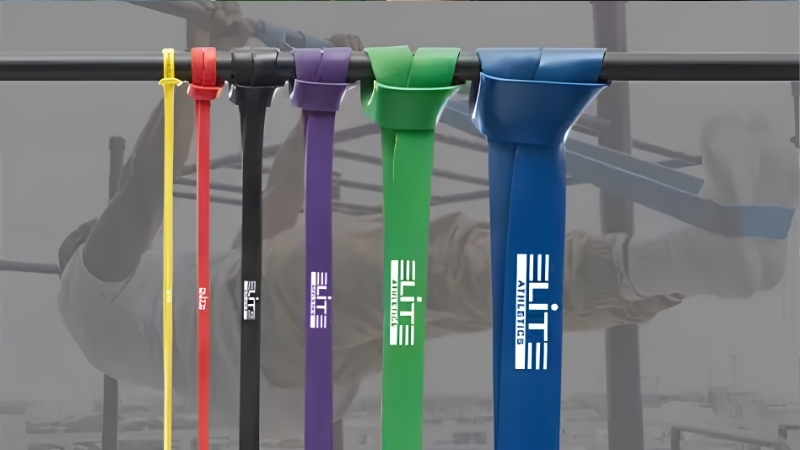
Widths run from about 1/2 in (13 mm) up to 2.5 in (64 mm), and the assistance scales with them. A 1/2 in band gives roughly 15 to 35 lb (7 to 16 kg) of help at the bottom of the rep, while a 1.75 in band gives far more, often over 100 lb at full stretch. Most people need two widths rather than one. Colour codes mean nothing across brands.
Assistance is not constant through the movement. A band pulls hardest at the bottom where it is stretched furthest, and almost nothing at the top, which is exactly the opposite of where most people struggle. That is a feature rather than a fault, but it changes how you should pick the width. Buy for the bottom of the rep.
Latex Layers, Continuous Loops and How Bands Fail
Quality bands are made from layered natural latex bonded into a continuous loop with no join. Cheaper bands use fewer layers or a bonded seam, and the seam is where they eventually split. A band under load stores real energy, so a failure at full stretch is not a trivial event. Seams are where cheap bands give way.
Inspect the band before every session, particularly along the edges where small nicks start. Store it out of sunlight and away from radiators, since heat and UV degrade latex faster than use does. Replace any band showing surface cracking rather than deciding to get one more session out of it. Latex ages faster in sunlight than in use.
Anchoring, Bar Type and Clearance Overhead
How you anchor the band matters as much as the band itself. Loop it over the bar and pull it through itself, keeping the knot tight against the bar rather than sliding. On a doorway bar, check the bar cannot rotate under the extra downward load a stretched band adds. Doorway bars are the usual weak point here.
Clearance is the other constraint. A stretched band plus your foot or knee needs roughly 12 in (30 cm) of space below the bar, and the bar itself needs enough height that you can hang with straight arms. Measure the height and the floor clearance before choosing which band to buy. Height decides the best resistance bands for pull-ups you can use.
Top Picks: Assistance Bands That Work at Home
The six below cover single bands and multi-width sets, from budget to serious. Most people need two widths rather than one, since assistance should reduce as you get stronger. Each entry names a real drawback, because latex bands are simple products with genuinely different build quality. Buy two widths and progress between them.
| Product | Type | Widths | Best for |
|---|---|---|---|
| WODFitters Bands | Loop bands | Several widths | Buying a set |
| Serious Steel Assisted Band | Loop band | Sold singly | One width |
| Gymreapers Pull Up Bands | Loop bands | Set or single | Build quality |
| Rubberbanditz Band | Loop band | Sold singly | Heavy assistance |
| Yes4All Assist Bands | Loop bands | Budget set | Starting out |
| Iron Bull Strength Bands | Loop bands | Set | Mixed training |
WODFitters Resistance Bands
WODFitters is the default set for anyone who wants a range of widths in one purchase, which is the sensible approach because assistance should drop as you get stronger. The bands are layered latex in the standard widths, and buying two or three at once costs less than adding them singly. Sets suit anyone planning a progression.
Sets tempt you into buying widths you will never use, particularly the very heaviest. Colour coding varies between brands, so ignore the colour and check the stated width in inches. Store them out of direct sunlight, since the thinner bands in a set degrade fastest of all. Check inches rather than trusting the colour.
Serious Steel Assisted Pull-Up Band
Serious Steel sells bands individually, which suits anyone who already knows the width they need and does not want three more sitting in a drawer. The build is solid layered latex, and buying one properly sized band usually costs less than a budget set that includes four you will not touch. One correct width beats four wrong ones.
Buying singly means guessing at the width if you have not used bands before, and getting it wrong means a second purchase. As with any latex band, inspect the edges before each session and replace it at the first sign of surface cracking rather than pushing on. Sizing is the risk with a single purchase.
Gymreapers Pull Up Assist Bands
Gymreapers bands sit slightly above the budget end on build quality, with consistent layering and edges that hold up better to repeated loading over a bar. For anyone using bands several times a week rather than occasionally, that consistency is what the extra money buys. It is among the best resistance bands for pull-ups for heavy use.
They cost more than the cheapest sets, which is hard to justify for light use, and the widths overlap with everything else here. There is no meaningful performance difference at low loads. Buy them for durability rather than for any difference you will feel during a set. Light users will not notice the difference.
Rubberbanditz Pull-Up Assist Band
Rubberbanditz specialises in the heavier widths, which matters if you cannot yet complete a single unassisted repetition and need substantial help at the bottom. The wider bands deliver enough assistance to make the movement trainable rather than something you attempt and fail at repeatedly. Heavy widths make the movement trainable.
Heavy bands are also the ones most likely to do the whole rep for you, which stalls progress quietly. Plan to move down a width within a couple of months. They are bulky to store and expensive compared with the mid widths, so buy one rather than a full range. Plan to move down a width within months.
Yes4All Pull Up Assist Bands
Yes4All covers the budget end with sets in the standard widths, which is enough to find out whether banded pull-ups will stay in your training before spending properly. For occasional use rather than several sessions a week, the difference in build quality is not what limits progress. Technique stalls progress long before latex does.
Layer consistency is lower than the mid-range brands, and edges nick more easily on a rough bar. Check them before every session without exception. Treat these as a one to two year purchase rather than something that will still be in the drawer in five years. Inspect the edges before every single session.
Iron Bull Strength Resistance Bands
Iron Bull sets cover pull-up assistance and general band work in the same purchase, which suits anyone who also wants bands for warm-ups, pull-aparts and accessory work. Owning one set that does both jobs is simpler than keeping two separate collections in the same room. One set covering both jobs saves storage.
Multi-purpose sets mean some widths are wrong for pull-ups specifically, and the very light bands are useless for assistance. Check which widths the set actually contains rather than trusting the marketing description, since the ranges vary noticeably between listings from the same brand. Read the width list rather than the headline.
Frequently Asked Questions
Four questions cover most of what people ask before buying assistance bands. They are about sizing, safety and anchoring, since those three decide whether banded pull-ups become a progression that works or a set of bands sitting unused in a cupboard within a month. Width answers most of them. Sizing is where beginners go wrong.
Which of the best resistance bands for pull-ups suits a beginner?
If you cannot do a single unassisted repetition, start around 1.25 to 1.75 in (32 to 44 mm). If you can already manage two or three, a 1/2 to 7/8 in (13 to 22 mm) band is enough. Body weight matters, so err towards more assistance and move down. Two bands cover the first year comfortably. Body weight matters as much as reps.
Can bands snap during a set?
They can, usually at a nick or an old seam rather than without warning. Inspect the edges before every session, store them away from heat and sunlight, and replace any band showing surface cracking. Never stretch a band towards your face while setting it up on the bar. Eye level is where the risk sits.
Do bands help at the hardest part of the rep?
No, and that is worth knowing before you buy. A band pulls hardest at the bottom and almost nothing at the top, which is the reverse of where most people fail. It still builds the pattern and the volume, but it will not train the top position directly. Add negatives for the top of the rep. Bands build volume, not the sticking point.
Will a doorway bar take the extra load?
Usually, but a stretched band adds downward force that the bar may not be rated for at all, and it can encourage the bar to rotate. Check the stated capacity and that the bar is seated properly before every set. A mounted bar is the safer anchor for the best resistance bands for pull-ups at heavy widths.
See More:
Final Thoughts
The best resistance bands for pull-ups are the two widths that match where you are now and where you will be in three months, not a full set of six. Buy by width rather than colour, inspect the latex before every session, and check what your bar is rated for. Then train the movement properly. Progress by dropping a width, not adding reps.


Write Your Review
No reviews yet. Be the first to share your experience!