
Key takeaways
- Low cost: A useful starter set often costs less than one adjustable dumbbell and far less than a complete weight system. A budget of roughly $15 to $40 can cover many home-training needs.
- Easy to store: Most bands can fit in a drawer, closet, or small gym bag. They do not require a rack, bench, or dedicated workout room.
- Portable: Bands weigh very little compared with metal weights. They are convenient for travel, office workouts, hotel rooms, and outdoor training.
- Beginner-friendly: You can start with a lighter band and practice controlled movement before progressing. Bands are also useful for people returning to exercise after a break.
- Versatile: A single long band can train the upper body, lower body, and core. With a secure anchor point, you can perform presses, rows, pulldowns, rotations, and anti-rotation exercises.
- Good for assisted pull-ups: A heavy band can reduce the amount of body weight you need to lift while you build the strength and technique for an unassisted pull-up.
- Joint-friendly options: The resistance is often smoother and less intimidating than a heavy dumbbell. Light bands can be useful for shoulder activation, warmups, and rehabilitation exercises when approved by a qualified professional.
- Progressive exercise options: You can move to a thicker band, combine two bands, increase range of motion, slow the lowering phase, or perform more repetitions.
What's inside
The Short Answer
Yes, resistance bands are worth it if you want an affordable, portable way to add strength training to your routine and you are willing to increase resistance gradually. They are especially useful for beginners, home exercisers, travelers, warmups, mobility work, and assisted pull-ups.
They are not a perfect replacement for a full set of dumbbells or a barbell. Band resistance changes throughout an exercise, usually becoming harder as the band stretches, and it can be difficult to measure exactly how much force you are using. If your main goal is maximal strength or heavy lower-body training, free weights may be a better long-term investment. For most casual home workouts, however, a good set of bands offers a lot of capability for relatively little money.
As an Amazon Associate we earn from qualifying purchases at no extra cost to you. Product prices and availability are accurate as of the date shown and are subject to change.


What You Actually Get
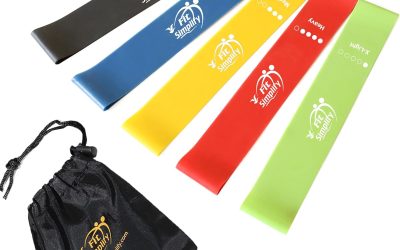
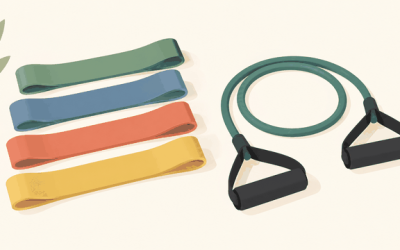
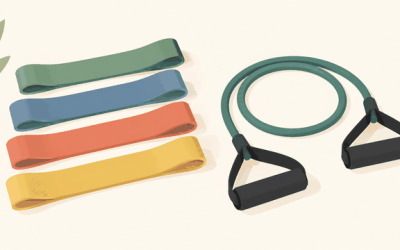
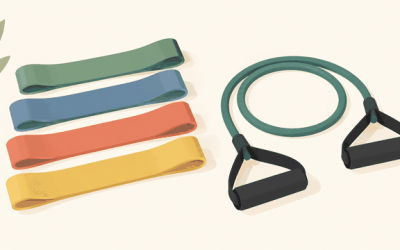
A resistance-band set typically includes several loop or tube bands with different resistance levels. Many sets use color coding, but colors are not standardized, so check the listed resistance or thickness rather than assuming that a particular color always means “heavy.” A basic set may cost about $15 to $30 and include three to five bands.
Loop bands are useful for exercises such as squats, rows, chest presses, shoulder work, glute bridges, lateral walks, and deadlift variations. Long pull-up bands can also be used for assisted pull-ups, stretching, mobility drills, and full-body movements. Some kits include handles, ankle straps, a door anchor, or a storage bag. Those extras can make a set more versatile, but they do not automatically make the bands stronger or safer.
The resistance listed on packaging is usually a range, not a precise weight equivalent. A band might be described as providing 10 to 35 pounds of resistance, depending on how far it is stretched. That means a “35-pound” band does not feel like holding a fixed 35-pound dumbbell throughout an exercise. The load is generally lightest at the start of the movement and increases as the band lengthens.
For a current entry-level purchase, a five-level set marketed for workouts and pull-up assistance costs around $16.99. Another colorful pull-up and exercise-band set marketed for stretching, physical therapy, and muscle training costs about $22.49. These are inexpensive ways to test whether band training fits your habits before spending more on a larger home gym.
Pros
- Low cost: A useful starter set often costs less than one adjustable dumbbell and far less than a complete weight system. A budget of roughly $15 to $40 can cover many home-training needs.
- Easy to store: Most bands can fit in a drawer, closet, or small gym bag. They do not require a rack, bench, or dedicated workout room.
- Portable: Bands weigh very little compared with metal weights. They are convenient for travel, office workouts, hotel rooms, and outdoor training.
- Beginner-friendly: You can start with a lighter band and practice controlled movement before progressing. Bands are also useful for people returning to exercise after a break.
- Versatile: A single long band can train the upper body, lower body, and core. With a secure anchor point, you can perform presses, rows, pulldowns, rotations, and anti-rotation exercises.
- Good for assisted pull-ups: A heavy band can reduce the amount of body weight you need to lift while you build the strength and technique for an unassisted pull-up.
- Joint-friendly options: The resistance is often smoother and less intimidating than a heavy dumbbell. Light bands can be useful for shoulder activation, warmups, and rehabilitation exercises when approved by a qualified professional.
- Progressive exercise options: You can move to a thicker band, combine two bands, increase range of motion, slow the lowering phase, or perform more repetitions.
Cons
- Resistance is hard to quantify: The force changes with stretch length, angle, and body position. Tracking progress is less straightforward than adding 5 pounds to a barbell.
- Anchoring can be awkward: A door anchor or furniture attachment must be used correctly. A slipping anchor can cause the band to snap back, hit you, or damage the door.
- Breakage is possible: Latex can dry out, crack, or tear, particularly when exposed to sunlight, heat, sharp edges, or abrasive surfaces. Inspect bands before every use.
- Some exercises are limited: Bands can make heavy squats, deadlifts, and presses challenging, but they may not provide enough resistance for experienced lifters. They also do not replicate the feel of a stable weight in your hand.
- They can feel different from weights: The hardest part of a band exercise is often near the end of the movement. This may be helpful for some exercises but less comfortable for others.
- Cheap kits vary in quality: A low price can mean inconsistent thickness, weak handles, or unclear resistance ratings. Look for secure stitching, smooth tubing, and clear care instructions.
- Some users may dislike the setup: If you prefer picking up a dumbbell and immediately starting a set, selecting bands, finding an anchor, and adjusting the length may feel inconvenient.
Who Should Buy It
Buy resistance bands if you want a compact home workout system, need equipment that stores easily, or are building an exercise habit without committing to expensive gear. They are a particularly sensible choice for beginners, renters, travelers, students, and people who want to add short strength sessions to walking, running, yoga, or cardio workouts.
They also make sense if your goals include general muscle conditioning, posture and upper-back work, glute training, mobility, warmups, or assisted pull-ups. A set with at least three resistance levels is more useful than a single band because it lets you match the load to different muscle groups. Your legs may need a heavier band than your shoulders, while a beginner may need a lighter band for controlled rows and presses.
For the best value, choose a set that includes multiple lengths or levels, clear resistance information, and bands long enough for your height and preferred exercises. If you plan to use door anchors, verify that the anchor is compatible with the door and follow the safety instructions. Test every setup with gentle tension before applying full force.
Who Should Skip It
Skip resistance bands as your primary equipment if you are training specifically for powerlifting, bodybuilding with substantial progressive loads, or a sport that requires precise strength measurement. Bands can supplement those goals, but they may not provide enough load or consistency on their own.
You may also want to skip them if you have nowhere to anchor a band safely, dislike variable resistance, or know you will not use equipment that requires setup. People with an injury, significant pain, or a post-surgical recovery plan should follow guidance from a physician or physical therapist rather than choosing exercises based only on a product label.
Cheaper Alternatives
| Option | Cost | Trade-off |
|---|---|---|
| Bodyweight training | $0 | Excellent for squats, lunges, push-ups, planks, and core work, but progression can be harder for pulling exercises and upper-body strength. |
| Backpack with books or water bottles | $0 if you already own one | Provides adjustable weight for squats, rows, and carries, but can be uncomfortable and is less convenient for pressing movements. |
| Single light resistance band | About $5-$12 | Very inexpensive and useful for warmups, shoulders, and glutes, but too limited for full-body progression. |
| Used adjustable dumbbells | About $30-$100 used | Offer more consistent resistance and better heavy-strength potential, but cost more, weigh more, and require storage space. |
| Stairs, a sturdy step, or a park bench | $0 | Useful for step-ups, split squats, incline push-ups, and cardio, but does not provide pulling resistance by itself. |
FAQ
Can resistance bands build muscle?
Yes. Muscle growth depends on challenging the muscle, using enough effort, and progressing over time. Bands can build muscle when you select a difficult resistance, perform controlled repetitions, and work close to fatigue. Progress by using a thicker band, increasing tension, adding repetitions, slowing the eccentric phase, or combining bands. For advanced lifters, bands may eventually become too light for some muscle groups.
How long do resistance bands last?
There is no guaranteed lifespan because usage, storage, material, and exposure to heat or sunlight all matter. Keep bands dry and away from sharp edges, pets, direct sunlight, and hot cars. Do not use a band with cuts, cracks, unusual thinning, sticky areas, or damaged stitching. Replacing a questionable band is cheaper than dealing with a sudden break.
Are bands better than dumbbells?
Neither is universally better. Bands are cheaper, lighter, quieter, and easier to store. Dumbbells provide a more predictable load and are usually better for heavy strength training and simple load tracking. If you have room and budget, combining a few bands with adjustable dumbbells gives you more exercise options than either choice alone.
What resistance band should a beginner buy?
Start with a set containing several levels rather than one extremely heavy band. A five-level kit in the roughly $15 to $30 range is a practical starting point. Choose a lighter level for shoulders and arms, a medium level for rows and presses, and a heavier level for leg exercises. The correct band should allow controlled form through your intended range of motion without snapping, twisting, or forcing you to compensate.


Write Your Review
No reviews yet. Be the first to share your experience!