
Key takeaways
What's inside
Best chest exercise with resistance bands has a single defensible answer: the anchored horizontal press. It matches the band’s rising tension curve to the pectoral’s strongest range, which no flye variation manages, and it needs one anchor and one pair of handles.
As an Amazon Associate we earn from qualifying purchases at no extra cost to you. Product prices and availability are accurate as of the date shown and are subject to change.
As an Amazon Associate we earn from qualifying purchases at no extra cost to you. Product prices and availability are accurate as of the date shown and are subject to change.


By Chris Parker
🛒 Best Price Today on Amazon
Prime members get fast, free shipping on everything above, plus member-only deals. New members get a 30-day free trial — cancel anytime.
Start 30-Day Prime Free Trial →See Today’s Amazon DealsWhy the Anchored Press Is the Best Chest Exercise With Resistance Bands
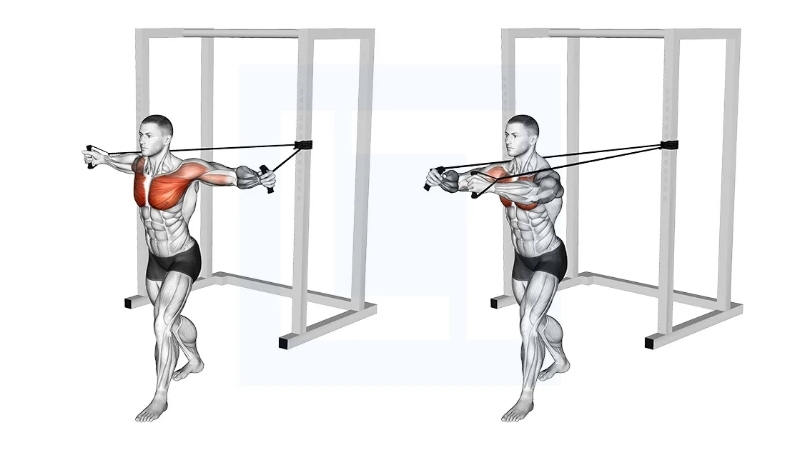
Any candidate for the best chest exercise with resistance bands has to deal with one fact: bands get harder as they stretch, which is the opposite of a dumbbell. The best chest exercise with resistance bands is therefore the one whose hardest point sits where you are strongest, and for the pectorals that is lockout rather than the bottom of the range.
Matching the Tension Curve to the Movement
A dumbbell press is hardest at the bottom, where the chest is stretched and mechanically weakest. A banded press is hardest at full extension, where the chest is contracting and strongest. That reversal is why banded pressing feels productive at loads that look modest on paper.
The flye pattern suffers under the same physics. Tension peaks when the hands come together, which is the position where the pectorals need the least assistance, and it drops away at the stretch where the muscle would benefit most.
Anchor Height, Footprint and Clear Space
Chest height is the correct anchor position, around 48-54 in (122-137 cm) for most adults, measured to the anchor point rather than to your shoulder. Anchoring too low turns the press into an incline and shifts load to the front deltoid.
Allow roughly 6-8 ft (1.8-2.4 m) of clear floor straight out from the anchor, because you step forward into tension and the band stretches to two or three times its resting length. Measure the actual space before deciding where the anchor goes.
Handles, Anchors and What Breaks
Failure happens at the contact points, not in the middle of the band. Carabiner burrs, a doorframe edge and a rough anchor eyelet all start a nick that spreads into a tear, so inspecting those points matters more than inspecting the tube itself.
Tube bands with an inner safety cord are the right choice for pressing, because a snapped tube stops at the cord rather than travelling toward your face. That single feature is worth more than any tension rating printed on the packaging.
Reps, Tempo and How to Load It
Elastic resistance rewards time under tension rather than maximal load, so sets of ten to twenty work better than sets of five. Two or three working sets, stopped a rep or two short of failure, produce steadier progress than grinding a single heavy set.
Progression comes from stepping further back to raise starting tension, stacking a second tube, or slowing the lowering phase to three or four seconds. Single-arm pressing roughly doubles the load per side without buying anything, which is the cheapest way forward.
Market Context for Band Training Gear
The mid tier of the band market is where layered latex with a safety sleeve has become standard, and it is the widest part of the shelf. Below it the compromises are consistent: single-layer tubes, foam handles that compress flat, and carabiners that deform rather than break.
The gap that remains is anchoring for people who cannot drill. Most equipment still assumes a garage with exposed studs, so the door anchor continues to be the most-used product in the category despite being the least sophisticated.
Home training is treated as permanent now rather than temporary, and durability has moved up the priority list accordingly. A band set with replaceable handles and a properly fixed wall anchor is a multi-year purchase rather than a stopgap.
Gear for the Best Chest Exercise With Resistance Bands
The equipment list is short: one anchor at chest height, one pair of handled tubes and something to press from if you want a bench angle. These seven cover every version of that setup.
| Product | Type | Role | Spec | Note |
|---|---|---|---|---|
| Bodylastics Stackable Set | Tube bands | The pressing load | Stacks to ~96 lb (43.5 kg) | Inner safety cord |
| Anchor Gym H1 Wall Mount | Wall anchor | Chest-height anchor | Lag bolts to stud | Permanent fixing |
| Bodylastics Heavy Door Anchor | Door strap | No-drill anchor | Any height | Rented homes |
| Serious Steel Flat Bands | Flat loops | Banded push-ups | Graded widths | No handles |
| Replacement Band Handles | Accessory | Grip comfort | Moulded or padded | First part to wear |
| FLYBIRD Adjustable Bench | Bench | Angle variations | Multiple back angles | Folds flat |
| Franklin ProSensor 710 | Stud finder | Safe installation | Multi-sensor | Cheapest insurance |
Bodylastics Stackable Resistance Bands Set
Stackable tubes with an inner safety cord are the correct tool for the best chest exercise with resistance bands. Clipping tubes together builds tension in stages toward roughly 96 lb (43.5 kg), and the moulded handles hold a neutral wrist through the press.
The handles and clips wear before the tubes do, though both are replaceable. Tension also drops sharply at the start of the rep, so a deliberate pause at the stretch is needed to keep the bottom range from becoming dead space.
Anchor Gym H1 Wall Mount
A single ball anchor bolted into a stud at chest height gives a fixed, repeatable press position that a door anchor cannot match. Nothing shifts mid-set, the height never changes, and the anchor disappears visually between sessions.
It provides only one height, so rows and pulldowns need separate provision. It also requires drilling into a stud centre, which rules it out for many rented properties and demands accurate stud location before the first hole.
Bodylastics Heavy Duty Door Anchor
Where drilling is not an option this makes the movement possible at all. Passing the strap through a closed door at shoulder height gives a chest-height anchor in seconds, and it moves between rooms and homes without leaving a mark.
The door must open away from you and stay closed throughout the set, and hollow-core doors are not appropriate under heavy tension. The stitching at the stopper is the wear point and deserves a look before each heavy session.
Serious Steel Flat Bands
Looped across the upper back, a flat band turns a push-up into a loaded press with tension that peaks exactly at lockout. It is the cheapest way to add resistance to chest work and it needs no anchor at all.
Positioning the band across the back solo is awkward, and heavier bands press uncomfortably into the shoulder blades. Flat loops also fray where they cross the hands, so the contact point needs inspecting rather than assuming.
Replacement Band Handles
Handles are the first component to fail in any tube set, and replacing them costs a fraction of a new set. Moulded or padded handles also hold the wrist in a neutral position, which matters over high-rep pressing sets.
They only fit systems with detachable clips, so integrated sets cannot be upgraded this way. Cheap replacements sometimes come with carabiners that have visible burrs, which is exactly what starts a tear in the tube.
FLYBIRD Adjustable Weight Bench
A bench lets you run banded presses lying down with the band under the bench, and adjusting the back angle shifts emphasis between upper and mid chest. It folds flat, which matters in a room that also has to be a living room.
The pad is narrower than commercial equipment and the seat-to-back gap is noticeable to some users. Check the assembly bolts after the first few sessions, since they tend to settle under repeated loading.
Franklin ProSensor 710 Stud Finder
Any wall anchor is only as good as the fixing behind it, and multi-sensor stud finders show the full stud width at once rather than beeping at an edge. That is what makes centre-drilling reliable rather than hopeful.
It does not detect cables or pipes, so it removes only part of the risk of drilling into a wall. Dense plaster over lath in older properties also defeats most consumer models.
Frequently Asked Questions
These are the questions that decide whether banded chest work produces anything, and they come up as soon as someone compares it with a dumbbell press.
Can bands build chest size on their own?
They can, provided sets are taken close to failure and volume increases over time. The best chest exercise with resistance bands loads the pectorals hardest at lockout, so pairing it with push-ups, which are hardest at the bottom, covers the full range.
Why does a flye feel easier than a press with the same band?
Because the flye peaks where the chest needs least help and offers almost nothing at the stretch. The press keeps the pectorals loaded across a longer usable range, which is the mechanical reason it outperforms the flye pattern with elastic resistance.
How do I progress when the heaviest band is easy?
Step further from the anchor to increase starting tension, stack a second tube, or slow the eccentric to three or four seconds. Single-arm pressing also roughly doubles the load per side without any additional equipment.
Is a door anchor safe for heavy pressing?
On a solid door that opens away from you and stays closed, yes. On a hollow-core internal door, no. Check the stopper stitching before heavy sets and never anchor on a door someone else might open mid-set.
See More:
- Ankle weights best
- Best rated ankle weights
- Best home workout equipment budget
- Best resistance bands for men
Final Thoughts
The best chest exercise with resistance bands is the anchored horizontal press, because it puts peak tension where the pectorals are strongest instead of where they are weakest. One chest-height anchor and one set of layered tubes with a safety cord is the whole requirement. Measure the clear floor in front of the anchor before you fit it.


Write Your Review
No reviews yet. Be the first to share your experience!