
Key takeaways
What's inside
Best chest exercises with resistance bands work as a set rather than individually, because each one covers a range the others miss. A full routine needs a horizontal press, a low-to-high angle, a loaded push-up and a stretch position. Here is how to build it.
As an Amazon Associate we earn from qualifying purchases at no extra cost to you. Product prices and availability are accurate as of the date shown and are subject to change.
As an Amazon Associate we earn from qualifying purchases at no extra cost to you. Product prices and availability are accurate as of the date shown and are subject to change.


By Chris Parker
🛒 Best Price Today on Amazon
Prime members get fast, free shipping on everything above, plus member-only deals. New members get a 30-day free trial — cancel anytime.
Start 30-Day Prime Free Trial →See Today’s Amazon DealsBuilding a Routine From the Best Chest Exercises With Resistance Bands
Elastic tension rises through the rep, so no single one of the best chest exercises with resistance bands loads the whole range. A complete routine solves that by stacking movements with different peak points, which is why the equipment list matters as much as the exercise list.
Anchor Heights the Routine Needs
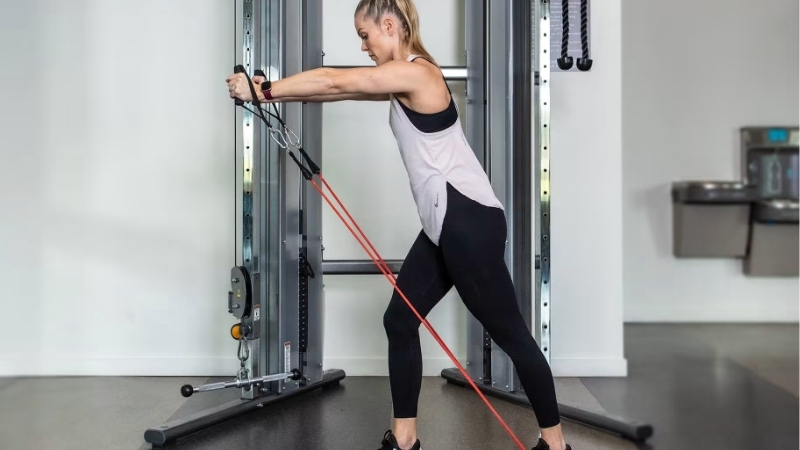
A full chest routine needs three anchor positions. Low at roughly 12 in (30 cm) covers low-to-high presses that bias the upper chest, chest height at 48-54 in (122-137 cm) covers the standard press, and a high point above 78 in (198 cm) covers high-to-low crossovers.
A door anchor supplies all three by moving up and down the frame, which is why it remains the most practical option for most homes. A multi-point wall board does the same job permanently if drilling is allowed.
Footprint and Clear Floor for a Full Session
Allow roughly 6-8 ft (1.8-2.4 m) straight out from the anchor for pressing, and about 6 x 8 ft (1.8 x 2.4 m) of floor overall once push-ups and floor pullovers are included. Bands stretch to two or three times their resting length, so the space is deeper than people expect.
Storage is the easy part. A full tube set with handles and anchors packs into a bag around shoebox size at roughly 5 lb (2.3 kg). Check the real dimensions of the training area before planning the routine rather than after.
Sequencing the Movements Within a Session
Start with the anchored press while you are fresh, because it carries the heaviest tension and the most technical demand. Follow with low-to-high work, then banded push-ups to failure, then a light pullover or stretch-position movement to finish.
Volume progresses before tension does. Adding a set or slowing the eccentric produces steadier progress than jumping to a much heavier band, since band steps are coarse and a single size increase can be a large percentage change.
Push-Up Loading Inside the Routine
The banded push-up is the one movement here that trains the stretched position properly, because bodyweight loads the bottom of the range where elastic tension is at its lowest. That makes it the necessary complement to every anchored movement in the session.
Loading it is straightforward: a flat band across the upper back adds tension that peaks at lockout, and push-up handles extend the range below hand level. Together they turn the exercise from a warm-up into a working set within the best chest exercises with resistance bands.
Market Context for Band Equipment
The mid tier is where layered latex with an inner safety cord has become standard, and it is where the widest choice sits. Below it the pattern is predictable: single-layer tubes that split sooner, foam handles that flatten, and carabiners that deform under repeated loading.
Anchoring for renters remains the thinnest part of the market. Most equipment assumes a wall you may drill, so door anchors and portable options are still doing most of the work despite being the least developed products in the category.
Durability has risen up the priority list as home training became permanent rather than temporary. Systems with replaceable handles and clips now make more sense than sealed sets, because the wear point can be renewed for a fraction of the original cost.
Gear for the Best Chest Exercises With Resistance Bands
These seven items cover the tension, the three anchor heights, the push-up loading and the bench angle. Each entry states the honest weakness, because in band training the weakness is always a contact point.
| Product | Type | Role in Routine | Spec | Note |
|---|---|---|---|---|
| Bodylastics Stackable Set | Tube bands | Presses and crossovers | Stacks to ~96 lb (43.5 kg) | Inner safety cord |
| WHATAFIT Tube Set | Tube bands | Budget starting point | Graded tubes | No safety cord |
| Serious Steel Flat Bands | Flat loops | Banded push-ups | Graded widths | Frays at contact |
| Bodylastics Heavy Door Anchor | Door strap | All three heights | Adjustable | Solid doors only |
| Anchor Gym CORE Station | Multi-point board | Permanent anchors | Spans two studs | Drilling required |
| Push-Up Handles | Accessory | Deeper push-up range | Rotating or fixed | Wrist relief |
| FLYBIRD Adjustable Bench | Bench | Incline and flat presses | Multiple angles | Folds flat |
Bodylastics Stackable Resistance Bands Set
Stackable tubes are the backbone of the routine because they cover presses, crossovers and pullovers from a single anchor. Clipping tubes together builds toward roughly 96 lb (43.5 kg) of tension, and the inner cord contains a failure rather than releasing it.
Handles and clips wear before the tubes, though both can be replaced. Tension also falls away at the start of each rep, so pausing at the stretch is necessary to stop the bottom of the range becoming wasted motion.
WHATAFIT Resistance Band Set
The budget starting point, and genuinely adequate for learning the routine. A full set with handles, door anchor and ankle straps costs a fraction of the premium options and covers the first few months of the best chest exercises with resistance bands.
There is no inner safety cord, which is the specific feature worth having once tension gets high. Batch consistency also varies, so inspect each tube along its length before the first session rather than assuming.
Serious Steel Flat Bands
A flat band across the upper back turns push-ups into a loaded press whose tension peaks at lockout. It needs no anchor, works anywhere and is the cheapest way to keep push-ups productive once bodyweight alone stops being challenging.
Getting the band positioned solo is fiddly and heavier bands dig into the shoulder blades. The band frays where it crosses the hands, so that strip needs checking before each session rather than the middle of the loop.
Bodylastics Heavy Duty Door Anchor
One cheap strap supplies all three anchor heights the routine needs, simply by moving it up or down the door. For anyone renting, this single item is what makes the full programme possible rather than a partial version of it.
The door must be solid, must open away from you and must stay closed throughout every set. Hollow-core internal doors are unsuitable, and the stitching at the stopper is the component that fails first.
Anchor Gym CORE Station
A multi-point board spanning two studs puts low, chest and high anchors on one plate, which suits this routine better than any single anchor. It removes the pause between movements spent repositioning a door strap.
It is a permanent installation requiring accurate stud location and a larger visual presence on the wall. Irregular framing may need a plywood backing board fitted first, which adds to the job.
Push-Up Handles
Handles allow the chest to travel below hand level, extending the push-up range beyond what flat palms permit, and they keep the wrist neutral during high-rep sets. Combined with a flat band across the back they make push-ups a genuine strength movement.
Rotating models add instability that some people find useful and others find distracting. Cheap plastic handles can flex under heavier users, so a stable base matters more than the rotation feature.
FLYBIRD Adjustable Weight Bench
Running banded presses on a bench with the band passed underneath lets you change the back angle and shift emphasis between mid and upper chest. It also provides the platform for banded pullovers at the end of the session.
The pad is narrow compared with commercial benches and the seat-to-back gap is noticeable to some. The assembly bolts settle after the first few sessions and benefit from a check with a spanner.
Frequently Asked Questions
These questions come up as soon as someone tries to run a full chest session on bands rather than a single movement.
How many exercises should the routine include?
Four covers the full range: an anchored press, a low-to-high movement, banded push-ups and a stretch-position finisher. Adding more usually increases fatigue without covering any new range, since band tension curves overlap heavily.
How many sets and reps?
Three sets of ten to twenty per movement suits elastic resistance, because the useful stimulus comes from time under tension rather than peak load. Take the push-up set close to failure and keep the anchored press two or three reps short of it.
Do I need a bench for this routine?
No, but it widens the options. All the best chest exercises with resistance bands can be done standing or on the floor, and a bench mainly adds angle variation and a stable platform for pullovers.
How often can I train chest with bands?
Two to three sessions a week is sustainable, because elastic resistance produces less joint stress than heavy pressing. Grip and wrists usually accumulate fatigue before the chest does, which is the practical limit to watch.
See More:
- Ankle weights best
- Best rated ankle weights
- Best home workout equipment budget
- Best resistance bands for men
Final Thoughts
The best chest exercises with resistance bands only produce a complete session when they are combined, since each one peaks at a different point in the range. A press, a low-to-high angle, a loaded push-up and a stretch finisher covers all of it. Set up three anchor heights and measure the clear floor in front before you start.


Write Your Review
No reviews yet. Be the first to share your experience!