
Key takeaways
What's inside
Best cheapest exercise bike shopping turns on two numbers most listings bury: flywheel weight and floor footprint. Everything else is packaging. This guide explains what changes between a 30 lb and a 49 lb flywheel, what friction pads cost you in noise, and lists six bikes with their real limits. Both numbers sit in the table below.
As an Amazon Associate we earn from qualifying purchases at no extra cost to you. Product prices and availability are accurate as of the date shown and are subject to change.


As an Amazon Associate we earn from qualifying purchases at no extra cost to you. Product prices and availability are accurate as of the date shown and are subject to change.
By Chris Parker
🛒 Best Price Today on Amazon
Prime members get fast, free shipping on everything above, plus member-only deals. New members get a 30-day free trial — cancel anytime.
How to Choose the Best Cheapest Exercise Bike
Budget bikes fail in patterns, which makes them easier to compare than the spec sheets imply. Picking the best cheapest exercise bike comes down to flywheel mass, resistance mechanism, the floor area it occupies permanently, and whether the saddle and bars actually adjust far enough for your body.
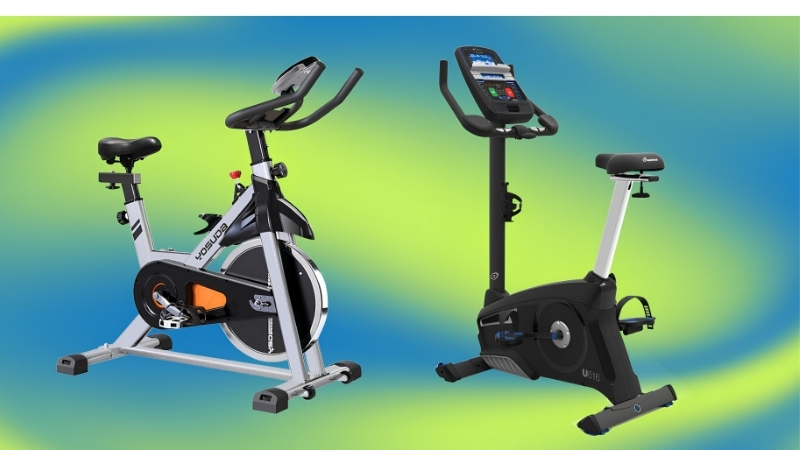
Flywheel Weight and Resistance Type
Flywheel mass on budget indoor cycles runs roughly 30 to 49 lb (13.6 to 22 kg). Heavier wheels carry momentum through the dead spot at the top of the pedal stroke, so the ride feels continuous rather than stuttering. Around 35 lb (16 kg) is the practical floor for a smooth stroke.
Resistance splits two ways at this price. Friction systems press a felt pad onto the wheel: cheap, infinitely variable, and a consumable that wears and squeaks. Magnetic systems hold magnets near the wheel with no contact, which is quieter and needs no maintenance, but costs more and usually steps through fixed levels.
Connected features have drifted down into this tier, and that is worth reading carefully. Several budget bikes now advertise app integration while the actual bike has no cadence sensor at all. Check what the machine does with no subscription paid, because that is the version you will own in month four.
Footprint, Ceiling and Where the Bike Actually Lives
Footprint decides whether the best cheapest exercise bike gets used or resented. Compact indoor cycles land near 40 x 21 in (102 x 53 cm), roughly 6 sq ft (0.55 sq m). Add about 24 in (61 cm) of clearance behind for mounting and another foot at each side.
Height matters more than people expect. Riding out of the saddle raises your head roughly 10 to 12 in (25 to 30 cm) above seated height, which becomes a genuine problem under a sloped ceiling or a low basement beam. Check the space standing on the pedals, not just sitting.
Transport wheels are the difference between a bike that moves and one that does not. Budget cycles weigh roughly 65 to 110 lb (29 to 50 kg), so front wheels and a tilt point matter. Measure the actual floor area, doorway and any turn in the hallway before ordering.
Rider Fit: Saddle, Handlebars and Q-Factor
Cheap bikes are sized for average bodies and quietly exclude the tails. Look for four-way adjustment, meaning saddle and handlebars move both up and fore-aft. Two-way bikes limit you to height changes only, which leaves taller and shorter riders reaching or cramped throughout the session.
Manufacturers often skip published height ranges entirely at this price, and testers over 6 ft (183 cm) regularly report maxing out the seatpost. If you are near either extreme, that omission is a warning sign rather than an oversight. Q-factor, the distance between pedals, is rarely listed and matters for knee comfort.
Noise, Floors and What Wears Out First
Drive type sets the noise floor. Belt drives are quiet and need no lubrication; chain drives are louder and need periodic oiling, and chains stretch over time. A friction pad adds its own squeak once it wears, and pads are cheap to replace but easy to forget about.
Under the bike, a mat is not optional on hardwood or in an upstairs room. It stops the frame marking the floor, catches sweat, and cuts vibration transmitted into the structure. Warranty terms are the real tell at this price: many budget bikes cover the frame for a year and parts for only three months.
The wider case for a home bike is time, not equipment. The WHO 2020 guidelines set 150 minutes of moderate activity per week plus two strength sessions, which works out near 22 minutes a day, and the CDC reports fewer than one in four US adults meet both. A bike at home removes the travel entirely. Check with a doctor before starting a new programme.
Top Picks: Best Cheapest Exercise Bike Options Compared
Six best cheapest exercise bike candidates below, each assessed on flywheel mass, resistance type, footprint and genuine weak point. Prices in this tier move constantly, so the ranking is built on hardware rather than on a figure that will read differently next month.
| Bike | Flywheel | Resistance | Best for |
|---|---|---|---|
| YOSUDA YB001 | 35 lb (16 kg) | Friction, belt drive | Lowest sensible entry price |
| Sunny Health SF-B1002 | 49 lb (22 kg) | Friction, chain drive | Heaviest wheel for the money |
| Sunny Health SF-B901 | 40 lb (18 kg) | Friction, chain drive | Smallest footprint |
| YOSUDA YB001R | 35 lb (16 kg) | Magnetic | Quiet flats and shared walls |
| Exerpeutic Folding Upright | Light | Magnetic, 8 levels | Storing it between sessions |
| Schwinn IC4 | 40 lb (18 kg) | Magnetic, micro-adjust | Spending a little more |
YOSUDA YB001: Lowest Sensible Entry Price
A 35 lb (16 kg) belt-driven flywheel with friction resistance, on a steel frame weighing roughly 69 lb (31 kg), in a footprint near 40.5 x 20.5 in (103 x 52 cm). The belt keeps it quiet for a friction bike and transport wheels make relocating it realistic.
Friction pads wear and eventually squeak, and there is no cadence tracking on the console. YOSUDA does not publish a rider height range, and testers around 6 ft (183 cm) have maxed the seatpost. Rated user weight sits near 270 lb (122 kg) on this model. Budget tier.
Sunny Health SF-B1002: Heaviest Wheel for the Money
A 49 lb (22 kg) chrome flywheel is unusual at this price and it shows in the stroke, which stays smooth through standing efforts where lighter wheels stutter. The steel frame is heavy enough to stay planted.
Chain drive means more noise and periodic lubrication, and the chain stretches with use. There is no console on this model, with cadence tracking sold separately as a sensor. Warranty is frame one year, parts three months, and rated capacity is around 275 lb (125 kg). Budget tier.
Sunny Health SF-B901: Smallest Footprint
A chain-driven cycle with a 40 lb (18 kg) flywheel occupying roughly 5.8 sq ft (0.54 sq m), which is the tightest genuine indoor cycle footprint in this group. If the bike has to live in a bedroom corner or beside a desk, that difference is the deciding factor.
Chain noise and friction pad wear apply here as with any bike of this type. The console is minimal and adjustment is more limited than the taller Sunny models. Rated capacity sits near 275 lb (125 kg). Budget tier, and the pick when space is the binding constraint.
YOSUDA YB001R: Quietest for Shared Walls
The magnetic version of the YB001, keeping the 35 lb (16 kg) flywheel but replacing the felt pad with non-contact magnets. Nothing touches the wheel, so there is no pad to wear, no squeak developing over months, and no maintenance beyond keeping it clean.
Magnetic resistance steps through fixed levels rather than adjusting continuously, which some riders find coarse mid-interval. It costs more than the friction YB001 for the same flywheel. Rated near 270 lb (122 kg). Budget to mid tier.
Exerpeutic Folding Upright Bike: Best for Storing Away
The only genuinely folding option here, using eight levels of magnetic tension and an upright rather than indoor-cycle geometry. It collapses down for storage against a wall or in a cupboard, which is the whole argument for it in a flat with no dedicated room.
Folding costs you flywheel mass, so the ride is noticeably lighter and less like outdoor cycling. It does not suit standing efforts or hard intervals. Budget tier, chosen for storage rather than ride quality.
Schwinn IC4: Worth the Step Up
A 40 lb (18 kg) flywheel with magnetic resistance adjusted through 100 micro-increments rather than fixed steps, plus Bluetooth for broadcasting cadence and heart rate to third-party apps. Four-way saddle and handlebar adjustment covers a wider range of riders than anything below it here.
It costs considerably more than the rest of this list and sits at the edge of what anyone would call cheap. It is heavy to move despite transport wheels. App classes are optional but heavily promoted, so be clear about what works unsubscribed. Mid tier.
Frequently Asked Questions
These four questions come up repeatedly from people buying the best cheapest exercise bike for a flat or a spare room. Each answer sticks to what the hardware does and what space it needs, rather than promising outcomes from any particular training pattern.
How heavy should the flywheel be?
Around 35 lb (16 kg) is the practical minimum for a smooth pedal stroke on an indoor cycle, and 40 to 49 lb (18 to 22 kg) feels noticeably more continuous through standing efforts. Lighter wheels are common on folding uprights, which trade ride quality for storage.
Is magnetic resistance worth paying extra for?
In a flat or an upstairs room, usually yes. Magnets never touch the wheel, so there is no pad to wear out, no squeak developing over months and no maintenance. The trade-off is fixed resistance steps on cheaper models and a higher purchase price for the same flywheel weight.
How much space does an exercise bike need?
Budget on roughly 40 x 21 in (102 x 53 cm) for the bike itself, plus about 24 in (61 cm) behind for mounting and a foot at each side. Standing on the pedals raises your head 10 to 12 in (25 to 30 cm), so check ceiling clearance too, especially under a slope.
Do I need a subscription to use it?
Not on any bike in this list. Every one functions fully as a bike without paying anything. What a subscription adds is guided classes and metric tracking, and on the cheapest models the bike may not have a cadence sensor to track with in the first place.
See More:
- Best beginner jump rope
- Best boxing jump rope
- Best boxer jump rope
- Best cheapest yoga mat
- Best workout exercise equipment
Final Thoughts
The best cheapest exercise bike is the one whose flywheel weight, footprint and adjustment range all fit your actual room and body. Take 35 lb (16 kg) as the floor, pay for magnetic resistance if you share walls, and measure the space standing on the pedals before you order.


Write Your Review
No reviews yet. Be the first to share your experience!