
Key takeaways
What's inside
Best exercise bike for knee rehabilitation comes down to four measurements most listings never publish: crank length, Q-factor, seat travel and the lowest usable resistance. This guide explains what each number does, where to find it when a listing omits it, and how to compare bikes on geometry. Your programme belongs to your clinician.
As an Amazon Associate we earn from qualifying purchases at no extra cost to you. Product prices and availability are accurate as of the date shown and are subject to change.
As an Amazon Associate we earn from qualifying purchases at no extra cost to you. Product prices and availability are accurate as of the date shown and are subject to change.




By Chris Parker
🛒 Best Price Today on Amazon
Prime members get fast, free shipping on everything above, plus member-only deals. New members get a 30-day free trial — cancel anytime.
Start 30-Day Prime Free Trial →See Today’s Amazon DealsThe Four Measurements That Decide Fit
Bike marketing focuses on flywheel weight and console features, neither of which affects how your joints move. The specifications below determine the actual geometry of the pedal stroke, which is what makes one best exercise bike for knee rehabilitation candidate suitable and another not.
Crank Length and How Far the Knee Travels
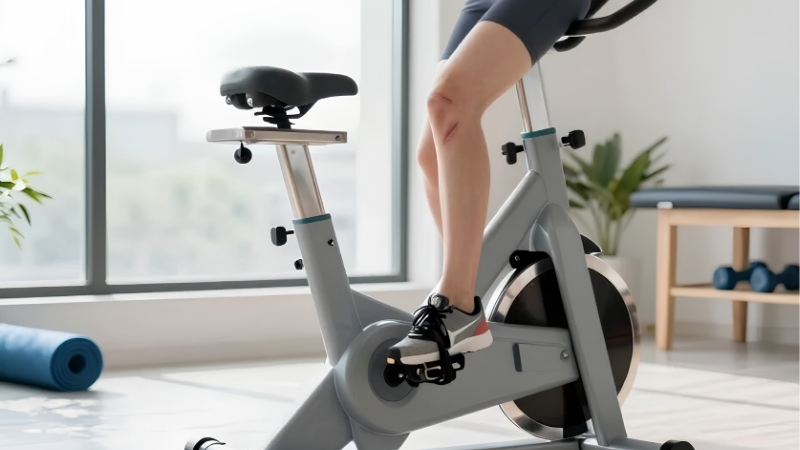
On the best exercise bike for knee rehabilitation, crank length is the distance from pedal spindle to crank axle, typically 165-175 mm. It sets the diameter of the circle your foot travels, and therefore how much the knee has to bend at the top of every single stroke.
Shorter cranks reduce that range of motion, which is why many stationary bikes intended for gentler use specify 165 mm or less on the spec sheet. Very few listings publish the figure, so it is worth asking the seller directly rather than assuming a standard length applies.
Q-Factor and Pedal Stance Width
Q-factor on the best exercise bike for knee rehabilitation is the horizontal distance between the outer faces of the crank arms, usually 150-200 mm. It determines how far apart your feet sit, and a wide stance changes the tracking of the knee through the stroke in a way some people notice immediately.
Narrower is not automatically better, since stance width should follow your own hip structure rather than any general rule. What matters is that the figure exists and is published, because a bike with an unusually wide Q-factor may simply not suit you.
Seat Travel, Fore-Aft Adjustment and Reach
Seat height range on an upright, or rail travel on a recumbent, decides whether the bike can be set to your own leg length at all. Check the stated user height range and treat the extremes with caution, since the ends of any range are usually a stretch.
Fore-and-aft adjustment is the specification most budget bikes omit entirely, and it is the one that positions the knee relative to the pedal. A bike offering both height and horizontal adjustment gives far more scope to reach a position that suits you.
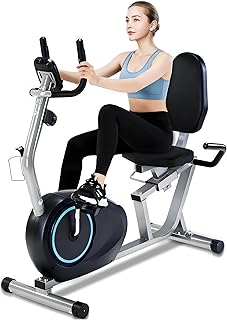
Recumbent bikes adjust by sliding the whole seat, which changes distance and angle together. That is simpler to operate but gives less independent control than separate adjustments, so weigh convenience against precision.
Resistance Floor, Increments and Footprint
On the best exercise bike for knee rehabilitation, the lowest usable resistance matters far more than the highest. Bikes with eight levels often start at a load that is already substantial, whereas sixteen or twenty-five level systems place level one genuinely light, which is the range gentle cycling actually uses.
On footprint, an upright needs roughly 40 x 20 in (102 x 51 cm) and a recumbent about 60 x 25 in (152 x 64 cm), plus 2 ft (0.6 m) of clear space around it. Measure that area and check the frame weight, since a light frame moves under load.
Top Picks: Best Exercise Bike for Knee Rehabilitation
The six best exercise bike for knee rehabilitation candidates below are grouped by how much adjustment each offers rather than by price. The table lists what is actually published for each, and the write-ups explain where the specification is strong and where it is thin.
| Bike | Type | Resistance levels | Seat adjustment | Price tier |
|---|---|---|---|---|
| Schwinn 270 Recumbent | Recumbent | 25 magnetic | Sliding rail | Mid to premium |
| Schwinn 170 Upright | Upright | 25 magnetic | Height only | Mid |
| Sunny Health SF-B1805 | Indoor cycle | Friction, infinite | Height and fore-aft | Mid |
| Marcy ME-709 Recumbent | Recumbent | 8 magnetic | Sliding rail | Budget |
| Exerpeutic 400XL | Folding semi-recumbent | 8 magnetic | Height range | Budget |
| Vive Pedal Exerciser | Portable pedals | Adjustable tension | Chair dependent | Budget |
Schwinn 270 Recumbent Bike
Twenty-five resistance levels put level one genuinely light, which is the specification that matters most here. The sliding seat rail offers a wide adjustment range and the back support lets you sit in a stable position without holding yourself upright.
Crank length and Q-factor are not published anywhere, which is the recurring frustration across this whole category. It is also bulky at around 64 x 27 in and heavy enough that repositioning it is a two-person job once assembled.
Schwinn 170 Upright Bike
The upright counterpart with the same twenty-five level resistance system in a smaller footprint of roughly 41 x 21 in. For anyone who can manage the step-over comfortably, it offers the same fine load control in less space.
It adjusts for seat height but not fore and aft, which limits how precisely you can position the knee relative to the pedal. The step-over height also rules it out for anyone who finds lifting a leg difficult.
Sunny Health SF-B1805 Indoor Cycle
Included specifically because it offers both height and fore-aft seat adjustment, which almost nothing else at this price does. Friction resistance also adjusts infinitely rather than in steps, letting you set a genuinely minimal load.
Friction resistance is not repeatable between sessions, so you cannot record a level and return to exactly the same load later. The riding position is also aggressive by default, which suits fitness cycling more than gentle use unless the bars are raised.
Marcy ME-709 Recumbent Bike
A straightforward recumbent with sliding seat adjustment at a low price, and stable enough that the frame does not shift under pedalling. For a simple, reliable low-impact bike without connected features, it covers the basics well.
Eight resistance levels means coarse steps and a level one that is not especially light. The console is minimal and the seat padding is thinner than premium recumbents, which is noticeable during longer sessions.
Exerpeutic 400XL Folding Bike
The folding option, which matters when the bike has to disappear between sessions. The frame is low, the seat height range is generous for the price, and the whole unit stores in a fraction of its working footprint.
Folding frames flex more than fixed ones and the movement is noticeable under harder pedalling. Eight resistance levels also gives coarse steps, and the pedal stroke is less smooth than heavier fixed-frame bikes at the same price.
Vive Pedal Exerciser
A set of floor pedals used from a chair, which removes frame geometry from the equation entirely since your chair sets the position. The footprint is about 16 x 20 in and it can be moved and stored by anyone.
Tension adjustment is coarse and the unit slides on hard floors unless braced. It also offers no seat adjustment of its own, so the fit depends entirely on the chair, which makes precise positioning difficult to achieve or repeat.
Frequently Asked Questions
These four questions cover the equipment specifications rather than any clinical guidance. Anything about your own knee, your recovery or how much cycling to do is a question for a doctor or physiotherapist, not a product page.
Where do I find crank length and Q-factor?
Rarely in the listing. Ask the seller or manufacturer directly, since both figures are usually known internally even when unpublished. If neither can tell you, treat that as a reason to consider a bike whose specifications are documented.
Does the best exercise bike for knee rehabilitation need a heavy flywheel?
No. Heavy flywheels smooth the stroke at higher speeds, which is a training benefit rather than a comfort one. At the gentle end of the range, resistance granularity and seat adjustment matter considerably more than flywheel mass.
Is friction or magnetic resistance better?
Magnetic is repeatable, so you can record a level and return to it, which helps when someone else is guiding your progression. Friction adjusts infinitely and can be set lighter, but it drifts between sessions and the pads wear over time.
Should a professional set up the bike?
If you are cycling as part of a rehabilitation plan, have your position checked by your physiotherapist. Seat height and fore-aft position determine how the knee moves through the stroke, and that is a clinical decision rather than a comfort preference.
See More:
- Ankle weights best
- Best rated ankle weights
- Best home workout equipment budget
- Best resistance bands for men
Final Thoughts
The best exercise bike for knee rehabilitation is chosen on crank length, Q-factor, seat travel and how light level one actually is, not on flywheel weight or console features. Ask the seller for unpublished figures, measure the floor space, and take all guidance on your programme from your clinician.


Write Your Review
No reviews yet. Be the first to share your experience!