
Key takeaways
What's inside
Best weight home gym decisions come down to two numbers before brand or exercise count: how the resistance is generated, and how much room the machine needs including the space your body sweeps through. This roundup compares six all-in-one systems on stack weight, pulley ratio, frame build and true footprint.
As an Amazon Associate we earn from qualifying purchases at no extra cost to you. Product prices and availability are accurate as of the date shown and are subject to change.


As an Amazon Associate we earn from qualifying purchases at no extra cost to you. Product prices and availability are accurate as of the date shown and are subject to change.
By Chris Parker
🛒 Best Price Today on Amazon
Prime members get fast, free shipping on everything above, plus member-only deals. New members get a 30-day free trial — cancel anytime.
How to Compare the Best Weight Home Gym Machines
Marketing for this category counts exercises, which tells you almost nothing. What separates a machine that gets used from one that becomes a clothes rail is the resistance mechanism, the honest footprint, and which parts the warranty actually covers. Those three filters eliminate most of the field quickly.
Resistance Type and Pulley Ratio
Three mechanisms dominate. Weight stacks give a familiar, linear load and the number on the plate is what you lift – provided the pulley ratio is 1:1. Many cable systems run 2:1, which means a 150 lb stack delivers roughly 75 lb at the handle. That single detail changes how a machine compares to free weights.
Power rod systems bend composite rods instead of lifting plates, so resistance rises through the range and the machine stays lighter and quieter. Incline bodyweight trainers use a percentage of your own mass on a sliding rail, which suits beginners and rehab-style work but has a hard ceiling once you get strong.
The wider shift is worth naming: home training stopped being a temporary substitute years ago, and build quality across the category has genuinely improved. So has the number of machines that look substantial and use thin tube, undersized cables and a single moulded pulley housing. Frame gauge tells you more than the exercise count on the box.
Footprint, Ceiling Height and Workout Envelope
The stated footprint is the base of the frame, not the space you need. Add roughly 2-3 ft (60-90 cm) behind and in front for seated rows, leg extensions and press arms travelling through their arc. A machine listed at 68 x 42 in (173 x 107 cm) realistically wants a clear area closer to 9 x 6 ft (2.7 x 1.8 m).
Height is the constraint that ends purchases. Full stack machines commonly stand 79-84 in (200-213 cm), and lat pulldown work needs clearance above that. Basements with ductwork and rooms with sloped ceilings frequently fail this test. Measure the actual area and ceiling height where the machine will stand before ordering.
Frame Gauge, Cables and Warranty Splits
Steel tube thickness is stated as gauge, where a lower number is thicker: 11-gauge frames are noticeably more rigid than 14-gauge under load and are the reason two machines with identical stack weights feel completely different. Weld quality at the base joints is usually where cheap frames start to flex first.
Cables are the wear part. They stretch, fray at the swage points and eventually need replacing, so check whether spares are sold separately before you buy. Warranties almost always split into frame, moving parts and upholstery, with wildly different terms – a lifetime frame warranty alongside 90 days on cables is common.
Top Picks: The Best Weight Home Gym Options by Type
These six span power rods, weight stacks, a Smith cage and an incline trainer, which covers every realistic approach in the category. Availability shifts and specifications get revised, so each entry focuses on mechanism, space demand and the specific compromise rather than a price that changes weekly.
| Machine | Resistance | Type | Best for |
|---|---|---|---|
| Bowflex Xtreme 2 SE | 210 lb power rods, upgradeable | Rod resistance | Quiet training, garages |
| Bowflex PR1000 | 210 lb power rods | Rod resistance + rail | Entry budget, mixed cardio |
| Marcy MWM-988 | 150 lb stack | Weight stack | Familiar stack feel |
| Body-Solid EXM1500S | 160 lb alloy stack | Weight stack | Build quality, longevity |
| Marcy SM-4033 Smith Cage | Your own plates | Smith bar + pulleys | Barbell-style training |
| Total Gym APEX G5 | Bodyweight percentage | Incline glideboard | Small flats, folds away |
Bowflex Xtreme 2 SE
Power rod resistance listed at 210 lb with an upgrade path to higher levels, no weight stack to maintain, and a frame that folds for storage. Rod resistance is near-silent, which makes this one of the very few machines in the category genuinely viable inside a flat or in a room directly above a bedroom.
The feel is the trade-off: resistance builds through the range rather than staying constant, so the load at lockout is higher than at the start and it does not translate directly to barbell numbers. Rods also fatigue over many years of use. Buy it for quiet, compact versatility rather than for matching gym loads.
Bowflex PR1000
The entry point of the rod-resistance line, also listed at 210 lb, with a sliding seat rail that adds a rowing motion to the exercise list. Assembly is manageable for one person, and the machine occupies a modest area for what it does, standing noticeably lower than most full weight stack machines do.
Rod count is the limiter – resistance is not upgradeable in the way the Xtreme range allows, so stronger users hit the ceiling on leg movements early. The rail adds length to the footprint. It suits a beginner testing whether machine training suits their routine before committing to a full weight stack.
Marcy MWM-988
A 150 lb (68 kg) selectorised stack with dual-function press arms, high and low pulleys and a leg developer, in a frame with a floor area in the region of 68 x 42 in (173 x 107 cm). It delivers the familiar pin-selector experience that most people already know from their local commercial gym floor. It is a small detail that quietly adds up.
Check the pulley ratio before comparing the stack to free weights, since effective load at the handle can be well below the plate number. Padding is thin by commercial standards and the frame uses lighter gauge tube than premium alternatives, so it flexes slightly under a strong user pulling hard on the high pulley.
Body-Solid EXM1500S
A 160 lb (72.5 kg) alloy stack in a heavier frame, aimed at buyers who intend to keep the machine for a decade rather than a season. Build quality, bearing pulleys and cable specification are the reasons it prices above the budget stack machines, rather than any extra exercise count printed on the box.
It is heavy, which means a two-person move and a floor that can carry the load, and assembly is a multi-hour job. Stack weight is still moderate for an experienced lifter on rows and pulldowns. This is a durability purchase rather than a maximum-load one, and the price tag reflects exactly that. Most buyers only notice this some weeks later.
Marcy SM-4033 Smith Cage
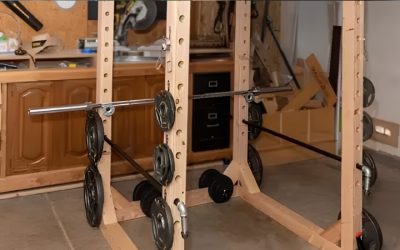
A Smith bar on fixed rails plus cable pulleys, using your own Olympic plates rather than a stack. That makes progression effectively unlimited and lets you train squats and presses with a barbell path while keeping the safety of a guided bar path during solo training sessions at home without a spotter.
Plates are an additional purchase and add significant cost and storage demand. The cage is the largest item here by a wide margin and needs a dedicated corner with real ceiling height. The fixed bar path also removes stabiliser demand compared with a free barbell, which some experienced lifters actively dislike.
Total Gym APEX G5
An incline glideboard using a percentage of bodyweight across multiple resistance levels, folding flat for storage under a bed or against a wall. For small flats with no dedicated room, it is the only machine on this list that genuinely disappears out of sight between training sessions. The best weight home gym question really comes down to this.
The ceiling arrives quickly for anyone already strong, since maximum resistance is capped by your own bodyweight and the steepest incline available. Foot placement and board length also suit some heights better than others. It excels at controlled, joint-friendly work and struggles to load a heavy lower body.
Frequently Asked Questions
The recurring questions in this category are about whether machines can replace free weights, how much stack weight is enough, and what maintenance the cables need. These four cover what buyers ask about the best weight home gym before committing to a machine of this size and weight. That gap tends to show up within a month.
How much stack weight does a home machine need?
For most home users, 150-160 lb (68-72 kg) is enough on a 1:1 ratio, because seated rows and pulldowns rarely exceed that in the first few years. If the machine runs a 2:1 pulley ratio, halve that stack number to estimate the real load arriving at the handle in your hands. It is the detail that decides the best weight home gym for most buyers.
Is a best weight home gym machine better than dumbbells?
Different, not better. Machines fix the movement path, which improves safety when training alone and reduces stabiliser demand. Dumbbells build more coordination and take a fraction of the space. Machines earn their footprint when you want to pull heavy without a rack and without a spotter standing there.
What maintenance do these machines need?
Cable inspection every few months for fraying near the swages, occasional pulley lubrication, and bolt re-torquing after the first month of use. Cables are consumable parts on any pulley system, so confirm that replacement cables are still available for your specific model before buying. It rarely appears anywhere on the spec sheet.
Can these machines go on an upper floor?
Rod-resistance and incline machines usually can, since they are lighter and quieter. Full stack machines combine substantial static weight with plate noise at the end of each rep, which carries through floors. Check your floor loading first, and use dense rubber matting underneath the frame either way.
See More:
Final Thoughts
The best weight home gym for your space is decided by resistance mechanism and honest floor measurement rather than by the exercise count printed on the box. Check pulley ratio before comparing stacks, add several feet to the stated footprint for your working envelope, verify ceiling height, and confirm replacement cables exist before you commit.

Write Your Review
No reviews yet. Be the first to share your experience!