
Key takeaways
What's inside
Best gym mat for home choices come down to material density and coverage area, not the thickness printed on the packaging. A 1/2 in foam tile and a 3/8 in rubber roll behave completely differently under a bench leg. This guide explains why that happens, then covers five mats across foam, rubber and solid PVC.
As an Amazon Associate we earn from qualifying purchases at no extra cost to you. Product prices and availability are accurate as of the date shown and are subject to change.


As an Amazon Associate we earn from qualifying purchases at no extra cost to you. Product prices and availability are accurate as of the date shown and are subject to change.
By Chris Parker
🛒 Best Price Today on Amazon
Prime members get fast, free shipping on everything above, plus member-only deals. New members get a 30-day free trial — cancel anytime.
How to Choose the Best Gym Mat for Home Training
The best gym mat for home use gets bought last and regretted first, usually because thickness was treated as the only specification that mattered. Material density decides dent resistance, coverage decides layout, and subfloor decides how much noise reaches the room below. Work through those four in order and the choice narrows quickly.
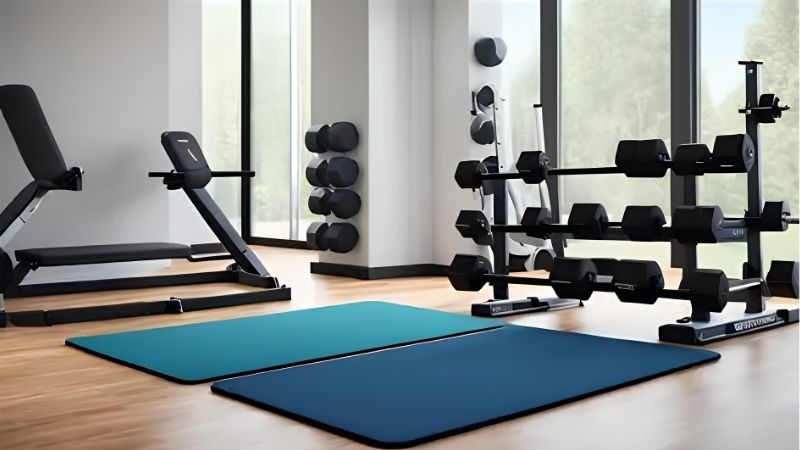
Material Density: Foam, Rubber and PVC
EVA foam is light, cheap and comfortable underfoot, and it compresses permanently under concentrated loads. A bench leg or a dumbbell edge leaves an impression that never recovers. It is excellent for bodyweight work, stretching and light dumbbells, and poor under anything combining feet and real mass.
Recycled rubber is dense and heavy – typically several times the weight of foam for the same area – and absorbs impact without permanent deformation. It is the material that survives dropped weights and machine feet. The trade-offs are cost, a rubber odour that takes weeks to fade, and difficulty moving it once installed.
Thickness Protects Against Different Things
Thickness protects against impact; density protects against static load. A 1/2 in (12 mm) foam tile feels substantial and still dents under a bench, while a 3/8 in (9.5 mm) rubber roll feels thinner and carries the same bench without a mark. Match the specification to the threat your floor actually faces.
For dumbbell training with controlled set-downs, 6-12 mm of rubber is ample. For heavier work, 3/4 in (19 mm) rubber becomes the sensible floor. Adjustable dumbbells and coated kettlebells should never be dropped regardless of what is underneath them, because the mat protects the floor rather than the equipment.
Coverage, Layout and Room Footprint
Work backwards from your training area. A dumbbell and bench setup needs roughly 6 x 6 ft (1.8 x 1.8 m) of protected floor, which is 36 sq ft – two packs of 24 sq ft interlocking tiles, or one large single-piece mat plus an offcut. Machines need only their own footprint plus a modest margin around the edges.
Interlocking tiles suit irregular rooms and can be lifted for cleaning; rolls give a seamless surface with no edges to catch a toe; single mats define a training zone in a shared living space. Measure the exact area, including door swings, before ordering, since returning heavy rubber is expensive and awkward.
Noise, Subfloor and Upper Floors
On upper floors, the low-frequency thud of weights reaching the ground is what neighbours hear, and mass absorbs it better than softness. Dense rubber outperforms thick foam here by a clear margin, and a foam underlayer beneath rubber improves things further again, at some cost to overall stability.
Concrete slabs need mats for comfort and equipment protection rather than sound. Suspended timber floors flex and amplify, so anything heavier than light dumbbells benefits from spreading the load across a larger mat area rather than concentrating it under four small equipment feet on bare timber boards.
Top Picks: Best Gym Mat for Home Use, by Training Load
These five cover the realistic buying paths: a large single-piece mat, interlocking foam, rubber rolls, dense rubber tiles and a machine mat. Each entry states what it protects against and where it fails, because no single flooring type handles bodyweight comfort and dropped iron equally well at the same time.
| Mat | Material | Thickness | Coverage | Best for |
|---|---|---|---|---|
| Gorilla Mats Premium | Foam, non-slip faces | 1/4 in (6 mm) | 6 x 4 ft | Bodyweight, yoga, HIIT |
| ProsourceFit Puzzle Mat | EVA foam tiles | 1/2 in (12 mm) | 24 sq ft per pack | Light dumbbells, kids |
| Rubber-Cal Recycled Roll | Recycled rubber | 3/8 in (9.5 mm) | Roll, cut to fit | Seamless training zone |
| IncStores Rubber Tiles | Recycled rubber | 8 mm | 2 x 2 ft tiles | Heavy dumbbells, racks |
| SuperMats Solid PVC | Solid PVC | 1/4 in (6 mm) | 4 x 6 ft | Treadmills, rowers |
Gorilla Mats Premium Large Exercise Mat
A single-piece 6 x 4 ft (183 x 122 cm) mat at 1/4 in (6 mm) with textured faces on both sides, so it stays put on hardwood and does not slide during lateral movement. No seams means nothing to catch or separate underfoot, and the whole thing rolls up for easy storage between training sessions. It is a small detail that quietly adds up.
At 6 mm it is a movement mat, not a load mat – bench feet and heavy dumbbells will mark it, and it does little for impact noise on upper floors. It is also priced above generic foam. Choose it for bodyweight training, mobility and conditioning rather than for protecting a floor from loose cast iron.
ProsourceFit Puzzle Exercise Mat
Interlocking EVA tiles at 1/2 in (12 mm) covering around 24 sq ft (2.2 sq m) per pack, with border pieces for a finished edge. Tiles let you shape the coverage to an awkward room and lift a section for cleaning, and the cost per square foot is comfortably the lowest of anything else on this particular list.
EVA dents permanently under point loads, so bench and rack feet leave impressions and tiles can separate when equipment is dragged across a seam. It also does relatively little to control the thud of weights on a suspended floor. As a first flooring layer for light training, the value is hard to beat.
Rubber-Cal Recycled Rubber Flooring Roll
Recycled rubber at 3/8 in (9.5 mm) supplied in rolls, giving a seamless surface across a defined area with no tile joints to separate under a shifting bench. Density is what you are buying: it resists denting from equipment feet and it absorbs impact far better than foam of roughly double the thickness.
Rolls are heavy and unwieldy for one person to position, and cutting to fit requires a sharp blade and patience. New recycled rubber has a strong odour that takes several weeks to fade in a closed room. Once it is down, the installation is effectively permanent, which is rather the whole point of it.
IncStores Rubber Gym Tiles
Interlocking recycled rubber at 8 mm in 2 x 2 ft (61 x 61 cm) tiles, combining rubber density with the layout flexibility of a puzzle system. For a dumbbell area or under a rack, this is the practical middle ground between cheap foam tiles and a full recycled rubber roll laid wall to wall. Most buyers only notice this some weeks later.
Tile edges can lift slightly if the subfloor is uneven, and the seams collect dust that needs sweeping out. Rubber is also heavy enough that a full room’s worth is a two-person job to carry in. Expect the same initial odour that comes with any recycled rubber product installed inside a closed room. That gap tends to show up within a month.
SuperMats Solid P.V.C. Mat
A rigid solid PVC mat at roughly 4 x 6 ft (122 x 183 cm) and 1/4 in (6 mm), designed to sit under a treadmill, rower or bike. Its job is spreading static load and stopping machine feet from pressing into carpet or scarring the hardwood underneath, while also catching dripped sweat during sessions. It rarely appears anywhere on the spec sheet.
It offers little impact absorption and is not intended for free weights – dropping anything on it can crack the sheet. It is also a fixed size with no interlocking option. For machine protection specifically, it does the one job that both foam and rubber tend to do imperfectly. The best gym mat for home question really comes down to this.
Frequently Asked Questions
Flooring questions cluster around thickness, dropped weights and whether foam is ever enough. These four cover what people ask about the best gym mat for home use before a first purchase, including the coverage calculation that most people get wrong at the start. The difference is obvious the moment it is used.
How thick should the best gym mat for home use be?
For bodyweight and light dumbbells, 6-12 mm of foam is fine. For heavier dumbbells and equipment feet, 8-10 mm of rubber outperforms thicker foam. For anything approaching dropped loads, 3/4 in (19 mm) rubber is the realistic minimum, and controlled set-downs remain necessary regardless of the surface.
Can I drop weights on a home gym mat?
Rubber flooring protects the floor beneath, but most home equipment is not designed to be dropped. Adjustable dumbbells, coated kettlebells and plastic-shelled weights crack or jam regardless of the surface. Treat matting as floor protection rather than as permission to start dropping loaded weights.
Does foam work under a bench or rack?
Not well. Concentrated point loads compress EVA permanently, and the impressions do not recover. Plywood spreader boards under the feet help a little, but rubber tiles remain the far more durable answer if a piece of equipment stays in one place permanently. None of that is visible in the product photographs.
How much mat do I need?
Around 36 sq ft covers a dumbbell and bench area at 6 x 6 ft; a machine needs its own footprint plus about 12 in of margin. Buy slightly more than the calculation suggests, since offcuts, border pieces and awkward corners all quietly consume material as you lay the floor out. That is worth checking before anything else is ordered.
See More:
Final Thoughts
The best gym mat for home training is matched to what actually threatens your floor: foam for movement, rubber for equipment feet and impact, solid PVC under machines. Measure the training area before ordering, buy slightly more coverage than the layout suggests, and remember that flooring protects the floor rather than the gear on it.

Write Your Review
No reviews yet. Be the first to share your experience!