
Key takeaways
What's inside
Best all-in-one power rack means a cage that also does lat pulldowns, dips and pull-ups without a second machine in the room. This guide covers upright gauge, hole spacing, cable ratios and the ceiling height these racks demand, then compares six that genuinely combine everything into one footprint.
As an Amazon Associate we earn from qualifying purchases at no extra cost to you. Product prices and availability are accurate as of the date shown and are subject to change.
As an Amazon Associate we earn from qualifying purchases at no extra cost to you. Product prices and availability are accurate as of the date shown and are subject to change.


By Chris Parker
🛒 Best Price Today on Amazon
Prime members get fast, free shipping on everything above, plus member-only deals. New members get a 30-day free trial — cancel anytime.
Start 30-Day Prime Free Trial →See Today’s Amazon DealsHow to Choose a Combination Power Rack
The best all-in-one power rack is always a compromise between capability and floor space, and the specifications that matter are rarely the ones in the marketing. The four criteria below cover what actually determines whether the best all-in-one power rack fits your room and your training.
Upright Gauge, Tubing Size and Capacity
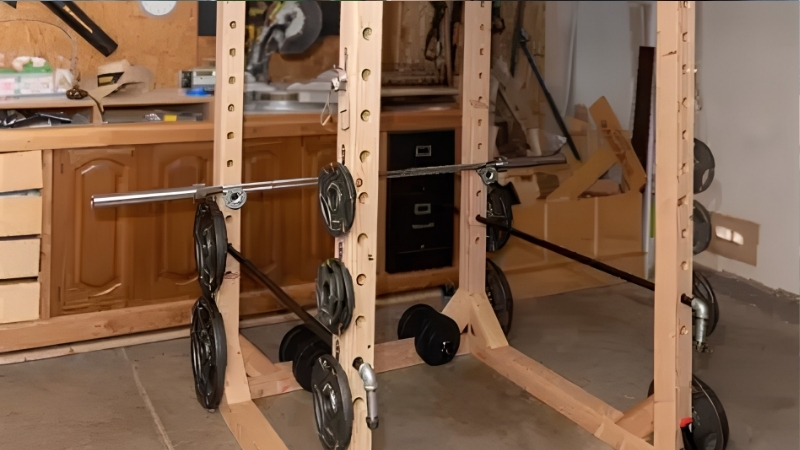
Candidates for the best all-in-one power rack typically use 2 x 2 in or 3 x 3 in (51 or 76 mm) tubing in 14, 12 or 11 gauge steel. Eleven gauge on 3 x 3 uprights is commercial specification; 14 gauge on 2 x 2 is entry level and adequate for most home training under 400 lb.
Rated capacity figures of 1000 lb and upward are common and largely theoretical for home use. What you actually feel is rigidity: a heavier rack does not shudder when you rerack a squat, and that stability is worth more day to day than any number printed on the box.
Gauge is the number to compare rather than capacity. Eleven gauge is roughly 3 mm of wall thickness against about 2 mm for 14 gauge, and that difference is what you feel through the uprights when a loaded bar lands in the J-cups.
Hole Spacing and Attachment Compatibility
Two-inch hole spacing is standard, but the better examples of the best all-in-one power rack use 1 in spacing through the bench and rack zone so you can set safeties and J-cups precisely. That one detail matters more than any accessory, because a safety pin an inch too high changes your bench setup.
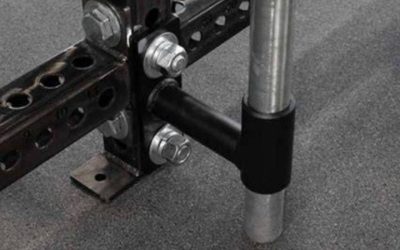
Check the hole diameter as well, usually either 5/8 in or 1 in, since it determines which third-party attachments will physically fit. A rack with a common hole size and spacing keeps your options open; a proprietary pattern locks you into one brand’s accessory range forever.
Lat Tower, Cable Ratio and Dip Stations
Plate-loaded lat towers usually run a 2:1 pulley ratio, meaning 100 lb of plates delivers roughly 50 lb at the handle. Weight-stack towers give a direct reading instead. Neither is wrong, but knowing the ratio prevents confusion about how much you are actually lifting.
Dip stations and pull-up bars are usually included, though pull-up bar height is fixed by the rack height. Check that the bar sits low enough to leave head clearance under your ceiling, since this is the single most common regret with a tall all-in-one rack.
Footprint, Ceiling Height and Assembly Space
A full cage with a lat tower occupies roughly 84 x 60 in (213 x 152 cm) of floor space and stands somewhere between 82 and 93 in (208-236 cm) tall. Add the plate loading pin and working space and the real requirement is closer to 9 x 8 ft (2.7 x 2.4 m) of clear room.
Ceiling height is the constraint that rules people out. You need the rack height plus 6-8 in (15-20 cm) for the pull-up bar to be usable, so measure floor to ceiling at the exact spot before ordering. Short-rack versions exist for basements and should be checked first.
Top Picks: Best All-in-One Power Rack Options
Every best all-in-one power rack below combines a cage with at least a lat tower and a dip station. The table lists the specs that decide the purchase, and each write-up names a genuine drawback so you can weigh capability against the floor and ceiling you actually have.
| Rack | Uprights | Cable system | Approx height | Price tier |
|---|---|---|---|---|
| Titan Fitness T-3 with Lat Tower | 2 x 3 in, 11 gauge | Plate loaded | Around 82-91 in | Mid |
| REP Fitness PR-4000 with Lat | 3 x 3 in, 11 gauge | Plate loaded | Around 80-93 in | Premium |
| Fitness Reality 810XLT | 2 x 2 in | Optional attachment | Around 83 in | Budget |
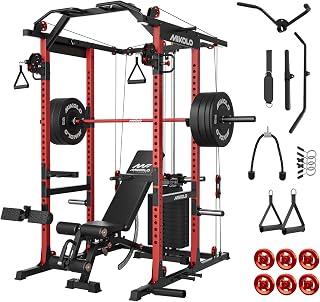
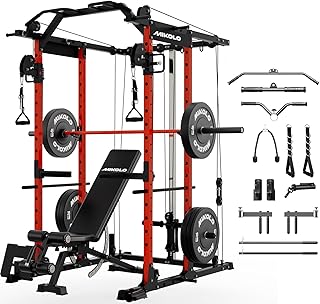
| Mikolo Power Cage with LAT | 2 x 2 in | Plate loaded | Around 86 in | Budget to mid |
| Marcy Smith Cage MWM-988 | Boxed frame | Weight stack | Around 85 in | Mid |
| Force USA MyRack | Modular, heavy gauge | Modular attachments | Around 87 in | Premium |
Titan Fitness T-3 with Lat Tower
The value benchmark for a serious all-in-one setup. Eleven-gauge uprights with 1 in hole spacing through the working zone give commercial-feeling rigidity, and the plate-loaded lat tower avoids the cost and bulk of a weight stack.
Finish quality is inconsistent between units and blemishes on arrival are routine rather than exceptional. Assembly is also long, typically several hours, and the instructions assume more familiarity with rack hardware than a first-time buyer usually has.
REP Fitness PR-4000 with Lat Attachment
Three-inch, eleven-gauge uprights and a wide accessory ecosystem make this the rack to buy if you expect to keep adding to it. Configuration options mean you can specify height to suit a low ceiling rather than cutting the pull-up bar out of your plans.
It is expensive once the lat tower and accessories are added, and the modular pricing makes the true cost harder to work out than a single boxed price. Assembly is also a genuine project rather than an afternoon.
Fitness Reality 810XLT Super Max Power Cage
The budget entry, and adequate for anyone training under moderate loads who wants a cage rather than a rack of stands. Multiple attachment points and a bar-holder layout cover most home training without any of the premium spend.
Two-inch uprights in lighter gauge mean noticeable movement under heavier squats, and the cable attachment is sold separately rather than integrated. Treat the rated capacity as generous and keep loads within what feels stable rather than what is printed.
Mikolo Power Cage with LAT Pulldown
Bundles the cage, lat tower and dip handles into one purchase at a price well under the established brands, which makes it the most complete budget package here. The plate-loaded cable works properly and the assembly is more manageable than the premium racks.
Steel gauge is lighter than the mid-tier options and hardware quality varies between units, so plan to retighten everything after the first few sessions. Attachment compatibility is also limited to their own range rather than the wider aftermarket.
Marcy Smith Cage MWM-988
A weight-stack machine with a Smith bar rather than a true power rack, included because it genuinely covers the widest range of movements from one footprint. The stack means no plate loading and no cable ratio arithmetic, which suits shared households.
A Smith bar is a fixed path, which is a real limitation for free-weight training. The stack also caps at a weight most lifters will pass on leg movements, and the frame does not accept third-party rack attachments at all.
Force USA MyRack
Modular by design, so you build the configuration you need and add cable, lat and other attachments over time. For a home gym intended to grow across years rather than being bought once, that path is the strongest argument here.
The cost climbs quickly once modules are added, and the base rack alone is not an all-in-one solution. Availability of individual attachments also varies, which can leave a planned configuration waiting on stock for months.
Frequently Asked Questions
These four questions cover what people want settled about the best all-in-one power rack before committing to something this large — ceiling requirements, whether all-in-one designs compromise too much, bolting down and what capacity actually means.
How much ceiling height do I need?
The rack height plus 6-8 in for the pull-up bar to be usable, which usually means 8 ft or more for a full-height cage. Short versions around 80 in exist for basements and garages, and checking this before ordering avoids the most common regret.
Is an all-in-one rack worth it over separate pieces?
In a single-room home gym, usually yes, because one footprint replaces three. If you have the space, separate pieces are often better at each individual job, particularly the cable station, where dedicated machines offer more travel and better ratios.
Does the best all-in-one power rack need bolting down?
Most home racks do not, provided they are heavy enough and you are not using bands anchored to the uprights. Band work and kipping both create upward force that a free-standing rack resists poorly, so bolt down or add weight if you train that way.
What does the capacity rating actually mean?
It is a static figure from the manufacturer rather than a working limit under dynamic load. Rigidity is the more useful measure, and it follows tubing size and gauge rather than the printed number. Judge racks by steel specification instead.
See More:
- Ankle weights best
- Best rated ankle weights
- Best home workout equipment budget
- Best resistance bands for men
Final Thoughts
The best all-in-one power rack for most home gyms uses 11 gauge steel with 1 in hole spacing in the working zone and a plate-loaded lat tower. Measure floor to ceiling at the exact spot, allow 9 x 8 ft of clear room, and check hole size and spacing so you are not locked into one brand’s accessories.



Write Your Review
No reviews yet. Be the first to share your experience!