
Key takeaways
What's inside
Best cable machine attachments are the cheapest way to widen what a home cable station can train, but only if they physically fit. This guide covers carabiner sizes, grip widths, swivel quality and load ratings, so you buy handles that work with the machine already standing in your room. Fit comes before features.
As an Amazon Associate we earn from qualifying purchases at no extra cost to you. Product prices and availability are accurate as of the date shown and are subject to change.
As an Amazon Associate we earn from qualifying purchases at no extra cost to you. Product prices and availability are accurate as of the date shown and are subject to change.



By Chris Parker
🛒 Best Price Today on Amazon
Prime members get fast, free shipping on everything above, plus member-only deals. New members get a 30-day free trial — cancel anytime.
Start 30-Day Prime Free Trial →See Today’s Amazon DealsHow to Choose the Best Cable Machine Attachments
The best cable machine attachments are not interchangeable. Three things decide whether one works on your machine: the size of the snap hook or carabiner, the width and angle of the grip, and whether the swivel actually turns under load. Two of the three are printed on the listing, and the third rarely is. Measure the hook before ordering.
Carabiner Fit, Swivel Quality and Load Rating
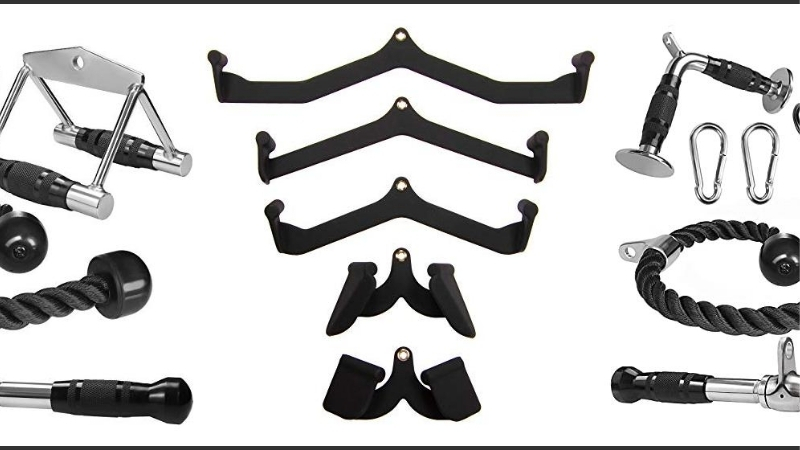
Home cable stations use snap hooks of different sizes, so measure the opening on your machine before ordering. Most attachments ship with a small ring that suits standard hooks, but functional trainers with heavy-duty clips often need a larger one, and a mismatch means an adapter carabiner on day one.
Swivels matter more than buyers expect. On rows and pulldowns the handle rotates through the movement, and a seized swivel puts that twist into your wrists instead. Look for a stated load rating and a solid steel swivel rather than a stamped plate, since that joint is where cheap handles fail first.
Grip Width, Angle and What Each Handle Trains
Grip width changes the exercise more than the machine does. A close neutral grip biases the mid-back and lats, a wide bar shifts work to the rear delts and upper traps, and single stirrup handles let each side work through its own range rather than following the stronger arm. Width changes the target muscle.
Angle is the second half. Rotating handles and rope attachments let the wrist find a neutral position, which is why triceps ropes stay comfortable on high-rep work. Fixed straight bars load the wrists more, so anyone with grip or elbow discomfort should start with rope and neutral grip options first.
Footprint, Storage and Clearance Around the Stack
Footprint is easy to forget with the best cable machine attachments, because the handles are small and the space they need is not. A 48 in (122 cm) lat bar wants clear width either side of the stack, and a rope needs room behind you for the full extension of the movement. Clearance decides which bar fits.
Storage is the other half. Wall hooks or a simple attachment rack keep handles off the floor and stop the carabiners scratching the frame paint. Measure the wall or the stack area you plan to use, and remember that a pile of handles on the floor is the fastest route to a rusty swivel. Hooks cost less than replacements.
Top Picks: Handles Worth Adding First
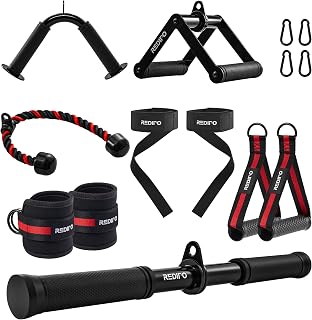
The best cable machine attachments cover a useful range: a rope, a lat bar, a close-grip row handle, single stirrups, ankle straps and a multi-grip option. Buy the rope and the stirrups first, since they cover the most exercises for the least money and fit almost every home cable station on the market. Buy in that order and nothing is wasted.
| Attachment | Trains | Typical size | Buy order |
|---|---|---|---|
| Rip Toned Tricep Rope | Triceps, face pulls | About 26 in | First |
| A2ZCARE Stirrup Handles | Rows, curls, flyes | Single grip | First |
| Yes4All Lat Pulldown Bar | Lats, upper back | 48 in wide | Second |
| A2ZCARE Double D Handle | Mid-back rows | Close neutral | Second |
| DMoose Ankle Straps | Glutes, hips | Padded cuff | Later |
| Multi-grip row handle | Several grips | Wide and neutral | Later |
Rip Toned Tricep Rope
A rope is the first attachment to buy, because it covers pushdowns, face pulls, overhead extensions and rope curls with one purchase. The standard length sits near 26 in (66 cm), and the free ends let the wrists rotate naturally, which is why it stays comfortable on higher-rep work. It is the first attachment to own.
Nylon ropes stiffen and fray at the ends over time, and cheap end caps come loose. Ropes are also the wrong tool for heavy loading, since the grip gives out before the muscle does. Treat it as a wear item and check the stitching where the rope meets the metal ring. Ropes are consumables, not lifetime kit.
A2ZCARE Stirrup Handles
Single handles are the most versatile pair of attachments you can own: one-arm rows, cable curls, flyes, pull-throughs and lateral raises all run from them. Working one side at a time also stops the stronger arm carrying the set, which is the main reason coaches keep them in every programme. They fit almost every machine.
Padding varies widely between brands, and thin foam becomes uncomfortable on higher-rep sets. Swivel quality is the thing to check before buying, since a stiff swivel is far more noticeable on single-arm work than on a bar. Store them on a hook to keep the bearings clean and dry. Swivel quality decides the best cable machine attachments here.
Yes4All Lat Pulldown Bar
A 48 in (122 cm) bar gives the wide grip that a short machine bar cannot, and the angled ends keep the wrists in a friendlier position at the top. It is the attachment that turns a basic stack into something that trains the upper back properly rather than approximately. Wide grips need wide clearance.
Long bars need clear width either side of the stack, so check the room before ordering rather than after. They are also awkward to store, and a bar leaning against a wall eventually falls. Shorter 38 in versions exist if the space is genuinely tight in your setup. Measure the width either side of the stack first.
A2ZCARE Double D Handle
The close neutral grip is the workhorse row handle, and it is the one most people can load heaviest without wrist discomfort. It suits seated rows and low pulls, and the narrow grip biases the mid-back in a way that a wide bar simply does not reach on the same machine. It handles the heaviest work of the set.
Welds and coating quality vary at the budget end, and rough edges show up on the knurled grip. Check the stated load rating, because this is the attachment that sees the heaviest work in most home setups and the one where a failure would be genuinely unpleasant mid-set. Check the welds before first use.
DMoose Ankle Straps
Ankle straps open up glute kickbacks, hip abduction and standing hamstring curls, which are the movements a home cable stack otherwise misses entirely. Padded cuffs with a D-ring are the standard design, and the fit around the ankle matters far more than the branding on the strap. They add movements a stack otherwise misses.
Cheap straps slip and rub, and the padding compresses within months of regular use. Check the closure length against your own ankle if you wear larger trainers, and wash the cuffs occasionally, since they sit against skin and pick up sweat faster than any other attachment. Hang them to dry after every session.
Multi-Grip Row Handle
A multi-grip handle combines wide, neutral and close positions on one frame, which saves buying three separate bars. It suits anyone who wants to rotate grips through a training block without a pile of hardware, and it stores on a single hook rather than across the whole wall. It replaces two or three separate bars.
They are heavier and pricier than single-purpose handles, and the extra grips overlap with attachments you may already own. Check the carabiner size carefully, because these frames are usually built for gym-grade clips rather than the smaller hooks fitted to budget home cable machines. Check the clip size before ordering.
Frequently Asked Questions
These questions come up whenever someone tries to widen what a home cable station can do. Most of them are compatibility questions, which is the part people discover only after a package arrives with a ring that does not fit the snap hook on their own machine. Compatibility beats features every time.
Will any attachment fit my cable machine?
Not always. The snap hook or carabiner on your machine sets the limit, so measure the opening before ordering. A cheap heavy-duty carabiner solves most mismatches, and it is worth keeping one in the box so a new handle never sits unused waiting for a replacement part. A spare carabiner solves most mismatches for very little.
Which attachment should I buy first?
A rope and a pair of single stirrup handles. Between them they cover pushdowns, face pulls, rows, curls, flyes and raises, which is most of what a home cable stack is used for. A lat bar and a close-grip handle make sensible second purchases after those. Those four cover the best cable machine attachments for most home setups.
Do swivels really matter?
Yes, particularly on single-arm work where the handle rotates through the movement. A seized swivel pushes that rotation into the wrist and elbow instead. Steel swivels with a stated load rating last longer than stamped plates, and they are the first thing to check on a budget handle. A stiff swivel is felt in the elbow.
How do I stop attachments rusting?
Keep them off the floor and out of direct contact with sweat. Wall hooks or a small rack solve most of it, and wiping the swivel occasionally does the rest. Ropes and ankle straps hold moisture longest, so hang them rather than leaving them coiled in a gym bag. Sweat, not use, is what corrodes hardware over time.
See More:
Final Thoughts
The best cable machine attachments for you are the ones that fit your hooks and your available width, not the longest list on a bundle page. Start with a rope and stirrup handles, add a lat bar and a close-grip handle later, and check the carabiner size before every order. Then hang them on the wall.

Write Your Review
No reviews yet. Be the first to share your experience!