
Key takeaways
What's inside
Best at home cable machine comparisons usually quote the stack weight and stop there. The number that actually decides how heavy the machine feels is the pulley ratio, and a 2:1 ratio halves the load at the handle before you have touched a thing. Ratio decides the felt weight. Stack figures alone tell you very little.
As an Amazon Associate we earn from qualifying purchases at no extra cost to you. Product prices and availability are accurate as of the date shown and are subject to change.
As an Amazon Associate we earn from qualifying purchases at no extra cost to you. Product prices and availability are accurate as of the date shown and are subject to change.


By Chris Parker
🛒 Best Price Today on Amazon
Prime members get fast, free shipping on everything above, plus member-only deals. New members get a 30-day free trial — cancel anytime.
Start 30-Day Prime Free Trial →See Today’s Amazon DealsHow to Choose the Best at Home Cable Machine
Three specifications decide the best at home cable machine purchase: the pulley ratio, whether the resistance comes from a stack or from plates you own, and the footprint including height. Stack weight on its own tells you very little until you know the first of those three. Three numbers, in that order. Everything else follows from those.
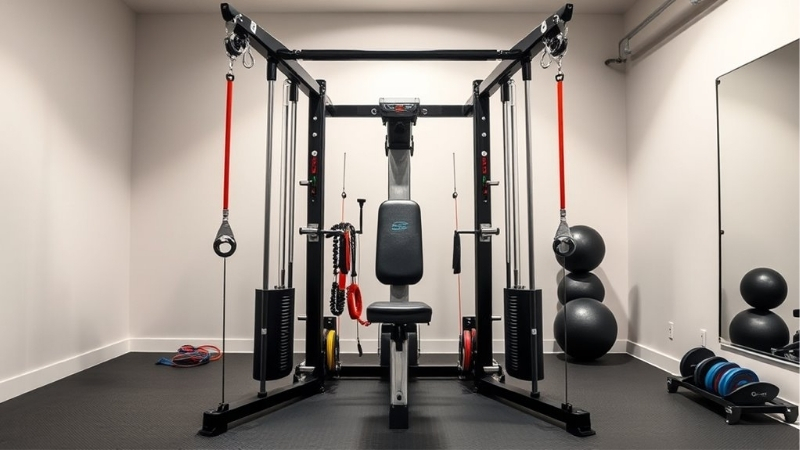
Pulley Ratio and What You Actually Lift
A 1:1 pulley delivers the full stack weight at the handle. A 2:1 ratio halves it, so a 150 lb (68 kg) stack gives 75 lb (34 kg) of resistance, while 4:1 quarters it. Manufacturers rarely lead with this, which is why machines feel lighter than expected on arrival. Ask for the ratio before ordering. It explains most post-delivery disappointment.
Neither ratio is wrong. Lower ratios give heavier resistance with less cable travel; higher ratios give lighter, smoother resistance with more range. For rows and pulldowns a lower ratio suits most people; for flyes and rotational work a higher ratio feels better. Neither ratio is wrong on its own. Match it to the movements you train.
Weight Stack Versus Plate Loaded
Stack machines change weight with a pin, which is fast and takes no storage. The stack sets a hard ceiling, though, and adding to it is rarely possible. Check what the stack gives at the handle after the ratio rather than what is printed on the side. Stacks cannot usually be extended. Handle weight is what matters after the ratio.
Plate-loaded units cost far less and scale with the plates you already own, which suits a room that has a barbell in it. They are slower to change and need plate storage nearby. For a first cable station in a home gym, they are usually the better value. Plate storage becomes part of the plan. Existing plates make this the value option.
Footprint, Ceiling Height and Anchoring
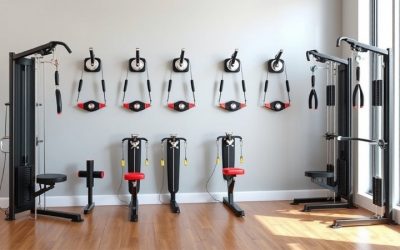
Full functional trainers occupy roughly 5 x 4 ft (1.5 x 1.2 m) plus 3 ft (0.9 m) of working space in front, and most need 7 to 8 ft (2.1 to 2.4 m) of height for a high pulldown. Measure to the lowest ceiling obstruction before ordering. Height rules out more rooms than floor area. Measure to the lowest fixture.
Wall and rack-mounted pulleys need far less floor but demand a solid fixing point, and plasterboard alone will not do. Rubber matting of 3/4 in (19 mm) under the frame protects flooring and stops lighter machines shifting during a heavy row. Wall mounts trade floor for fixings. Matting stops lighter frames shifting.
Top Picks: Cable Stations for Home Use
The six below cover stack machines, plate-loaded pulleys and wall mounts. Match the ratio to the training you actually do, then check the height. Each entry names a genuine drawback, because footprint, cost and usable resistance pull against each other in every design here. Match the best at home cable machine to your ratio needs.
| Machine | Resistance | Space | Best for |
|---|---|---|---|
| Marcy MWM-988 | Stack | Large | All-round pick |
| Powerline PFT100 | Plate loaded | Large | Dual pulleys |
| Bowflex Xtreme 2 SE | Rods | Medium | Quiet training |
| Titan Wall Mount | Plate loaded | Small | Solid walls |
| Yes4All Pulley | Plate loaded | Minimal | Budget start |
| Rubber matting | Flooring | Minimal | Under the frame |
Marcy MWM-988
The Marcy stack machine is the common first cable station: a fixed stack, a high pulley, a low pulley and a seat, all in one frame. It removes the plate handling entirely and changes weight with a pin, which is what makes stack machines pleasant to use. Pin changes take about a second. No plate handling is the real appeal.
The stack sets a ceiling you cannot raise, the ratio means the handle weight is lower than the printed figure, and the footprint is substantial. Check the stated resistance at the handle rather than at the stack before deciding whether it will be heavy enough. Footprint is substantial for one station.
Body-Solid Powerline PFT100
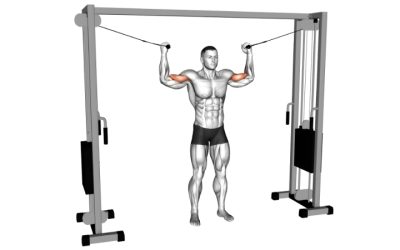
A plate-loaded functional trainer gives two independent pulleys, which is what makes cable training genuinely useful: single-arm rows, chest flyes, wood chops and pull-throughs all need one side moving alone. It also scales with plates rather than capping at a stack. Two pulleys open up single-arm work.
It needs plates you already own plus somewhere to store them, and changing weight is far slower than a pin. Check the stated pulley ratio, since it determines what the plates actually deliver. It also needs real height for the top pulley position. Plate handling slows every change. Two pulleys are what make it worth the space.
Bowflex Xtreme 2 SE
Bowflex uses flexible rods rather than a stack, which makes it quiet, compact for what it offers and free of the plate handling entirely. In a flat where noise matters and a plate-loaded frame is impractical, that combination is genuinely difficult to replicate. Quiet matters more in a flat than anywhere.
Rod resistance feels different from cable and gets harder through the range rather than staying constant. Rods have a finite life and the ceiling is lower than a real stack. Buy it for the space and the quiet rather than for maximum resistance. Rods wear out eventually and need replacing. Quiet is the reason to consider it.
Titan Wall Mount Cable Station
A wall-mounted pulley removes the floor footprint almost entirely, which is the single biggest constraint in most home gyms. Fixed properly into masonry or studs, it gives a high and low pulley position for a fraction of the space a full trainer demands. It is the best at home cable machine for tight rooms.
It requires a genuinely solid wall and correct anchors, which rules out plasterboard alone. Cable travel is shorter than a full trainer and there is only one pulley. Check the projection and the mounting height carefully, since neither can be changed after drilling. Plasterboard alone will not hold it.
Yes4All LAT Pulley System
The cheapest route into cable work is a plate-loaded pulley you hang from a rack or a beam. It gives pulldowns and low rows for a small fraction of any machine here, using plates you already have and taking almost no permanent space. It needs a rack or a rated beam. It is the cheapest cable option here by far.
It needs a rack or a rated anchor point, the cable travel is limited and the pulley ratio means the plate weight is not what you feel. It is a starting point rather than a machine. Check the stated capacity of whatever you hang it from. It is a starting point rather than a machine. Check the anchor capacity carefully.
Rubber Gym Matting
Cable machines are heavy and their feet concentrate load, which marks laminate and dents timber. A 3/4 in (19 mm) rubber mat spreads it, stops lighter frames shifting during heavy rows, and takes noise out of the floor below in a flat. Feet concentrate load into small areas. Timber floors dent before laminate marks.
Mats are heavy to carry alone and smell strongly for the first fortnight after unwrapping. Air them outside before laying them down, and measure the frame footprint plus clearance first, since cutting thick rubber at home rarely gives a straight edge. Measure the frame footprint first. Air the mat outside before laying it down.
Frequently Asked Questions
These four questions come up whenever cable training moves from a gym into a spare room. They cover resistance, space and fixing, since those decide whether a machine gets used daily or becomes an expensive frame in the corner within a few months. Ratio and height answer most of them. Both are checkable before ordering.
Why does my at home cable machine feel so light?
Almost always the pulley ratio. A 2:1 ratio halves the stack at the handle, so a 150 lb (68 kg) stack delivers 75 lb (34 kg). Check the stated ratio before buying, since it explains most of the disappointment people report after delivery. Handle weight is the figure that counts. Ask the seller if it is not published.
Should the best at home cable machine be stack or plate loaded?
Stack for speed and simplicity, plate loaded for scale and price. If you already own a barbell and plates, plate loaded is usually the better value and has no ceiling. If you want to change weight between sets in seconds, a stack wins. Existing plates tip the decision quickly. Stacks win on speed between sets.
How much ceiling height do I need?
Allow around 7 to 8 ft (2.1 to 2.4 m) for a full trainer with a high pulldown position. Wall mounts need less overall but still need the pulley mounted well above head height. Measure to the lowest obstruction in the room, since a light fitting decides this far more often than the ceiling itself does.
Can I mount a pulley to plasterboard?
No. You need masonry or timber studs behind it, and anchors rated for the load rather than the ones supplied. If you are unsure what is behind the wall, get advice before drilling, since a pulley under load pulls far harder than a shelf does. Get advice before drilling anything. A loaded pulley pulls far harder than a shelf.
See More:
Final Thoughts
The best at home cable machine is chosen by pulley ratio and footprint rather than by the number printed on the stack. Work out what the handle weight actually is, measure the height as well as the floor, and put matting under whatever you buy. Then check the handle weight honestly. That is the best at home cable machine test.


Write Your Review
No reviews yet. Be the first to share your experience!