
Key takeaways
What's inside
Best power rack attachments are not a shopping list to work through, they are a sequence. Buy them in the wrong order and you end up with a landmine before you own safeties, which is the one item that changes what you can train alone.
As an Amazon Associate we earn from qualifying purchases at no extra cost to you. Product prices and availability are accurate as of the date shown and are subject to change.
As an Amazon Associate we earn from qualifying purchases at no extra cost to you. Product prices and availability are accurate as of the date shown and are subject to change.


By Chris Parker
🛒 Best Price Today on Amazon
Prime members get fast, free shipping on everything above, plus member-only deals. New members get a 30-day free trial — cancel anytime.
Start 30-Day Prime Free Trial →See Today’s Amazon DealsHow to Prioritise the Best Power Rack Attachments
Buy the best power rack attachments in this order: safety first, then movement patterns the rack cannot already do, then convenience. The best power rack attachments follow that order because the first category changes whether you can train to failure alone, and the last only saves you time.
Compatibility: Tube Size and Hole Spacing
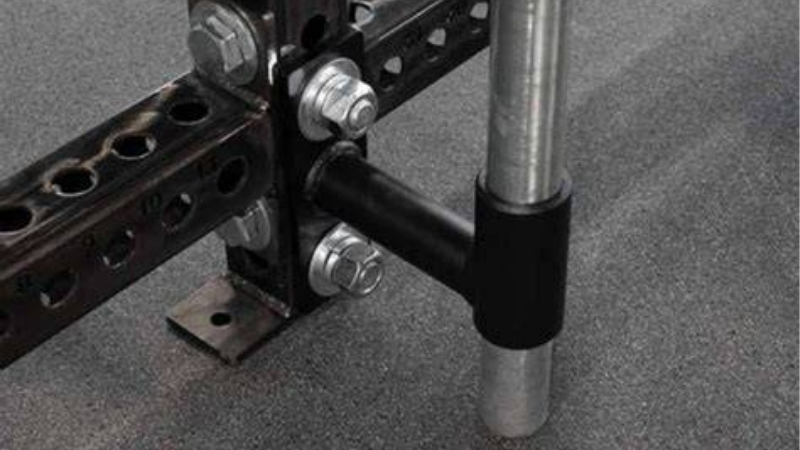
Consumer racks commonly use 2 x 2 in tube with 5/8 in holes, while heavier racks use 3 x 3 in tube with 1 in holes. Attachments are built for one standard and do not adapt between them.
Hole spacing varies even within one manufacturer’s range and often changes between product generations. Check the compatibility list for your exact rack model rather than the brand, because a same-brand attachment is not automatically a fit.
Footprint: What Each Attachment Adds to the Rack
Attachments grow the rack in every direction. A lat tower adds roughly 2-3 ft (0.6-0.9 m) of depth, dip bars project around 18 in (46 cm) forward, and plate horns add 8-12 in (20-30 cm) to each side.
Height matters too. Any tower assembly sits above the rack, so a cage that just clears an 8 ft (2.4 m) ceiling may not once a pulley housing is fitted. Measure the assembled height and the clear working area before buying anything.
Safeties Come Before Everything Else
Strap safeties and pin-and-pipe safeties both catch a failed lift, and owning either is what makes squatting and benching alone reasonable. This is the one attachment that changes the risk profile of the whole setup rather than adding an exercise.
Straps are quieter and gentler on the bar knurling, while pins are faster to reposition and take more abuse. Either is better than the flip-down arms that ship with many budget racks, which often sit too high for a low bar squat.
Filling the Gaps a Rack Leaves
A bare rack covers squats, presses and pulls. The gaps are dips, rotational and unilateral work, and vertical pulling under load, which is why dip bars, a landmine and a lat tower are the three attachments that add genuinely new movements.
Everything after that is convenience: plate horns tidy the floor, band pegs allow accommodating resistance, and better J-cups protect the bar. Useful, but none of them lets you train something you could not train before.
Band Pegs and Accommodating Resistance
Band pegs at the base of the uprights let you attach flat bands to the bar, which increases resistance as you stand up from a squat or lock out a press. That matches the strength curve in a way plates alone cannot.
They are cheap and take no space, which puts them ahead of most convenience items on the list. Among the best power rack attachments they sit just after the movement-adding pieces and before storage upgrades.
Market Context for Rack Accessories
The mid tier has broadened considerably, and attachments that were once commercial-only now fit consumer racks at ordinary prices. Compatibility rather than availability has become the main obstacle for most buyers.
Below that tier the compromises are specific: thinner steel that flexes at the mounting bracket, plastic pulley wheels that develop flat spots, and welded rather than bolted joints. The bracket where the attachment meets the upright is what to inspect on arrival.
What the market still under-serves is the low-ceilinged room. Almost every tower assumes a garage, so genuinely low-profile designs remain scarce and a wall-mounted pulley is often the more realistic purchase in a basement.
Top Picks: Best Power Rack Attachments in Buying Order
These seven are listed roughly in the order most people should buy them, starting with safety and ending with convenience. Each entry gives the compatibility caveat and the honest weakness.
| Attachment | Adds | Priority | Footprint Impact | Note |
|---|---|---|---|---|
| Titan Strap Safety System | Failed-lift protection | First | None | Quiet, saves knurling |
| Pin and Pipe Safeties | Failed-lift protection | First | None | Faster to move |
| Titan T-3 Dip Bars | Pressing pattern | Second | About 18 in forward | Check tube size |
| Synergee Landmine Attachment | Rotational and unilateral | Second | Small | Needs floor clearance |
| Titan T-3 Lat Tower | Vertical pulling under load | Third | 2 to 3 ft depth | Adds height too |
| Plate Storage Horns | Floor tidiness and stability | Fourth | 8 to 12 in per side | Adds rack mass |
| Sandwich J-Cups | Bar protection | Fifth | None | Replaces stock cups |
Titan Strap Safety System
Nylon straps spanning the rack catch a failed lift without the metal-on-metal impact of pins, which protects the bar knurling and keeps the noise down in a shared building. They also sag slightly, which absorbs some of the drop.
They need to be set with more care than pins, since the sag means the effective catch height is lower than where they are pinned. They also wear over time and should be inspected for fraying before heavy sessions.
Pin and Pipe Safeties
The traditional option, and the one that takes the most abuse. Repositioning between exercises takes seconds rather than minutes, which matters when squats and bench presses are in the same session at different heights.
A dropped bar hits steel, which is loud and marks the knurling over time. The plastic sleeves that protect the bar also wear through and need replacing, though they cost very little.
Titan T-3 Dip Bars
Dips are the pressing pattern a rack cannot otherwise supply, and bolt-on dip handles cover them without any additional floor space. Depth adjustment lets you set the width to your shoulders rather than accepting a fixed spacing.
They project around 18 in (46 cm) into the working area, which matters in a tight garage. Compatibility is also strictly tied to tube size and hole spacing, so confirm both before ordering.
Synergee Landmine Attachment
A landmine sleeve adds rotational and unilateral work that nothing else in a rack covers, including landmine presses, rows and Romanian deadlifts. It costs little and takes almost no storage space.
It needs clear floor around the pivot point, which is awkward in a rack tucked into a corner. The sleeve also wears where the bar rotates, and cheaper units develop play within a year of regular use.
Titan T-3 Lat Tower
Vertical pulling under adjustable load is the last major gap in a rack setup, and a lat tower closes it along with low rows on most versions. It is the attachment that most expands what the rack can train.
It adds 2-3 ft (0.6-0.9 m) of depth and significant height, which makes ceiling clearance the first thing to check. Plate loading also means the plate requirement doubles on a 2:1 pulley setup.
Plate Storage Horns
Horns get plates off the floor, which makes loading faster and adds mass to the rack itself, improving stability during pull-ups and heavier work. They are cheap and fit almost any rack with the right hole pattern.
They add 8-12 in (20-30 cm) to each side, which can block a doorway or a walkway in a narrow room. Loaded horns also make the rack considerably harder to move afterwards.
Sandwich J-Cups
Upgraded J-cups with a nylon or UHMW liner protect the bar knurling from the steel-on-steel contact that stock cups cause. Over years of use that is the difference between a bar that keeps its knurl and one that does not.
They are a convenience and preservation purchase rather than a capability one, and they must match the tube and hole standard exactly. Cheaper versions also have liners that compress and need replacing.
Frequently Asked Questions
These questions come up whenever someone owns a bare rack and has to decide where the next hundred goes.
Which attachment should I buy first?
Safeties, without much argument. Among the best power rack attachments they are the only category that changes whether you can train to failure alone, and every other purchase is an exercise addition rather than a risk reduction. Buy them with the rack rather than after it.
Will attachments from another brand fit?
Sometimes, if the tube size and hole spacing match exactly, but it is not safe to assume. Check the stated compatibility for your specific rack model, since manufacturers change hole spacing between generations of the same product.
Do I need dip bars if I have a bench?
A bench covers pressing lying down, not the vertical pressing pattern dips supply. If your programme already includes overhead pressing, dip bars are lower priority than a landmine or a lat tower.
Are plate horns worth it?
For stability, yes. Loaded horns add mass low on the frame, which noticeably reduces rack movement during pull-ups and dynamic work. They are also the cheapest way to make a light rack feel more solid without bolting it to the floor or the wall.
See More:
- Ankle weights best
- Best rated ankle weights
- Best home workout equipment budget
- Best resistance bands for men
Final Thoughts
The best power rack attachments are bought in order: safeties first, then dip bars, a landmine and a lat tower to close the movement gaps, then storage and J-cups for convenience. Check tube size, hole spacing and assembled height against your room before ordering any of them.


Write Your Review
No reviews yet. Be the first to share your experience!