
Our Top Picks
Pros & cons
- Ten exercises in one compact power tower footprint
- Eight height levels fit users of very different sizes
- Thickened backrest pad spreads pressure for more comfort
- 360-pound capacity is lower than some heavier-duty towers
- Multiple height and backrest adjustments take time to dial in
 Fuel Pureformance Bodyweight Training Dip Station Black/Blue25 x 30 x 39 inches17 PoundsCheck on Amazon
Pros & cons
- Triangular base folds flat for easier storage than H-shaped towers
- Five grip positions let you target different muscle angles
- Pin-and-lock handles set up without tools or loose bolts
- 440-pound capacity is a hard ceiling for heavier athletes
- 39.4-inch width still needs a fairly open space to use
The best dip stations for a home gym depend on four things: how much room you have, how heavily you train, whether the handles fit your shoulders, and how much movement you’ll tolerate during a set. For most homes, a freestanding parallel-bar station with a wide base, adjustable height, and a published capacity comfortably above the user’s body weight is the most versatile choice. Choose a wall-mounted option if floor space is scarce and you can anchor it securely; choose a heavier, fixed-frame station if stability matters more than storage.
Dip station types: what you gain and give up
- Adjustable freestanding parallel bars: The most adaptable option for dips, support holds, and some variations of leg raises. They can be repositioned or stored, but lighter models may shift or rock.
- Fixed-frame freestanding stations: Usually more substantial and stable, with fewer adjustments to check. They take up more permanent floor space and are harder to move.
- Wall-mounted dip bars: Keep the floor clear and can feel exceptionally solid when mounted into suitable structural material. They are not portable, and secure installation is essential.
- Doorway-mounted bars: Compact, but compatibility depends on the doorway and the exact mounting system. Do not assume a pull-up bar is suitable for dips; use only a product explicitly designed for that exercise and installation.
Compare the main specifications before you buy
The table gives useful screening ranges for common home-gym designs, not specifications for any particular model. Manufacturers define capacity differently, so check what the stated limit covers and follow the product’s instructions.

SPORTSROYALS Power Tower, Multi-Function Pull up Bar Dip Station with Upgraded Adjustable Foot Cover Equipment for Home Gym,360LBS
Chosen because it specifies 360LBS.
View on AmazonFuel Pureformance Bodyweight Training Dip Station Black/Blue
Picked as a relevant option in this category.
View on Amazon
Sportsroyals Adjustable Dip Bar for Home,400lbs Cap Calisthenics Equipment
Chosen because it specifies 400lbs Cap Calisthenics Equipment.
View on Amazon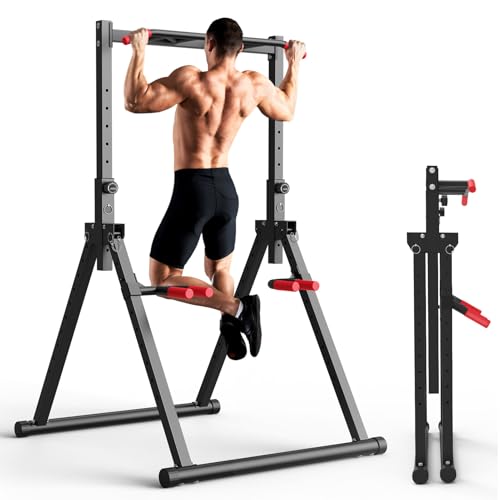
SERTT Foldable Power Tower Dip Station for Pull Ups, Dips & Push Ups, Upgraded Free Standing Pull Up Bar Station, Multi-function Workout Equipment for Home Gym Strength Training, Support 440LBS
Chosen because it specifies Dips & Push Ups and Upgraded Free Standing Pull Up Bar Station.
View on Amazon| Station type | Typical footprint or projection | Typical product weight | Published capacity to look for | Best fit |
|---|---|---|---|---|
| Adjustable freestanding bars | About 24–36 in wide by 24–36 in deep (61–91 by 61–91 cm) | About 20–45 lb (9–20 kg) | At least 300 lb (136 kg); more headroom for dynamic training | Smaller budgets, shared rooms, varied exercises |
| Heavy fixed-frame station | About 30–48 in wide by 30–48 in deep (76–122 by 76–122 cm) | About 40–100 lb (18–45 kg) | Often 400–600 lb (181–272 kg); verify the actual model | Frequent training and a dedicated workout area |
| Wall-mounted bars | About 20–30 in of projection (51–76 cm); wall width varies | About 15–35 lb (7–16 kg) | Commonly 300–600 lb (136–272 kg); installation matters too | Keeping the floor clear in a suitable room |
| Doorway-mounted dip-specific system | Varies by doorway; check required clearance | About 10–25 lb (5–11 kg) | Use only within the maker’s stated limit and approved setup | Very limited floor space, if the doorway is compatible |
Capacity is not a guarantee that a station will feel stable. A high rating does not tell you whether the frame flexes, slides on your floor, or suits your build. For weighted dips, include your body weight and added load when comparing against the stated limit, and leave a sensible margin rather than shopping right at the maximum.
Choose by your space and training habits
| Your situation | What to prioritize | Likely best match |
|---|---|---|
| Apartment or shared room; station must move | Compact base, manageable weight, locking adjustments, protective feet | Adjustable freestanding bars, provided the base stays planted |
| Beginner doing body-weight dips a few times weekly | Simple assembly, comfortable spacing, stable frame, clear instructions | Fixed or adjustable freestanding station with a capacity above your total training load |
| Experienced trainee adding a weight belt | Wide, rigid base; minimal flex; generous capacity headroom | Heavy fixed-frame model or correctly installed wall-mounted bars |
| Permanent gym corner and frequent use | Durable finish, secure joints, replaceable or inspectable hardware | Heavy fixed-frame station |
| Floor space is the main constraint | Clear wall structure, suitable anchors, room to enter and exit the bars | Wall-mounted bars, only if the wall and installation meet the instructions |
Handle spacing and stability: the details that change the choice
Check spacing against your body
Handle spacing is often missing from listings, or measured inconsistently. Ask for the center-to-center distance between handles and compare it with a station you already find comfortable, if possible. A gap that feels too narrow can crowd your arms; one that is too wide may make the position feel awkward. Adjustable width is useful when several people will share the station, but each adjustment adds hardware that needs to lock firmly.
Also check handle diameter and grip surface. A textured or slightly padded grip can help with comfort, but thick padding may wear, compress, or rotate over time. Smooth metal is easy to wipe clean but can feel slippery with sweaty hands. Avoid choosing by a single “ergonomic” label when the actual dimensions are available.
Look beyond the capacity number
- Base geometry: Wider feet and a long front-to-back base generally resist tipping better, but need more floor area.
- Frame and joints: Inspect tube thickness, welds, bolts, and adjustment pins. A tall, narrow frame can flex even if its stated capacity looks ample.
- Floor contact: Rubber feet can reduce sliding and protect hard floors. On carpet, check whether the feet sit flat rather than rocking on an uneven surface.
- Movement in use: The station should remain planted during controlled support holds. Do not try to “fix” instability by adding improvised weights unless the manufacturer allows it.
Measure the whole workout footprint
The listed base dimensions are only part of the space you need. You also need room to step between the bars, lower your legs, and get on and off without hitting a wall, furniture, or another piece of equipment. As a planning example, a station with a 30-by-30-inch base (76 by 76 cm) might need a clear area closer to 48 by 48 inches (122 by 122 cm), depending on handle position and the user’s height. Measure your own movement path before ordering; this is a planning allowance, not a universal clearance standard.
For a wall-mounted station, measure the projection from the wall as well as the width. Confirm that the mounting surface and fasteners are approved for the model. Drywall alone is not a suitable anchor point for a loaded dip station. If you are unsure about the wall structure or installation, consult a qualified installer.
Ownership checks that help a station last
On freestanding models, bolts and adjustment points are common places for looseness to develop. Recheck fasteners at the intervals in the manual, and stop using the station if a weld, pin, foot, or frame member is damaged. Wipe sweat from grips and exposed metal after use; mild soap and water are usually preferable to harsh solvents unless the manufacturer specifies otherwise. Check that rubber feet have not cracked or gone missing, since uneven contact can make a previously stable frame rock.
For adjustable bars, confirm both sides are set to the same height and width before each session. Do not exceed the stated load, use the station on a sloped or unstable surface, or add attachments that the maker has not approved. These small checks matter more as training becomes heavier or more dynamic.
Bottom line
Pick adjustable freestanding bars if flexibility and storage matter most, a heavy fixed-frame station if you train often and have a dedicated area, or wall-mounted bars if floor space is tight and you can install them into suitable structure. Before deciding, compare the actual footprint, handle spacing, product weight, and capacity—not just the headline load rating. The best dip stations are the ones that fit your body and room while staying secure through the training you plan to do.



Write Your Review
No reviews yet. Be the first to share your experience!