
Key takeaways
What's inside
Home gym best lists usually rank everything against one imaginary buyer with a spare garage. In practice the winner changes completely depending on ceiling height, who lives below you and how many people share the kit. These six are category winners rather than a single ranking, one for each common situation.
As an Amazon Associate we earn from qualifying purchases at no extra cost to you. Product prices and availability are accurate as of the date shown and are subject to change.

#1 Pick

#2 Pick

#3 Pick

#4 Pick

#5 Pick

#6 Pick

#7 Pick

#8 Pick
As an Amazon Associate we earn from qualifying purchases at no extra cost to you. Product prices and availability are accurate as of the date shown and are subject to change.
By Chris Parker
🛒 Best Price Today on Amazon
Prime members get fast, free shipping on everything above, plus member-only deals. New members get a 30-day free trial — cancel anytime.
How to Decide What Home Gym Best Actually Means for You
A single home gym best winner is close to useless as a concept, because two buyers with identical budgets can need opposite answers. The four criteria below narrow which category you are shopping in before any product enters the conversation.
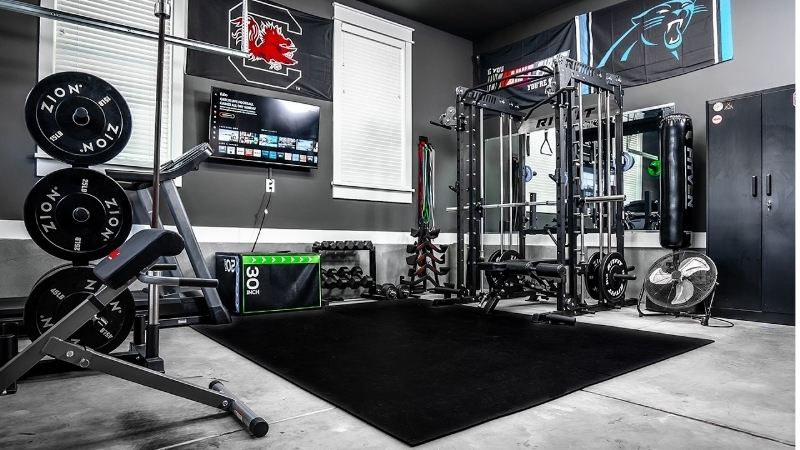
Define Best Before You Start Shopping
Home gym best value, best for a small room, best for a flat and best for heavy loading are four different products. Writing down which of those you are actually buying removes most of the confusion that comparison tables tend to create.
The honest starting question is how many sessions a week you will realistically do and what those sessions look like. Three strength sessions in a bedroom leads somewhere very different from daily conditioning in a garage, even at the same budget.
The barrier for most people is not willpower but the time and distance involved in getting to a gym, which is precisely what equipment at home removes. That reframes the purchase as buying back travel time rather than buying motivation.
The Two Constraints That Decide Everything
Space and noise settle the home gym best question long before price does. A cage that will not fit under a 7 ft (213 cm) ceiling is not an option at any price, and a piece that thumps through the joists is not an option in a first-floor flat at any price either.
Noise divides cleanly by mechanism. Bands, suspension trainers and magnetic resistance are effectively silent. Anything involving impact, contact friction or a fan generates sound that travels, and no amount of carpet fixes structural transmission.
Space divides by whether the item stores or stays. Folding and packable equipment lets a room keep its original job; fixed frames claim their footprint permanently. That distinction usually matters more than the specification sheet does.
Footprint and Ceiling by Room Type
A spare bedroom typically offers 8 to 10 ft (244 to 305 cm) of usable width and a standard ceiling, which suits folding and wall-mounted equipment. Basements often have the floor area but not the height, which rules out full cages and tall lat towers.
Garages tend to offer both the height and the floor area, but they usually have no heating, which shifts the answer toward equipment that tolerates temperature swings and damp, and away from anything with a screen or a battery in it.
Measure the actual dimensions of the room before choosing a category, ceiling included, along with doorway width and any staircase turn. A rack that cannot reach the room is a more common problem than one that does not fit inside it.
Where Household Size Changes the Answer
A single user can tolerate slow weight changes, because nobody else is waiting for the equipment. Screw-lock dumbbells, plate-loaded equipment and anything else needing setup time all work perfectly well when the session belongs to a single person.
Two or three users at different strengths change the calculation entirely. A pin-selected stack or a dial dumbbell that adjusts in seconds turns a shared session into something workable rather than a queue with rest periods that no longer mean anything.
Shared use also raises the durability question, because a set adjusted three times as often reaches its wear limits three times faster. Parts availability therefore matters far more in a household of three than in a household of one.
Top Picks: 6 Home Gym Best Category Winners
One home gym best winner per situation rather than a ranked list, so the right entry depends on which constraint binds hardest in your case. The table pairs each winner with the room it suits and with what it demands from you in return.
| Category | Pick | Suits | Footprint | Trade-off |
|---|---|---|---|---|
| Best overall value | Bowflex SelectTech 552 | Almost any room | Under 2 sq ft | Cannot be dropped |
| Best for tiny rooms | TRX All-in-One | Rooms with no spare floor | A drawer | Body-weight ceiling |
| Best for flats | Sunny SF-RW5515 rower | Upstairs, neighbours below | Folds upright | Needs 82 in (208 cm) length |
| Best for heavy strength | Titan T-3 Power Rack | Garages and tall rooms | ~12 sq ft, fixed | Needs 80 in (203 cm) height |
| Best for shared use | Body-Solid Powerline P2X | Two or three users | Fixed footprint | Stack sets a ceiling |
| Best budget starter | Bodylastics band set | Testing the habit | A bag | Variable resistance |
1. Best Overall Value: Bowflex SelectTech 552
It wins on movement patterns per square foot, which is the metric that matters most in a room with another purpose. One pair covers pressing, rowing, hinging and single-leg work from 5 to 52.5 lb (2.3 to 23.8 kg) per hand and stores under a bed.
The plastic housing cannot be dropped or rested on the ends, and the increment widens from 2.5 lb to 5 lb above 25 lb. Legs outgrow the ceiling long before the upper body does, which is what eventually pushes most owners toward a barbell and a rack.
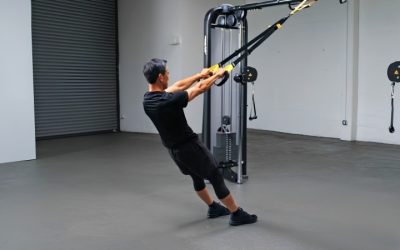
2. Best for Tiny Rooms: TRX All-in-One Suspension Trainer
Nothing else covers pulling in a room with no floor to spare. It weighs a couple of pounds, packs into a drawer, anchors over a door or to a beam, and handles rows, presses, split squats and core work using body weight as the load.
Load is capped at a proportion of your own mass, so stronger lifters plateau on pulling movements. The door anchor needs a solid door that opens away from you, and progression comes from changing foot position rather than adding weight.
3. Best for Flats: Sunny Health and Fitness SF-RW5515
Magnetic resistance makes this the conditioning option that does not travel through a floor, which is the constraint that rules out most cardio equipment upstairs. It works the whole body, folds upright afterwards and costs far less than an air rower.
Magnetic resistance does not scale with effort the way air does, so the top setting feels limited to strong rowers, and the shorter rail suits shorter users better than tall ones. Seat rollers are the wear part on high-mileage units.
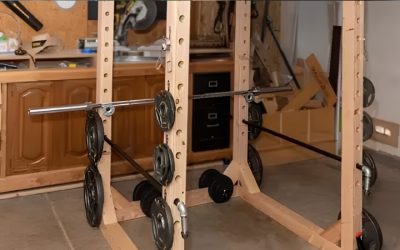
4. Best for Heavy Strength: Titan T-3 Series Power Rack
The only category where a fixed frame is the right answer. Eleven-gauge steel uprights and safety bars allow squatting and pressing alone, and the integrated top bar covers the vertical pull that almost every other home setup is missing.
It stands over 80 in (203 cm), claims roughly 12 sq ft permanently and does not fold, so low ceilings and shared rooms rule it out. Assembly takes hours, and it is freight-delivered, which complicates both delivery and eventual resale.
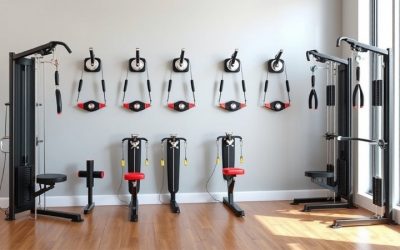
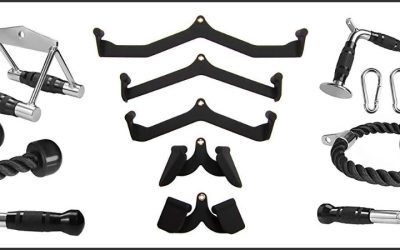
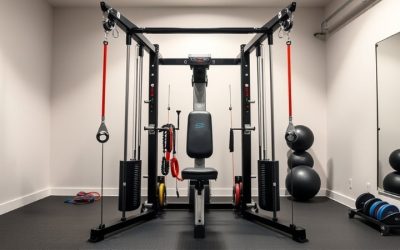
5. Best for Shared Use: Body-Solid Powerline P2X
A pin change takes roughly two seconds, which is exactly what makes a stack machine work for a household rather than turning it into a queue. Press, pulldown and low pulley stations sit on a frame considerably tighter than that of a full multi-gym.
The stack sets a firm ceiling once the pulley ratio is applied, cable travel is shorter than commercial equivalents, and the footprint is permanent. Cables are consumables here, so confirm that replacements are still orderable before buying.
6. Best Budget Starter: Bodylastics Band Set
By some distance the lowest-risk way to find out whether the training habit actually sticks. Clip-together tubes with a door anchor cover rows, presses, pull-aparts and pull-up assistance, weigh almost nothing at all and store in a single drawer between sessions.
Resistance is variable and lightest where most lifts are hardest, so bands cannot carry a strength programme alone. Latex degrades with sunlight, heat and age whether used or not, making replacement a running cost rather than a repair.
Frequently Asked Questions
Deciding which home gym best category applies to your situation raises the same handful of questions repeatedly. Each answer below works from room dimensions, resistance mechanism and household size rather than from general recommendation.
What Is the Single Best First Purchase?
Adjustable dumbbells, in almost every situation. One pair covers four of six movement patterns in under 2 sq ft of storage, works in any room, and remains useful whatever you buy next. A bench is the logical second purchase rather than the first.
What Works in a Flat With Neighbours Below?
Anything without impact or contact friction. Bands, suspension trainers, magnetic rowers and bikes are all viable; dropping weights, jumping and air resistance are not. Rubber matting under the working area handles the rest of the transmitted vibration.
What Suits Someone Over Six Feet Tall?
Check rail length on rowers, seat and handlebar adjustment ranges on bikes, and cable travel on lat stations, since all three commonly run short. Benches and racks are rarely the problem; anything with a fixed range of motion usually is.
Is a Full Rack Worth It for One Person?
Only if you have the ceiling height, the floor space to give up permanently, and a training goal that genuinely needs barbell loading. For one person training three times a week for general strength, dumbbells and a bench cover more ground per square foot.
See More:
- Best changeable dumbbells
- Best rated yoga mat
- Best mat yoga
- Best home gym equipmen
- Best fitness equipment for home gym
Final Thoughts
Working out which home gym best category applies to you is most of the decision. Measure ceiling height and floor area first, rule out anything that transmits impact if you live above someone, and let household size decide how fast weight changes need to be.

Write Your Review
No reviews yet. Be the first to share your experience!